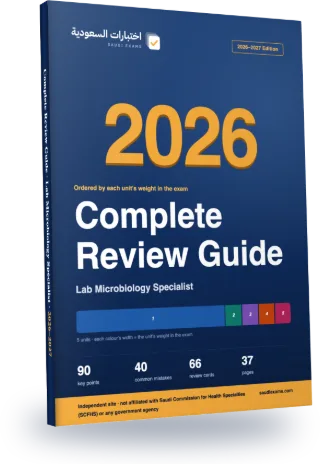
Lab Microbiology Specialist Complete Review Guide 2026–2027
Every exam topic in a 37-page Arabic PDF, ordered from the heaviest unit to the lightest. The first three chapters alone cover about 80% of the exam questions.
- 37Pages
- 90Key points
- 40Common mistakes
- 66Flashcards
Guide map
Each chapter is one exam unit, ordered by its weight in the real exam.
| Chapter | Unit | Weight | Exam questions | Key points |
|---|---|---|---|---|
| 1 | Microbiology | 65% | 100 | 18 |
| 2 | Urinalysis and Other Body Fluids | 8% | 12 | 18 |
| 3 | Immunology and Serology | 8% | 12 | 18 |
| 4 | Laboratory Operations | 8% | 13 | 18 |
| 5 | Patient Safety and Professionalism | 8% | 13 | 18 |
Chapter 1 in full: Microbiology
65% of the exam, about 100 questions. These are its key points, as in the guide.
- (Specimen collection, transport and direct examination) Blood culture yield rises about 3% per mL of blood cultured; for adults, 20 to 30 mL per set is recommended.
- (Specimen collection, transport and direct examination) Auramine-phenol is a fluorescent acid-fast stain, more sensitive than Ziehl-Neelsen; India ink is a negative stain that shows capsules as halos.
- (Culture media, incubation and identification) Plates for anaerobic incubation should be incubated within 15 minutes of inoculation; retain the specimen at least 48 hours after the final report.
The rest of chapter 1, on this page
- (Culture media, incubation and identification) MALDI-TOF MS is now the primary identification method; it is rapid and accurate for bacteria and most fungi, but yeasts need full extraction.
- (Gram-positive cocci) Staphylococci are catalase positive, facultatively anaerobic cocci in clusters; Micrococcus is strictly aerobic; tube coagulase is the confirmatory method.
- (Gram-positive cocci) S. pyogenes is group A, bacitracin sensitive, PYR positive and CAMP negative; S. agalactiae is group B, bacitracin resistant and CAMP positive.
- (Gram-positive bacilli, Clostridium and anaerobes) Clostridium species form endospores and are usually motile and catalase negative; C. perfringens is the exception and is non-motile.
- (Enterobacterales, Vibrio, Campylobacter and Helicobacter) Enterobacterales are oxidase negative and reduce nitrate to nitrite; Shigella and Klebsiella are non-motile.
- (Enterobacterales, Vibrio, Campylobacter and Helicobacter) Campylobacter is oxidase positive, does not ferment or oxidise carbohydrates, and the diarrhoeal species grow at 42 to 43 C but not 25 C.
- (Non-fermenters, Neisseria, Haemophilus and fastidious Gram-negatives) Neisseria species are oxidase positive and mostly catalase positive; N. gonorrhoeae grows poorly on whole blood agar, so GC agar is used.
- (Mycobacteria, spirochetes and cell-wall-deficient or intracellular bacteria) Mycobacteria have waxy envelopes that resist staining; automated liquid culture plus solid media gives the best recovery.
- (Mycobacteria, spirochetes and cell-wall-deficient or intracellular bacteria) T. pallidum is 0.1 to 0.2 micrometre wide, invisible by Gram stain, and seen by dark-field or phase-contrast microscopy or silver stain.
- (Antimicrobial susceptibility testing and resistance mechanisms) Disk diffusion uses a 0.5 McFarland inoculum and agar 4.0 mm deep; a denser inoculum gives smaller zones.
- (Antimicrobial susceptibility testing and resistance mechanisms) MRSA carries mecA, which codes for PBP2a, a penicillin-binding protein with low affinity for most beta-lactams.
- (Medical mycology) Mucorales show wide, ribbon-like, pauciseptate hyphae with right-angle branching; diabetes is the leading underlying disease worldwide.
- (Medical mycology) Galactomannan is an Aspergillus antigen; beta-D-glucan is a non-specific fungal marker that also appears in Candida and Pneumocystis.
- (Medical parasitology) For malaria, the thick film concentrates parasites for detection, the thin film confirms species, and Giemsa is used with pH 7.2 buffered water.
- (Medical virology) CMV IgM alone cannot diagnose primary infection because false positives occur, for example in acute EBV infection.
Common mistakes in this chapter
- Slide coagulase detects bound coagulase (clumping factor); tube coagulase detects free coagulase. S. lugdunensis can be slide positive but tube negative.
- A positive GDH only shows C. difficile is present; toxin A and B detection shows whether a toxin-producing strain is active.
- Optochin sensitivity and bile solubility identify S. pneumoniae; bacitracin and PYR identify S. pyogenes. Do not swap the two sets.
- Thick and thin malaria films have different jobs: the thick film concentrates parasites for detection, and the thin film is for species. Methanol fixes only the thin film.
- Treponemal tests stay positive after treated infection, while non-treponemal results fall to negative or low titre.
- An ESBL hydrolyses oxyimino-cephalosporins but not cephamycins such as cefoxitin or carbapenems; do not call resistance to all cephalosporins ESBL.
- Staphylococcus and Micrococcus are both catalase positive clusters or tetrads; Staphylococcus is facultatively anaerobic and Micrococcus is strictly aerobic.
- A positive NAAT can rule in tuberculosis, but a negative NAAT cannot rule it out.
The other chapters are in the full guide
One purchase · lifetime access · review guide included
7-day review plan
The chapters are spread over 6 days by weight so each day carries a similar load. Day 7 is a full exam.
Day 1 · 65% of the exam
Chapter 1: Microbiology
Day 2 · 8% of the exam
Chapter 2: Urinalysis and Other Body Fluids
Day 3 · 8% of the exam
Chapter 3: Immunology and Serology
Day 4 · 8% of the exam
Chapter 4: Laboratory Operations
Day 5 · 8% of the exam
Chapter 5: Patient Safety and Professionalism
Day 6
Full mock exam: 150 questions in 180 minutes, then review the common mistakes in the units where you lost marks.
How many correct answers do you need?
- Pass mark 60%90 correct out of 150
Before you read: see your score today
10 free questions from the main units, no sign-up. Then you know which chapter to start with.
Try 10 free questions and see your levelA look at each chapter
The first three key points of each chapter, as they appear in the guide (in Arabic in the PDF).
Chapter 1: Microbiology
- (Specimen collection, transport and direct examination) Blood culture yield rises about 3% per mL…
- (Specimen collection, transport and direct examination) Auramine-phenol is a fluorescent acid-fast stain, more sensitive…
- (Culture media, incubation and identification) Plates for anaerobic incubation should be incubated within 15…
Chapter 2: Urinalysis and Other Body Fluids
- (Urine collection, physical and chemical examination) Mid-stream urine is the recommended routine collection: discard…
- (Urine collection, physical and chemical examination) Clean-catch urine, with periurethral cleaning and collection of…
- (Urine collection, physical and chemical examination) Process urine within 4 hours if possible. If…
Chapter 3: Immunology and Serology
- (Immune system, immunoglobulins, complement and hypersensitivity) IgM is the first antibody made after exposure…
- (Immune system, immunoglobulins, complement and hypersensitivity) Immunoglobulin results are compared across IgM, IgG and…
- (Immune system, immunoglobulins, complement and hypersensitivity) There are nine major complement proteins, C1 to…
Chapter 4: Laboratory Operations
- (Quality control, quality assurance and basic statistics) Internal quality control uses control samples with…
- (Quality control, quality assurance and basic statistics) A Levey-Jennings chart plots control results against…
- (Quality control, quality assurance and basic statistics) SD measures imprecision, which reflects random error…
Chapter 5: Patient Safety and Professionalism
- (Patient identification, specimen labelling and error reporting) Identify the patient by matching to the…
- (Patient identification, specimen labelling and error reporting) Three common identification errors: label and requisition…
- (Patient identification, specimen labelling and error reporting) A restrictive specimen acceptance policy reduces identification…
The full guide comes with lifetime access
The full guide (37 pages) is included with lifetime access to this exam, together with every question and full mock exam. Chapter 1 is free for everyone.
Questions about the guide
Is the guide free?
Chapter 1 is free to read on the guide page. The full guide comes with lifetime access to this exam; 7-day access does not include it.
Is it up to date for 2026–2027?
Yes. Unit weights and exam facts follow what the exam body last published, and the last check date is printed in the guide. If the standards change we update the file and buyers download the new version.
Does the guide have questions?
No. The guide covers key points and common mistakes; scoring, weak-area practice and full mock exams are on the site.
Can I read it on my phone?
Yes. A5 pages in a single column, with chapters linked from the contents.
- Pages
- 37
- Edition
- 1448 AH · 2026–2027
- Language
- Arabic
- Last updated
Full prep for this exam
All of this in one purchase.
- Full mock exam, same as the real one150 questions in 180 minutes. You get a total score and a score for every unit.
- Practice unit by unit572 questions, every option explained with its source. Starts with your weakest units.
- Complete Review Guide 2026–2027 (PDF)Ordered by each unit's weight in the exam. With lifetime access only.
Choose your access
Continue with your Google account and you go straight to the payment page.