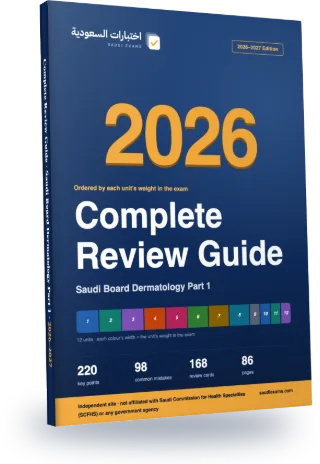
Saudi Board Dermatology Part 1 Complete Review Guide 2026–2027
Every exam topic in a 86-page Arabic PDF, ordered from the heaviest unit to the lightest. The first three chapters alone cover about 30% of the exam questions.
- 86Pages
- 220Key points
- 98Common mistakes
- 168Flashcards
Guide map
Each chapter is one exam unit, ordered by its weight in the real exam.
| Chapter | Unit | Weight | Exam questions | Key points |
|---|---|---|---|---|
| 1 | Anatomy, structure and development of skin | 10% | 15 | 18 |
| 2 | Innate immune system related to dermatology | 10% | 15 | 18 |
| 3 | Adaptive immune system related to dermatology | 10% | 15 | 18 |
| 4 | Dermal connective tissue and subcutaneous tissue | 10% | 15 | 18 |
| 5 | Neoplasms | 10% | 15 | 22 |
| 6 | Genodermatosis | 10% | 15 | 18 |
| 7 | Infectious and environmental | 10% | 15 | 18 |
| 8 | Therapeutics | 10% | 15 | 18 |
| 9 | Keratinocytes, epidermal and dermal-epidermal cohesion | 5% | 8 | 18 |
| 10 | Pigmentation | 5% | 7 | 18 |
| 11 | Skin appendages | 5% | 8 | 18 |
| 12 | Hair, nail and mucosa | 5% | 7 | 18 |
Chapter 1 in full: Anatomy, structure and development of skin
10% of the exam, about 15 questions. These are its key points, as in the guide.
- (Epidermal layers, keratinization and epidermal differentiation) Basal cells carry keratin 5/14; when they leave the basal layer and become postmitotic spinous cells they switch to keratin 1/10.
- (Epidermal layers, keratinization and epidermal differentiation) The stratum lucidum (palms and soles) is a thin pale band between the granular layer and stratum corneum; it contains eleidin, derived from modified keratohyalin.
- (Epidermal layers, keratinization and epidermal differentiation) Filaggrin breakdown yields natural moisturizing factor; pyrrolidone carboxylic acid (from glutamic acid cyclization) is about 12 percent of it; calpain-1 acts in both profilaggrin processing and filaggrin degradation.
The rest of chapter 1, on this page
- (Epidermal layers, keratinization and epidermal differentiation) TGM1 deficiency (collodion baby, later large dark scales and ectropion) fails to ester-link omega-hydroxyceramides to involucrin and scaffold proteins, impairing the permeability barrier.
- (Epidermal layers, keratinization and epidermal differentiation) LOR mutation (extended translation creating a nuclear localization signal) gives palmoplantar keratoderma with honeycomb depressions and pseudoainhum.
- (Epidermal layers, keratinization and epidermal differentiation) Normal keratinocyte transit from basal layer to stratum corneum takes about 14 days; psoriasis-type scale shows accelerated, incomplete keratinization with retained nuclei in the cornified layer.
- (Dermis, dermoepidermal junction and skin embryology) p63 (p53 homologue) is required for the switch from keratin 8/18 to keratin 5/14 and for epidermal commitment of surface ectoderm.
- (Dermis, dermoepidermal junction and skin embryology) In fetal epidermis, basal cells divide asymmetrically under the periderm to form an intermediate layer that matures into the stratum spinosum; terminal differentiation into granular and cornified layers occurs around weeks 22 to 24.
- (Dermis, dermoepidermal junction and skin embryology) Junctional EB shows separation within the lamina lucida; LAMB3 is an example gene.
- (Dermis, dermoepidermal junction and skin embryology) Photoaging: ROS activate MAPK and AP-1, raising MMP-1 without a matching rise in TIMPs, so collagen is fragmented.
- (Cutaneous vasculature, nerves and sensory receptors) Papillary loops (true capillaries) of the superficial plexus lie closest to the dermoepidermal junction and are a major determinant of heat exchange; the deep plexus arterioles (four to five smooth muscle layers) send ascending branches to the papillary plexus, follicles and sweat glands.
- (Cutaneous vasculature, nerves and sensory receptors) Arteriovenous anastomoses in glabrous skin (palms, lips) connect arterioles directly to venules, bypassing capillaries.
- (Cutaneous vasculature, nerves and sensory receptors) Resting skin blood flow is about 250 mL/min, roughly 5 percent of cardiac output; heat-induced rise beyond loss of vasoconstrictor tone is due to active vasodilation by sympathetic nerves releasing acetylcholine with co-transmitters.
- (Cutaneous vasculature, nerves and sensory receptors) Meissner corpuscle (dermal papillae, rapidly adapting) detects low-frequency flutter and slip; Pacinian corpuscle (lamellae around an Abeta fibre, deep dermis) detects high-frequency vibration.
- (Cutaneous vasculature, nerves and sensory receptors) Hairy skin: C low-threshold mechanoreceptors (about 1 m/s, slow gentle stroking, absent in glabrous skin) versus Adelta low-threshold mechanoreceptors (D-hair, about 15 m/s, respond to rapid cooling).
- (Resident skin cells and regional variation of skin) Pheomelanin is yellow-to-red and its synthesis needs a cysteine-dependent step; melanosome transport uses kinesin 2 on microtubules (long range) and myosin Va-melanophilin-Rab27a (short range).
- (Resident skin cells and regional variation of skin) Langerhans cells contain rod or tennis-racket Birbeck granules whose main component is langerin (CD207); they self-renew locally, with blood precursors repopulating only after severe inflammation; migration needs CCR7 up and E-cadherin down.
- (Resident skin cells and regional variation of skin) Merkel cells derive from epidermal progenitors (Atoh1-dependent), are CK20 positive with dense-core granules, and act as mechanoreceptors relaying touch to Abeta endings.
Common mistakes in this chapter
- Keratin 5/14 marks basal proliferative cells; keratin 1/10 is the postmitotic spinous program. Keratin 8/18 and 6/16 are distractors.
- Desmoglein 3 decreases and desmoglein 1 increases with differentiation, not the reverse.
- Do not swap Langerhans cells (spinous layer) with melanocytes and Merkel cells (basal layer).
- TGM1 defect is a failure to ester-link omega-hydroxyceramides to involucrin and scaffold proteins; do not confuse it with the empty lamellar granules of ABCA12.
- Meissner corpuscle detects low-frequency flutter and slip in dermal papillae; Pacinian corpuscle in the deep dermis detects high-frequency vibration.
- Ruffini (SAII) has a receptive field about five times larger than Merkel units; both fire during sustained stimulation.
- Dark skin has similar melanocyte numbers to light skin; the difference is melanosome size, dispersion and retention, not cell count.
- Langerhans cells self-renew locally at steady state; blood-derived precursors matter only after severe inflammation.
The other chapters are in the full guide
One purchase · lifetime access · review guide included
7-day review plan
The chapters are spread over 6 days by weight so each day carries a similar load. Day 7 is a full exam.
Day 1 · 20% of the exam
Chapter 1: Anatomy, structure and development of skin
Chapter 7: Infectious and environmentalDay 2 · 20% of the exam
Chapter 2: Innate immune system related to dermatology
Chapter 8: TherapeuticsDay 3 · 15% of the exam
Chapter 3: Adaptive immune system related to dermatology
Chapter 9: Keratinocytes, epidermal and dermal-epidermal cohesionDay 4 · 15% of the exam
Chapter 4: Dermal connective tissue and subcutaneous tissue
Chapter 10: PigmentationDay 5 · 15% of the exam
Chapter 5: Neoplasms
Chapter 11: Skin appendagesDay 6 · 15% of the exam
Chapter 6: Genodermatosis
Chapter 12: Hair, nail and mucosa
How many correct answers do you need?
- Pass mark 65%98 correct out of 150
Before you read: see your score today
10 free questions from the main units, no sign-up. Then you know which chapter to start with.
Try 10 free questions and see your levelA look at each chapter
The first three key points of each chapter, as they appear in the guide (in Arabic in the PDF).
Chapter 1: Anatomy, structure and development of skin
- (Epidermal layers, keratinization and epidermal differentiation) Basal cells carry keratin 5/14; when they leave…
- (Epidermal layers, keratinization and epidermal differentiation) The stratum lucidum (palms and soles) is a…
- (Epidermal layers, keratinization and epidermal differentiation) Filaggrin breakdown yields natural moisturizing factor; pyrrolidone carboxylic…
Chapter 2: Innate immune system related to dermatology
- (Antimicrobial peptides and the complement system) Kallikrein 5 cleaves hCAP18 to LL-37; with higher…
- (Antimicrobial peptides and the complement system) In psoriasis LL-37 complexes with self-DNA, which plasmacytoid…
- (Antimicrobial peptides and the complement system) Dermcidin is an anionic peptide from eccrine sweat…
Chapter 3: Adaptive immune system related to dermatology
- (Antigen presentation, MHC and T-cell subsets) MHC class I molecules pair with β2-microglobulin, show…
- (Antigen presentation, MHC and T-cell subsets) MHC class II has an open-ended groove accepting…
- (Antigen presentation, MHC and T-cell subsets) Th2
Chapter 4: Dermal connective tissue and subcutaneous tissue
- (Collagen types, synthesis and related disorders) Type I procollagen needs N-propeptide trimming by procollagen…
- (Collagen types, synthesis and related disorders) Lysyl hydroxylase 1 (PLOD1) forms hydroxylysine; its deficiency…
- (Collagen types, synthesis and related disorders) Glycine substitutions in the triple helix slow folding…
Chapter 5: Neoplasms
- (Keratinocyte neoplasms and precursors (actinic keratosis, SCC, BCC)) Actinic keratosis: architectural disorder, nuclear atypia…
- (Keratinocyte neoplasms and precursors (actinic keratosis, SCC, BCC)) UVB forms cyclobutane pyrimidine dimers and…
- (Keratinocyte neoplasms and precursors (actinic keratosis, SCC, BCC)) Imiquimod is a toll-like receptor 7…
Chapter 6: Genodermatosis
- (Ichthyoses and keratinization disorders) Ichthyosis vulgaris: FLG null variants truncate profilaggrin, leaving scant keratohyalin…
- (Ichthyoses and keratinization disorders) X-linked ichthyosis: steroid sulphatase deficiency raises cholesterol sulphate, inhibiting corneodesmosome…
- (Ichthyoses and keratinization disorders) Harlequin ichthyosis: ABCA12 mutations disrupt lipid transport and lamellar body…
Chapter 7: Infectious and environmental
- (Bacterial skin infections and mycobacterial disease) Type 1 leprosy reaction is type IV hypersensitivity…
- (Bacterial skin infections and mycobacterial disease) Erythema nodosum leprosum is an immune-complex (type III)…
- (Bacterial skin infections and mycobacterial disease) M. leprae prefers cool tissue, with viability falling…
Chapter 8: Therapeutics
- (Topical corticosteroids, calcineurin inhibitors and other topical agents) Absorption is greatest at genitals, eyelids…
- (Topical corticosteroids, calcineurin inhibitors and other topical agents) Long-term facial steroid use causes skin…
- (Topical corticosteroids, calcineurin inhibitors and other topical agents) Repeated empirical potent steroids for persistent…
Chapter 9: Keratinocytes, epidermal and dermal-epidermal cohesion
- (Keratins and the keratinocyte cytoskeleton) Keratin 5 and keratin 14 are expressed in basal…
- (Keratins and the keratinocyte cytoskeleton) Mutations at the ends of the keratin rod domain…
- (Keratins and the keratinocyte cytoskeleton) Recessive null alleles of keratin 14 produce no protein;…
Chapter 10: Pigmentation
- (Melanocyte biology and melanogenesis) Tyrosinase carries out both tyrosine hydroxylation and DOPA oxidation to…
- (Melanocyte biology and melanogenesis) Dopachrome tautomerase (TYRP2) converts dopachrome to DHICA in the eumelanin…
- (Melanocyte biology and melanogenesis) OA1 (GPR143) is a G protein-coupled receptor for L-DOPA affected…
Chapter 11: Skin appendages
- (Eccrine and apocrine sweat glands and their disorders) Clear cells of the eccrine secretory…
- (Eccrine and apocrine sweat glands and their disorders) CFTR deficiency lowers duct Cl- uptake…
- (Eccrine and apocrine sweat glands and their disorders) Sweating is driven by acetylcholine, which…
Chapter 12: Hair, nail and mucosa
- (Hair follicle structure and the hair cycle) The inner root sheath has three layers…
- (Hair follicle structure and the hair cycle) Catagen is a transition phase of about…
- (Hair follicle structure and the hair cycle) Pigment-producing melanocytes lie among the matrix cells…
The full guide comes with lifetime access
The full guide (86 pages) is included with lifetime access to this exam, together with every question and full mock exam. Chapter 1 is free for everyone.
Questions about the guide
Is the guide free?
Chapter 1 is free to read on the guide page. The full guide comes with lifetime access to this exam; 7-day access does not include it.
Is it up to date for 2026–2027?
Yes. Unit weights and exam facts follow what the exam body last published, and the last check date is printed in the guide. If the standards change we update the file and buyers download the new version.
Does the guide have questions?
No. The guide covers key points and common mistakes; scoring, weak-area practice and full mock exams are on the site.
Can I read it on my phone?
Yes. A5 pages in a single column, with chapters linked from the contents.
- Pages
- 86
- Edition
- 1448 AH · 2026–2027
- Language
- Arabic
- Last updated
Full prep for this exam
All of this in one purchase.
- Timed supplemental practice sessions150 questions in 90 minutes. You get a total score and a score for every unit.
- Practice unit by unit527 questions, every option explained with its source. Starts with your weakest units.
- Complete Review Guide 2026–2027 (PDF)Ordered by each unit's weight in the exam. With lifetime access only.
Choose your access
Continue with your Google account and you go straight to the payment page.