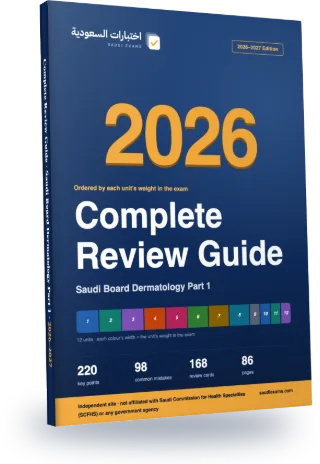
الملخص الشامل للبورد السعودي الجلدية – الجزء الأول 1448
كل نقاط الاختبار في ملف PDF من 86 صفحة، مرتبة من الوحدة الأكبر وزنًا إلى الأصغر. الفصول الثلاثة الأولى وحدها نحو 30% من أسئلة الاختبار.
- 86الصفحات
- 220النقاط الأساسية
- 98الأخطاء الشائعة
- 168بطاقات المراجعة
خريطة الملخص
كل فصل وحدة من وحدات الاختبار. الترتيب حسب وزن الوحدة في الاختبار الحقيقي.
| الفصل | الوحدة | الوزن | أسئلة الاختبار | نقاط الملخص |
|---|---|---|---|---|
| 1 | تشريح الجلد وبنيته وتطوره | 10% | 15 | 18 |
| 2 | الجهاز المناعي الفطري المتعلق بالأمراض الجلدية | 10% | 15 | 18 |
| 3 | الجهاز المناعي المكتسب المتعلق بالأمراض الجلدية | 10% | 15 | 18 |
| 4 | النسيج الضام الأدمي والنسيج تحت الجلد | 10% | 15 | 18 |
| 5 | الأورام | 10% | 15 | 22 |
| 6 | الأمراض الجلدية الوراثية | 10% | 15 | 18 |
| 7 | الأمراض المعدية والبيئية | 10% | 15 | 18 |
| 8 | العلاج | 10% | 15 | 18 |
| 9 | الخلايا الكيراتينية والتماسك البشروي والبشروي الأدمي | 5% | 8 | 18 |
| 10 | التصبغ | 5% | 7 | 18 |
| 11 | ملحقات الجلد | 5% | 8 | 18 |
| 12 | الشعر والأظافر والأغشية المخاطية | 5% | 7 | 18 |
الفصل الأول كاملًا: تشريح الجلد وبنيته وتطوره
10% من الاختبار، نحو 15 سؤالًا. هذه نقاطه الأساسية كما في الملخص.
- (Epidermal layers, keratinization and epidermal differentiation) Basal cells carry keratin 5/14; when they leave the basal layer and become postmitotic spinous cells they switch to keratin 1/10.
- (Epidermal layers, keratinization and epidermal differentiation) The stratum lucidum (palms and soles) is a thin pale band between the granular layer and stratum corneum; it contains eleidin, derived from modified keratohyalin.
- (Epidermal layers, keratinization and epidermal differentiation) Filaggrin breakdown yields natural moisturizing factor; pyrrolidone carboxylic acid (from glutamic acid cyclization) is about 12 percent of it; calpain-1 acts in both profilaggrin processing and filaggrin degradation.
بقية الفصل الأول على هذه الصفحة
- (Epidermal layers, keratinization and epidermal differentiation) TGM1 deficiency (collodion baby, later large dark scales and ectropion) fails to ester-link omega-hydroxyceramides to involucrin and scaffold proteins, impairing the permeability barrier.
- (Epidermal layers, keratinization and epidermal differentiation) LOR mutation (extended translation creating a nuclear localization signal) gives palmoplantar keratoderma with honeycomb depressions and pseudoainhum.
- (Epidermal layers, keratinization and epidermal differentiation) Normal keratinocyte transit from basal layer to stratum corneum takes about 14 days; psoriasis-type scale shows accelerated, incomplete keratinization with retained nuclei in the cornified layer.
- (Dermis, dermoepidermal junction and skin embryology) p63 (p53 homologue) is required for the switch from keratin 8/18 to keratin 5/14 and for epidermal commitment of surface ectoderm.
- (Dermis, dermoepidermal junction and skin embryology) In fetal epidermis, basal cells divide asymmetrically under the periderm to form an intermediate layer that matures into the stratum spinosum; terminal differentiation into granular and cornified layers occurs around weeks 22 to 24.
- (Dermis, dermoepidermal junction and skin embryology) Junctional EB shows separation within the lamina lucida; LAMB3 is an example gene.
- (Dermis, dermoepidermal junction and skin embryology) Photoaging: ROS activate MAPK and AP-1, raising MMP-1 without a matching rise in TIMPs, so collagen is fragmented.
- (Cutaneous vasculature, nerves and sensory receptors) Papillary loops (true capillaries) of the superficial plexus lie closest to the dermoepidermal junction and are a major determinant of heat exchange; the deep plexus arterioles (four to five smooth muscle layers) send ascending branches to the papillary plexus, follicles and sweat glands.
- (Cutaneous vasculature, nerves and sensory receptors) Arteriovenous anastomoses in glabrous skin (palms, lips) connect arterioles directly to venules, bypassing capillaries.
- (Cutaneous vasculature, nerves and sensory receptors) Resting skin blood flow is about 250 mL/min, roughly 5 percent of cardiac output; heat-induced rise beyond loss of vasoconstrictor tone is due to active vasodilation by sympathetic nerves releasing acetylcholine with co-transmitters.
- (Cutaneous vasculature, nerves and sensory receptors) Meissner corpuscle (dermal papillae, rapidly adapting) detects low-frequency flutter and slip; Pacinian corpuscle (lamellae around an Abeta fibre, deep dermis) detects high-frequency vibration.
- (Cutaneous vasculature, nerves and sensory receptors) Hairy skin: C low-threshold mechanoreceptors (about 1 m/s, slow gentle stroking, absent in glabrous skin) versus Adelta low-threshold mechanoreceptors (D-hair, about 15 m/s, respond to rapid cooling).
- (Resident skin cells and regional variation of skin) Pheomelanin is yellow-to-red and its synthesis needs a cysteine-dependent step; melanosome transport uses kinesin 2 on microtubules (long range) and myosin Va-melanophilin-Rab27a (short range).
- (Resident skin cells and regional variation of skin) Langerhans cells contain rod or tennis-racket Birbeck granules whose main component is langerin (CD207); they self-renew locally, with blood precursors repopulating only after severe inflammation; migration needs CCR7 up and E-cadherin down.
- (Resident skin cells and regional variation of skin) Merkel cells derive from epidermal progenitors (Atoh1-dependent), are CK20 positive with dense-core granules, and act as mechanoreceptors relaying touch to Abeta endings.
أخطاء شائعة في هذا الفصل
- Keratin 5/14 marks basal proliferative cells; keratin 1/10 is the postmitotic spinous program. Keratin 8/18 and 6/16 are distractors.
- Desmoglein 3 decreases and desmoglein 1 increases with differentiation, not the reverse.
- Do not swap Langerhans cells (spinous layer) with melanocytes and Merkel cells (basal layer).
- TGM1 defect is a failure to ester-link omega-hydroxyceramides to involucrin and scaffold proteins; do not confuse it with the empty lamellar granules of ABCA12.
- Meissner corpuscle detects low-frequency flutter and slip in dermal papillae; Pacinian corpuscle in the deep dermis detects high-frequency vibration.
- Ruffini (SAII) has a receptive field about five times larger than Merkel units; both fire during sustained stimulation.
- Dark skin has similar melanocyte numbers to light skin; the difference is melanosome size, dispersion and retention, not cell count.
- Langerhans cells self-renew locally at steady state; blood-derived precursors matter only after severe inflammation.
بقية الفصول في الملخص الكامل
شراء واحد · وصول دائم · معه الملخص الشامل
خطة مراجعة 7 أيام
وزّعنا الفصول على 6 أيام حسب وزنها حتى يتقارب حمل كل يوم، واليوم السابع لاختبار كامل.
اليوم 1 · 20% من الاختبار
الفصل 1: تشريح الجلد وبنيته وتطوره
الفصل 7: الأمراض المعدية والبيئيةاليوم 2 · 20% من الاختبار
الفصل 2: الجهاز المناعي الفطري المتعلق بالأمراض الجلدية
الفصل 8: العلاجاليوم 3 · 15% من الاختبار
الفصل 3: الجهاز المناعي المكتسب المتعلق بالأمراض الجلدية
الفصل 9: الخلايا الكيراتينية والتماسك البشروي والبشروي الأدمياليوم 4 · 15% من الاختبار
الفصل 4: النسيج الضام الأدمي والنسيج تحت الجلد
الفصل 10: التصبغاليوم 5 · 15% من الاختبار
الفصل 5: الأورام
الفصل 11: ملحقات الجلداليوم 6 · 15% من الاختبار
الفصل 6: الأمراض الجلدية الوراثية
الفصل 12: الشعر والأظافر والأغشية المخاطية
كم إجابة صحيحة تحتاج؟
- درجة النجاح 65%98 إجابة صحيحة من 150
قبل أن تقرأ: اعرف درجتك اليوم
10 أسئلة مجانية من أهم الوحدات، بدون تسجيل. تعرف بعدها من أي فصل تبدأ.
جرّب 10 أسئلة مجانية واعرف مستواكلمحة من كل فصل
أول ثلاث نقاط من كل فصل كما تظهر في الملخص.
الفصل 1: تشريح الجلد وبنيته وتطوره
- (Epidermal layers, keratinization and epidermal differentiation) Basal cells carry keratin 5/14; when they leave…
- (Epidermal layers, keratinization and epidermal differentiation) The stratum lucidum (palms and soles) is a…
- (Epidermal layers, keratinization and epidermal differentiation) Filaggrin breakdown yields natural moisturizing factor; pyrrolidone carboxylic…
الفصل 2: الجهاز المناعي الفطري المتعلق بالأمراض الجلدية
- (Antimicrobial peptides and the complement system) Kallikrein 5 cleaves hCAP18 to LL-37; with higher…
- (Antimicrobial peptides and the complement system) In psoriasis LL-37 complexes with self-DNA, which plasmacytoid…
- (Antimicrobial peptides and the complement system) Dermcidin is an anionic peptide from eccrine sweat…
الفصل 3: الجهاز المناعي المكتسب المتعلق بالأمراض الجلدية
- (Antigen presentation, MHC and T-cell subsets) MHC class I molecules pair with β2-microglobulin, show…
- (Antigen presentation, MHC and T-cell subsets) MHC class II has an open-ended groove accepting…
- (Antigen presentation, MHC and T-cell subsets) Th2
الفصل 4: النسيج الضام الأدمي والنسيج تحت الجلد
- (Collagen types, synthesis and related disorders) Type I procollagen needs N-propeptide trimming by procollagen…
- (Collagen types, synthesis and related disorders) Lysyl hydroxylase 1 (PLOD1) forms hydroxylysine; its deficiency…
- (Collagen types, synthesis and related disorders) Glycine substitutions in the triple helix slow folding…
الفصل 5: الأورام
- (Keratinocyte neoplasms and precursors (actinic keratosis, SCC, BCC)) Actinic keratosis: architectural disorder, nuclear atypia…
- (Keratinocyte neoplasms and precursors (actinic keratosis, SCC, BCC)) UVB forms cyclobutane pyrimidine dimers and…
- (Keratinocyte neoplasms and precursors (actinic keratosis, SCC, BCC)) Imiquimod is a toll-like receptor 7…
الفصل 6: الأمراض الجلدية الوراثية
- (Ichthyoses and keratinization disorders) Ichthyosis vulgaris: FLG null variants truncate profilaggrin, leaving scant keratohyalin…
- (Ichthyoses and keratinization disorders) X-linked ichthyosis: steroid sulphatase deficiency raises cholesterol sulphate, inhibiting corneodesmosome…
- (Ichthyoses and keratinization disorders) Harlequin ichthyosis: ABCA12 mutations disrupt lipid transport and lamellar body…
الفصل 7: الأمراض المعدية والبيئية
- (Bacterial skin infections and mycobacterial disease) Type 1 leprosy reaction is type IV hypersensitivity…
- (Bacterial skin infections and mycobacterial disease) Erythema nodosum leprosum is an immune-complex (type III)…
- (Bacterial skin infections and mycobacterial disease) M. leprae prefers cool tissue, with viability falling…
الفصل 8: العلاج
- (Topical corticosteroids, calcineurin inhibitors and other topical agents) Absorption is greatest at genitals, eyelids…
- (Topical corticosteroids, calcineurin inhibitors and other topical agents) Long-term facial steroid use causes skin…
- (Topical corticosteroids, calcineurin inhibitors and other topical agents) Repeated empirical potent steroids for persistent…
الفصل 9: الخلايا الكيراتينية والتماسك البشروي والبشروي الأدمي
- (Keratins and the keratinocyte cytoskeleton) Keratin 5 and keratin 14 are expressed in basal…
- (Keratins and the keratinocyte cytoskeleton) Mutations at the ends of the keratin rod domain…
- (Keratins and the keratinocyte cytoskeleton) Recessive null alleles of keratin 14 produce no protein;…
الفصل 10: التصبغ
- (Melanocyte biology and melanogenesis) Tyrosinase carries out both tyrosine hydroxylation and DOPA oxidation to…
- (Melanocyte biology and melanogenesis) Dopachrome tautomerase (TYRP2) converts dopachrome to DHICA in the eumelanin…
- (Melanocyte biology and melanogenesis) OA1 (GPR143) is a G protein-coupled receptor for L-DOPA affected…
الفصل 11: ملحقات الجلد
- (Eccrine and apocrine sweat glands and their disorders) Clear cells of the eccrine secretory…
- (Eccrine and apocrine sweat glands and their disorders) CFTR deficiency lowers duct Cl- uptake…
- (Eccrine and apocrine sweat glands and their disorders) Sweating is driven by acetylcholine, which…
الفصل 12: الشعر والأظافر والأغشية المخاطية
- (Hair follicle structure and the hair cycle) The inner root sheath has three layers…
- (Hair follicle structure and the hair cycle) Catagen is a transition phase of about…
- (Hair follicle structure and the hair cycle) Pigment-producing melanocytes lie among the matrix cells…
الملخص كاملًا مع الوصول الدائم
الملخص كاملًا (86 صفحة) يأتي مع الوصول الدائم لهذا الاختبار، ومعه كل الأسئلة والاختبارات التجريبية الكاملة. الفصل الأول مجاني للجميع.
أسئلة عن الملخص
هل الملخص مجاني؟
الفصل الأول مجاني للقراءة على صفحة الملخص. الملخص كاملًا يأتي مع الوصول الدائم لهذا الاختبار، ولا يشمله وصول 7 أيام.
هل يناسب اختبارات 1448؟
نعم. أوزان الوحدات ومعلومات الاختبار مكتوبة وفق آخر ما نشرته الجهة المنظمة، وتاريخ آخر تحقق مكتوب في الملخص. إذا تغيّرت المعايير نحدّث الملف، ومن اشترى يحمّل النسخة الجديدة.
هل في الملخص أسئلة؟
لا. الملخص للنقاط والأخطاء الشائعة فقط؛ قياس الدرجة والتدريب حسب نقاط الضعف والاختبارات التجريبية الكاملة على الموقع.
هل يُقرأ على الجوال؟
نعم. الصفحات بحجم A5 وعمود واحد، والفصول مرتبطة بالفهرس.
- عدد الصفحات
- 86
- الإصدار
- 1448هـ · 2026–2027
- اللغة
- العربية
- آخر تحديث
كل ملخصات اختبارات التخصصات الصحية
العودة إلى صفحة اختبار الجزء الأول للبورد السعودي – الأمراض الجلدية
التحضير الكامل للاختبار
كل هذا في شراء واحد.
- جلسات تدريب تكميلي بتوقيت150 سؤالًا في 90 دقيقة. تخرج بدرجتك الكلية ودرجة كل وحدة.
- تدريب على كل وحدة527 سؤال، لكل خيار شرحه ومصدره. تبدأ بأضعف وحداتك.
- الملخص الشامل 1448 (PDF)مرتب حسب وزن كل وحدة في الاختبار. مع الوصول الدائم فقط.
اختر مدة الوصول
سجّل الدخول بحساب Google ثم تنتقل مباشرة إلى صفحة الدفع.