Lab Clinical Biochemistry Specialist Syllabus: 5 Sections and Weights
The five Laboratory – Clinical Biochemistry exam sections with official weight ranges, what each covers, how our 150-question mock splits them, and the reference books.
- Questions and time
- 150 questions · 3 hours
- Pass mark
- 60%
- correct answers to pass (60%)
- 90 of 150
- Exam fee
- Paid to SCFHS online when you apply through Mumaris Plus; the amount is shown in your application
Start with 10 free questions to find what needs more work. No sign-up, with answer explanations.
Try 10 free questions and see your levelPut what you just read into practice
Lab Clinical Biochemistry Specialist
Start with 10 free questions to find what needs more work. No sign-up, with answer explanations.
Try 10 free questions and see your levelLast checked: 17 November 2026. Weights and content can change at any time, so check the classification exams page on the SCFHS website and the Laboratory – Clinical Biochemistry content guideline (PDF) before you start studying. This is an independent website, not affiliated with the Saudi Commission for Health Specialties (SCFHS) or Prometric.
The SCFHS Laboratory Specialist – Clinical Biochemistry exam has five sections. Clinical Chemistry carries 50–60% and Immunology and Serology 15–20%, so those two make up about three quarters of the paper. Urinalysis and Other Body Fluids, Laboratory Operations, and Patient Safety and Professionalism carry 5–10% each. Use this page to decide where to start.
Exam format at a glance
| Item | Details |
|---|---|
| Questions | 150 multiple-choice questions |
| Time | 3 hours |
| Pass mark | 60% |
| Distribution | The real distribution can differ from the published weights by up to 5% (plus or minus) in each section |
| Exam language | Not stated by SCFHS. The guideline and all its references are in English except three Saudi documents, so we treat the exam as English (our inference) |
The five sections and their weights
SCFHS publishes a range for each section. The last column is the split we use in our full mock exams (150 questions). It is our choice within each range, set so the total is 150, and it is not an official count.
| Section | Official weight | Questions in our mock exam |
|---|---|---|
| 1. Clinical Chemistry | 50–60% | 87 |
| 2. Urinalysis and Other Body Fluids | 5–10% | 12 |
| 3. Immunology and Serology | 15–20% | 28 |
| 4. Laboratory Operations | 5–10% | 12 |
| 5. Patient Safety and Professionalism | 5–10% | 11 |
| Total | 150 |
Because the real weights can move by 5%, a small section is still worth about 10 to 15 questions, and Immunology and Serology could reach 20% or more of the paper. Our practice questions follow the same split, and your result is shown section by section.
A note on detail: the SCFHS guideline names the five sections and gives a weight range for each. It has no topic list. The topic lists below are our own breakdown, built from the chapters of the reference books SCFHS names, and are not an official outline.
Section 1: Clinical Chemistry (50–60%, 87 questions)
This is the core of the exam. We split it into fifteen topics.
- Analytical principles: spectrophotometry, ion-selective electrodes, electrophoresis, chromatography, mass spectrometry, immunoassay and point-of-care testing.
- Pre-analytical variables, interferences, reference intervals and method evaluation.
- Water, sodium, potassium, chloride and osmolality.
- Acid-base balance and blood gases.
- Calcium, phosphate, magnesium, vitamin D and bone metabolism.
- Carbohydrate metabolism and diabetes mellitus.
- Lipids, lipoproteins and dyslipidaemia.
- Liver function, bilirubin and hepatic enzymes.
- Clinical enzymology, pancreatic and gastrointestinal function.
- Renal function, nitrogen compounds and kidney disease.
- Cardiac biomarkers and plasma proteins.
- Endocrinology: thyroid, adrenal, pituitary, gonadal and pregnancy testing.
- Iron, trace elements, vitamins and nutritional assessment.
- Tumour markers, therapeutic drug monitoring and toxicology.
- Inherited metabolic disease, porphyrias, newborn screening and molecular basics.
How to prepare: for each analyte learn four things: what the test measures and how, the usual causes of a high and a low result, what interferes with it, and which second test you would order next. Practise pattern questions, such as a set of electrolyte and blood gas results or a thyroid panel, because many questions give a few results and ask for the most likely explanation or the next step. Keep the formulas (anion gap, calculated osmolality, eGFR inputs, Friedewald) on one page and work through them by hand.
Section 2: Urinalysis and Other Body Fluids (5–10%, 12 questions)
- Urine: collection, physical and chemical (dipstick) examination.
- Urine microscopy, proteinuria and what they show about renal disease.
- Other fluids: cerebrospinal, serous, synovial and amniotic fluid, semen and faeces.
How to prepare: learn casts, crystals and cells from images, then test yourself. For each body fluid, write what a normal result looks like and which findings separate infection, inflammation and bleeding.
Section 3: Immunology and Serology (15–20%, 28 questions)
- The immune system: immunoglobulins and complement.
- Hypersensitivity, allergy and immunodeficiency.
- Autoimmunity and its laboratory diagnosis.
- Immunoassay techniques, monoclonal proteins and transplant immunology.
- Serology of infectious disease: hepatitis, HIV, syphilis and TORCH.
How to prepare: this section is bigger here than in the other SCFHS laboratory specialist exams, so give it real time. Understand each method's principle (what binds to what, and what is read) before memorising names. Learn autoantibody patterns as pairs of antibody and disease, and for viral hepatitis write what each marker means in acute infection, chronic infection and after vaccination.
Section 4: Laboratory Operations (5–10%, 12 questions)
- Quality control and quality assurance: control charts, Westgard rules, bias and imprecision, external quality assessment.
- Quality management systems and accreditation.
- Biosafety, waste and transport of specimens.
- Specimen handling, equipment, documentation and information systems.
How to prepare: for quality control, learn how to read a control chart and what a shift or a trend means, and which rule detects random and which detects systematic error. Practise dilutions and solution calculations on paper. Read the WHO Laboratory Quality Management System Handbook from the reference list for the quality system terms.
Section 5: Patient Safety and Professionalism (5–10%, 11 questions)
- Patient identification, specimen labelling and error reporting.
- Infection prevention: standard precautions and hand hygiene.
- Saudi health-professions law, patient rights and professional conduct.
- Communication, critical results, confidentiality and ethics.
How to prepare: most questions give a workplace situation and ask for the safest or most professional action. Read the three Saudi documents on the reference list (patient rights and responsibilities, the Implementing Regulations of the Health Professions Practice Law, and the national standards for laboratories and blood banks), and practise choosing the action that protects the patient first.
Official reference list
SCFHS lists these as a study aid only. It states that the list does not imply endorsement of these references, and that exam questions are not necessarily taken from them.
- Marshall, Lapsley and Day, Clinical Chemistry (8th ed., 2016)
- Bishop, Fody and Schoeff, Clinical Chemistry: Techniques, Principles, Correlation (6th ed., 2010)
- Clinical Biochemistry (1st ed., 2016), Charles University
- Ging, The Biochemistry of Body Fluids (4th ed.)
- Brunzel, Fundamentals of Urine and Body Fluid Analysis (4th ed., 2013)
- Todd, Spickett and Fairclough, Lecture Notes: Immunology (7th ed.)
- Landsverk and Wong, Clinical Molecular Diagnostic Techniques: A Brief Review
- WHO, Laboratory Quality Management System Handbook
- The Patient Rights and Responsibilities document (Arabic)
- The Implementing Regulations of the Health Professions Practice Law (Arabic)
- The national standards for laboratories and blood banks (Arabic)
How it differs from the other SCFHS laboratory exams
This is the clinical biochemistry specialist exam: 150 questions, five sections and a 60% pass mark, with Clinical Chemistry at 50–60%. The SCFHS Laboratory Technician exam has six sections and a 55% pass mark, and spreads its weight across several disciplines. The microbiology specialist exam has the same five-section layout but puts 60–70% on microbiology. The SLLE (professional laboratory specialist licensure exam) has 200 questions and nine sections. Do not study from the technician or SLLE guide for this exam.
How our practice follows this syllabus
Our questions are in English, matching the language of the guideline and its references. The section split in our full mock exam is the one in the table above, and every practice set ends with your result in each section so you know where to start.
Finished reading? Try a set of questions
Start with 10 free questions to find your weakest units. Keep practising with the full question bank and mock exams from SAR 26.
Put the plan to work here
SAR 34 $9
One purchase · lifetime access · review guide included
- 595 questions, every option explained with its source
- Full mock exams: 150 questions in 180 minutes, like the real one
- Practice that starts with your weakest units, plus a review of your mistakes
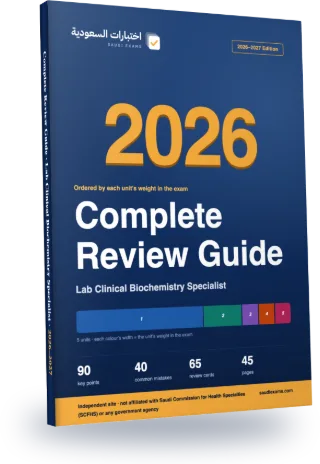 Complete Review Guide 2026–2027 included (PDF)Ordered by the weight of each unit in the examBuy now · SAR 34or 7 days for SAR 26
See everything included
Full mock exams like the real one and 595 explained questions that find your weak spots and train them
- Unlimited full mock exams to practise your pace and check your performance across the whole exam
- Practise 10 weak-area questions, starting where you lose the most marks
- 595 questions explaining why every option is right or wrong
- Arabic and English with one pass
- Unit notes and flashcards, then questions to check your understanding
This exam is part of professional classification as a laboratory specialist in clinical biochemistry, and you cannot get a practice licence without classification. If you do not pass you get further attempts under SCFHS rules and pay the evaluation fee. Source Last verified: 2026-11-17