Lab Clinical Biochemistry Exam Study Plan: 6 Weeks
A 6-week and a 2-week study plan for the lab clinical biochemistry specialist exam by section weight, with a full 150-question mock two days before the exam.
- Questions and time
- 150 questions · 3 hours
- Pass mark
- 60%
- correct answers to pass (60%)
- 90 of 150
- Exam fee
- Paid to SCFHS online when you apply through Mumaris Plus; the amount is shown in your application
Start with 10 free questions to find what needs more work. No sign-up, with answer explanations.
Try 10 free questions and see your levelPut what you just read into practice
Lab Clinical Biochemistry Specialist
Start with 10 free questions to find what needs more work. No sign-up, with answer explanations.
Try 10 free questions and see your levelLast verified: 17 November 2026. Check the SCFHS classification exams page and the Laboratory – Clinical Biochemistry content guideline (PDF) before you start, because weights and rules can change. This is an independent guide with no link to SCFHS, Prometric or any government body.
The exam has 150 questions across five sections. Clinical Chemistry carries 50–60% and Immunology and Serology 15–20%. This plan gives Clinical Chemistry the first four weeks, Immunology and the small sections week five, and uses week six to close gaps and sit a full mock. The detail of each section is in the exam content guide, and the application steps are in the registration guide.
Numbers to build your plan on
| Item | What it means for your study |
|---|---|
| 150 multiple-choice questions | Per the SCFHS content guideline. The guideline does not state the number of options; our questions use four. |
| 3 hours | 180 minutes for 150 questions is 72 seconds a question. Practise sitting the full time in one go. |
| Pass mark 60% | That is 90 of 150 questions. Your result on this site shows your percentage in each section, so you can compare sections and track progress. |
| Weights can move by up to 5% per section | Do not skip a small section. Even the smallest is worth about 11 questions in our mock exam. |
| Language | The guideline does not state it. We treat the exam as English (our inference), so revise terms in English from the start. Our questions and explanations are in English. |
| Calculator | Not mentioned in the guideline, so practise calculations by hand with simple numbers. |
Split your time by section
The percentages are the official ranges. The question counts are the split in our 150-question full mock exam:
| Section | Official weight | Questions | Your time in the plan |
|---|---|---|---|
| Clinical Chemistry | 50–60% | 87 | Weeks 1–4 |
| Urinalysis and Other Body Fluids | 5–10% | 12 | Week 4 (1 day) and week 5 (1 day) |
| Immunology and Serology | 15–20% | 28 | Week 5 (2 days) |
| Laboratory Operations | 5–10% | 12 | Week 5 (1 day) |
| Patient Safety and Professionalism | 5–10% | 11 | Week 5 (1 day) |
Clinical Chemistry is more than half the paper, so it takes four of the six weeks. Immunology and Serology is the second biggest section and gets two days. The three smaller sections together are 35 questions and each gets a focused day. They are short topics learned by pattern, so they reward revision more than long reading.
The 6-week plan
The plan assumes one to two hours a day. Count back six weeks from your booking date once SCFHS opens booking in your application. Each week has the same rhythm: five days of reading and practice, one day to redo the week's mistakes, and one light day.
Week 1: Baseline, methods and fluids
- Day 1: take the free practice test (10 free questions, no sign-up). Note your percentage in each section and your three weakest.
- Day 2: analytical principles: spectrophotometry, ion-selective electrodes, electrophoresis, chromatography, mass spectrometry.
- Day 3: immunoassay principles and interference, pre-analytical variables, reference intervals and method evaluation.
- Day 4: water, sodium and osmolality.
- Day 5: potassium, chloride, bicarbonate and the anion gap.
Week 2: Acid-base, minerals, glucose and lipids
- Day 1: acid-base balance and blood gases. Interpret a few sets of results by hand.
- Day 2: calcium, phosphate, magnesium, vitamin D and bone metabolism.
- Days 3–4: diabetes diagnosis, glucose and HbA1c measurement, DKA and hypoglycaemia.
- Day 5: lipids, lipoproteins and dyslipidaemia, including the LDL calculation.
Week 3: Liver, enzymes, kidney, heart and proteins
- Day 1: bilirubin and jaundice.
- Day 2: liver enzymes and clinical enzymology, pancreatic and gastrointestinal tests.
- Day 3: creatinine, eGFR, kidney disease classification.
- Day 4: cardiac biomarkers.
- Day 5: plasma proteins and electrophoresis patterns.
Week 4: Endocrine, nutrition, drugs and urine
- Day 1: thyroid and pituitary tests. Day 2: adrenal, gonadal and pregnancy tests.
- Day 3: iron, trace elements and vitamins, then tumour markers.
- Day 4: therapeutic drug monitoring, toxicology, inherited metabolic disease and molecular basics.
- Day 5: urine collection, dipstick, microscopy and renal disease. Open the practice area, pick your two weakest Clinical Chemistry topics and do 10 questions from each.
Week 5: Immunology, body fluids, operations and safety
- Day 1: immune system, immunoglobulins, complement, hypersensitivity and immunodeficiency.
- Day 2: autoimmunity, immunoassay techniques, monoclonal proteins, infection serology.
- Day 3: CSF, serous and synovial fluid, semen and faeces.
- Day 4: Laboratory Operations: quality control, Westgard rules, quality systems, biosafety, specimen handling. Do the calculations on paper.
- Day 5: Patient Safety and Professionalism: patient identification, infection prevention, law and rights, critical results.
Week 6: Close the gaps and sit the full mock
- Days 1–3: redo every question in your error notebook, then practise your weakest topics 10 questions at a time.
- Day 4: a light day. Skim your formula page and result-pattern cards.
- Day 5 (two days before the exam): sit one full mock exam (next section).
- Day 6: review only the mistakes from the mock. Do not open a new topic.
The full mock exam, two days before the real one
- 150 questions in 180 minutes, in one sitting. The content guideline does not mention a break, so do not plan one.
- No phone and no notes. Calculate by hand.
- If a question stalls you, flag it and move on; at 72 seconds each, one slow question costs the next one.
- Afterwards, open the result for each section. The section with the lowest percentage is what you review on your last study day.
The 2-week plan if you are short of time
Build it on Clinical Chemistry and Immunology, about three quarters of the exam, and keep a short pass over each small section:
| Day | Task |
|---|---|
| 1 | Free practice test (10 questions) and pick out your weakest sections |
| 2 | Analytical methods, pre-analytical variables, reference intervals |
| 3 | Sodium, potassium, osmolality, acid-base and blood gases |
| 4 | Calcium, bone, glucose, HbA1c and diabetes complications |
| 5 | Lipids, liver tests, bilirubin and enzymes |
| 6 | Kidney tests, cardiac markers and plasma proteins |
| 7 | Thyroid, adrenal, gonadal, pregnancy tests |
| 8 | Iron, vitamins, tumour markers, drug monitoring, inherited disease |
| 9 | Immunology and serology |
| 10 | Urinalysis and other body fluids |
| 11 | Laboratory Operations, with calculations on paper |
| 12 | Patient Safety and Professionalism |
| 13 | Full mock exam: 150 questions in 180 minutes |
| 14 | Review only the mock's mistakes, then an early night |
How to handle your mistakes
- Read the explanation of every option, not just the correct answer. A wrong option today can be the right answer tomorrow.
- Write the cause of each mistake in one phrase: missing fact, confused two similar tests, calculation slip, missed interference, or rushed reading. One cause usually repeats.
- Redo missed questions after two days, then after a week. When you answer one correctly twice in a row, take it out of your notebook.
What this site adds to your plan
- The free practice test: 10 free questions from the exam's sections, with the answer, its explanation and your percentage in each section, no sign-up.
- The practice area: practise section by section, with an error notebook and practice on your weakest topics. The remaining questions need a paid pass.
- The full mock exam of 150 questions in 180 minutes, the same question count and total time as the guideline. It also needs a paid pass.
This is an independent exam preparation website with no link to SCFHS, Prometric or any government body.
Finished reading? Try a set of questions
Start with 10 free questions to find your weakest units. Keep practising with the full question bank and mock exams from SAR 26.
Put the plan to work here
SAR 34 $9
One purchase · lifetime access · review guide included
- 595 questions, every option explained with its source
- Full mock exams: 150 questions in 180 minutes, like the real one
- Practice that starts with your weakest units, plus a review of your mistakes
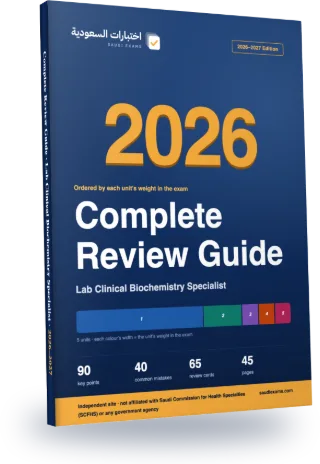 Complete Review Guide 2026–2027 included (PDF)Ordered by the weight of each unit in the examBuy now · SAR 34or 7 days for SAR 26
See everything included
Full mock exams like the real one and 595 explained questions that find your weak spots and train them
- Unlimited full mock exams to practise your pace and check your performance across the whole exam
- Practise 10 weak-area questions, starting where you lose the most marks
- 595 questions explaining why every option is right or wrong
- Arabic and English with one pass
- Unit notes and flashcards, then questions to check your understanding
This exam is part of professional classification as a laboratory specialist in clinical biochemistry, and you cannot get a practice licence without classification. If you do not pass you get further attempts under SCFHS rules and pay the evaluation fee. Source Last verified: 2026-11-17