National Science and Mathematics Olympiad (NSMO) – Cities and Provinces Test: Science
National Science and Mathematics Olympiad (NSMO) – Cities and Provinces Test: Science — Number of questions: 25 questions. Exam time: 120 minutes. Pass mark: Mawhiba does not publish a pass mark; students who qualify move on to the next stage. Exam fee: Free: registration in both tracks of the National Gifted Olympiad has no fee. Source: King Abdulaziz & His Companions Foundation for Giftedness and Creativity (Mawhiba), in partnership with the Ministry of Education (Last verified: 2026-11-18). Question bank: full mock exams of 25 questions in 120 minutes, like the real test with a result for every unit, plus 514 explained questions across 7 units, every option explained, a review of your mistakes, and two ways to practise: see the answer right away, or sit a full timed mock. Free questions: a 10-question diagnostic test covering the main units, no sign-up; at the end you get your score and your weakest units. With lifetime access: the Complete Review Guide, a 34-page PDF ordered by unit weight; chapter 1 is free to read on the guide page.
Last verified on the King Abdulaziz & His Companions Foundation for Giftedness and Creativity (Mawhiba), in partnership with the Ministry of Education website: 18 November 2026
If you sat the exam today, what would you score?
10 free questions · no sign-up · your score as soon as you finish
Question 1 of 10
During an experiment to measure the dimensions of a sample, a student decided to convert the unit of measurement from metres to centimetres when recording the length of the object. Which of the following statements correctly describes what happens when the unit is changed?
All 10 free questions with answers and an explanation for every option
Where the questions come from
- Atomic Structure and the Periodic Table5 questions
- Chemical Bonding4 questions
- Physics and Measurement1 questions
- Introduction to Fluids3 questions
- Motion in One Dimension4 questions
- The Cell: Structure, Chemistry and Energy3 questions
- Cell Division and Ecology5 questions
Exam facts
- Exam language
- Arabic or English
- Number of questions
- 25 questions Source
- Exam time
- 120 minutes Source
- Pass mark
- Mawhiba does not publish a pass mark; students who qualify move on to the next stage Source
- Exam fee
- Free: registration in both tracks of the National Gifted Olympiad has no fee Source
- Registration
- Through the school coordinator only, who registers nominated students on Mawhiba's website; students cannot register individually for the scientific track Source
Last verified: 2026-11-18
Where other sources differ
- Each question appears in Arabic and English on the same sheet, so practise the science terms in both languages.
- The paper has three sections in a row: chemistry (9 questions), then physics (8), then biology (8); within each section a question is worth 3, then 4, then 5 points, for a total of 100.
- The 2026 sample comes with a periodic table showing atomic numbers, relative atomic masses and electronegativities, so every question here states the values it needs.
Exam body
King Abdulaziz & His Companions Foundation for Giftedness and Creativity (Mawhiba), in partnership with the Ministry of Education: Official website: King Abdulaziz & His Companions Foundation for Giftedness and Creativity (Mawhiba), in partnership with the Ministry of Education
How to register
- The student does not register themselves: registration for the NSMO scientific track goes through the school coordinator, so tell the coordinator you want to take part in science.
- The school registers the nominated students on Mawhiba's website unless they are already registered, and the coordinator nominates students within the allocation Mawhiba sets.
- Check the conditions: Saudi nationality, a grade targeted this year (the science test is for first and second intermediate students), and general education in a public, private or international school.
- The student sits the Cities and Provinces Competition test: 25 questions in 120 minutes, each shown in Arabic and English, answered on a separate answer sheet in pencil.
- The student receives a participation certificate after passing each stage, and those who pass continue to the next training and tests.
Study guides (2)
Frequently asked questions
How many questions are in the NSMO science test and how long is it?
25 multiple-choice questions in 120 minutes, according to the instructions in Mawhiba's published 2026 sample test: 9 in chemistry, 8 in physics and 8 in biology. Each question is shown in Arabic and English. Our full mock exams have the same number of questions and time.
Can I try NSMO Science questions for free?
Yes. Free questions: a 10-question diagnostic test covering the main units, no sign-up; at the end you get your score and your weakest units. The free practice test page lists the same questions with answers and an explanation for every option. The rest of the questions and the full mock exams come with a pass from SAR 26.
What makes this NSMO Science question bank different?
Question bank: full mock exams of 25 questions in 120 minutes, like the real test with a result for every unit, plus 514 explained questions across 7 units, every option explained, a review of your mistakes, and two ways to practise: see the answer right away, or sit a full timed mock. Practice questions and explanations are ready to use on your phone. Try the free questions and read the explanations before you buy.
Is there a PDF review guide for NSMO Science?
Yes. "NSMO Science Complete Review Guide 2026–2027" is a 34-page Arabic PDF: 7 units ordered from the heaviest in the exam to the lightest, each chapter with key points, common mistakes and review cards, plus a 7-day plan. Chapter 1 is free to read on the guide page; the full guide comes with lifetime access to this exam and is not part of 7-day access. The guide has no questions: scoring, practice and mock exams are on the site.
Who can sit the science test?
Saudi first and second intermediate students in general education (public, private or international), nominated by their schools. Third intermediate and first secondary students sit the separate physics, chemistry or biology tests instead.
How do I register and what does it cost?
Registration for the scientific track goes through the school coordinator, who registers nominated students on Mawhiba's website; students do not register themselves. Registration is free. Ask your school coordinator for the track timetable.
What topics does the science test cover?
The Stage 1 science bag has three sections: biology (cell structure, chemistry and energy, cell division, ecology), chemistry (atomic structure, the periodic table, ionic and covalent bonds) and physics (measurement, fluids, motion in one dimension). Our bank is split into seven units that follow these sections.
What score do I need to pass?
Mawhiba does not publish a pass mark for this stage, so we do not show a pass percentage. We show your score in each branch and overall so you see where you lose marks.
Is the mock exam score here an official score?
No. This is an independent website with no link to Mawhiba, the Ministry of Education or any government body. Our bank includes the 25 questions of Mawhiba's published 2026 science sample test with its official answers; the other questions are our own practice questions built like them on the science bag's sections. The result is an estimate of your level, not an official result.
Is this an official site, and how do I pay?
It is an independent site, not part of Qiyas, this exam's regulator or any government body, with practice questions and answer explanations. You pay once, with no automatic renewal, through Waffo Pancake (the merchant of record) by Visa, Mastercard, Apple Pay or Google Pay, and your statement shows "WAFFO". If you were charged twice or the pass did not open, email support@saudiexams.com.
NSMO Science Complete Review Guide 2026–2027
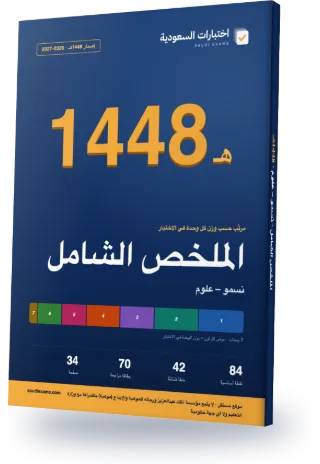
34-page · 84 key points · 42 common mistakes · 70 review cards
The first three chapters alone cover about 56% of the exam. Short on time? Start there.
About the question bank
The first-stage science test of the NSMO olympiad: 25 multiple-choice questions in 120 minutes for first and second intermediate students, mixing chemistry, physics and biology on one paper, and it decides whether your student moves on. We prepared 514 questions on the three sections of the official science bag, from atoms and bonds to fluids, motion, the cell and ecology, so your student sees where they stand before test day.
- 514 questions in the bank
- 25 questions in 120 min per mock
- 70 flashcards
Past exam questions with every option explained
What you get
- 514questions in the bankPractise with the answer shown right away, or sit a full timed mock
- 7unitsSplit by the exam syllabus
- 70flashcardsTo lock in terms and definitions
- 84quick review pointsEach unit in a few key lines
Study material sample: Atomic Structure and the Periodic Table
Summary
Atomic structure and the periodic table covers topics 1–2 of the chemistry section of the bag (chemistry pp. 3–20) and brought 5 of the 25 questions on the 2026 paper, tied with u7 for the most. It starts with Dalton's atomic theory and the three laws of chemical combination: conservation of mass, definite proportions and multiple proportions. Then come the atomic models, the proton, neutron and electron, atomic and mass numbers, isotopes and average atomic mass. The unit ends with electron configurations of atoms and ions and with how the modern periodic table is ordered by atomic number into groups and periods.
What the exam focuses on · Common traps · Try the flashcards
What the exam focuses on
- Using conservation of mass to find a missing mass before or after a reaction.
- Checking data from several samples against the law of definite proportions, and finding a simple formula from masses.
- Finding protons, neutrons and electrons from the atomic number, mass number and ion charge.
Show 3 more
- Calculating the average atomic mass of an element from its isotopes and their abundances.
- Writing electron configurations of atoms and simple ions, and spotting ions with the same configuration as a noble gas.
- Reading group and period from a configuration, and explaining why the table is ordered by atomic number, not mass.
Common traps
- Forgetting the gas: a burning metal gains mass because oxygen from the air joins it, and mass is still conserved.
- Treating two compounds of the same elements as one: different mass ratios mean different compounds (multiple proportions).
- Getting the electrons of an ion backwards: X⁻ has one more electron than protons, X²⁺ has two fewer.
Show 3 more
- Taking a simple mean of isotope masses instead of weighting each one by its abundance.
- Thinking isotopes differ in protons; they differ only in neutrons, so they have the same chemistry.
- Ordering the table by atomic mass: argon (Z = 18) comes before potassium (Z = 19) although it is heavier.
Try the flashcards
Tap a card to see the answer
Law of definite proportions
A pure compound always has the same elements in the same mass ratio.
Law of multiple proportions
Masses of one element combining with a fixed mass of another in different compounds are in a small whole-number ratio.
Mass number A
Protons + neutrons in the nucleus.
Atomic number Z
Number of protons; it identifies the element and orders the periodic table.
Isotopes
Atoms of the same element with different numbers of neutrons.
Average atomic mass
Weighted mean: Σ (isotope mass × fractional abundance).
Electrons in X²⁻
Z + 2.
Rutherford's gold-foil result
Most of the atom is empty space with a small, dense, positive nucleus.
Why you can trust these questions
- Published questions: 514. Read the explanations and references, and report any error from the question.
- Exam facts last checked against the organiser’s website: 2026-11-18. We check them again every three months and two weeks before each test.
- Found a mistake? Tap "Report an error" under any question in the practice area, or email us at support@saudiexams.com
- Independent website. Not affiliated with ETEC (Qiyas), the Financial Academy, ACAMS, the ACFE, DAMA, CompTIA, Saudi Aramco or any government body.
Update log
- 2026-11-18 Published the science Cities and Provinces test facts from Mawhiba's published sample test and the Stage 1 science bag.
Full prep for this exam
All of this in one purchase.
- Full mock exam, same as the real one25 questions in 120 minutes. You get a total score and a score for every unit.
- Practice unit by unit514 questions, every option explained with its source. Starts with your weakest units.
- Complete Review Guide 2026–2027 (PDF)Ordered by each unit's weight in the exam. With lifetime access only.
Choose your access
Continue with your Google account and you go straight to the payment page.