NSMO Science Syllabus: Seven Units and Test Format
What the science Cities and Provinces test covers for first and second intermediate students: 25 questions in 120 minutes across chemistry, physics and biology.
- Questions and time
- 25 questions · 120 minutes
- Pass mark
- Mawhiba does not publish a pass mark; students who qualify move on to the next stage
- Exam fee
- Free: registration in both tracks of the National Gifted Olympiad has no fee
Start with 10 free questions to find what needs more work. No sign-up, with answer explanations.
Try 10 free questions and see your levelPut what you just read into practice
Start with 10 free questions to find what needs more work. No sign-up, with answer explanations.
Try 10 free questions and see your levelLast verified: 18 November 2026. The number of questions, time and points come from Mawhiba's published 2026 science sample test and its answer key, and the content comes from the Stage 1 science bag. They may change, so check before the test. This is an independent guide, not affiliated with Mawhiba, the Ministry of Education or any government body, and it does not promise any score.
The Cities and Provinces test is the first stage of the NSMO scientific track of the National Gifted Olympiad. This guide is about the science test, which is for first and second intermediate students and mixes chemistry, physics and biology on one paper. Registration steps are in the registration guide.
Test format
- 25 multiple-choice questions with four options (A–D), in three sections in a row: chemistry (9 questions), physics (8) and biology (8).
- 120 minutes.
- Points rise within each section according to the answer key: in chemistry questions 1–4 are worth 3, 5–7 are worth 4 and 8–9 are worth 5; in physics and biology questions 1–2 are worth 3, 3–5 are worth 4 and 6–8 are worth 5, for a total of 100.
- Each question is printed in Arabic and English on the same sheet.
- The 2026 sample comes with a periodic table showing atomic numbers, relative atomic masses and electronegativities.
- The instructions ban calculators "in the mathematics test only" and do not say outright that they are allowed in this test; ask your school coordinator.
Bag sections and questions on the 2026 paper
The bag has three sections, each with its own page numbers. Mawhiba does not publish how questions are split across topics. The numbers below are how the 25 questions of the 2026 sample test fall across the bag, by our reading; a future paper may differ.
| Unit | Questions in 2026 | What it covers |
|---|---|---|
| Atomic Structure and the Periodic Table | 5 | Chemistry section, topics 1–2 (pp. 3–20): laws of chemical combination, atomic models, protons, neutrons and electrons, isotopes, electron configuration, the periodic table. |
| Chemical Bonding | 4 | Chemistry section, topics 3–4 (pp. 21–34): ions and ionic bonds, ionic formulas, the metallic bond, covalent bonds, naming molecules, electronegativity and polarity, coordinate bonds. |
| Physics and Measurement | 1 | Physics section, chapter 1 (pp. 3–13): equations, basic and derived quantities, SI units and prefixes, conversions, significant digits. |
| Introduction to Fluids | 3 | Physics section, chapter 2 (pp. 14–22): density, pressure and liquid pressure, atmospheric pressure, Pascal's principle and the hydraulic press, Archimedes' principle. |
| Motion in One Dimension | 4 | Physics section, chapter 3 (pp. 23–37): displacement, speed, velocity and acceleration, motion graphs, equations of motion, free fall. |
| The Cell | 3 | Biology section, chapters 1–3 (pp. 8–37): cell theory and cell types, organelles, the membrane and transport, macromolecules and enzymes, photosynthesis and respiration. |
| Cell Division and Ecology | 5 | Biology section, chapters 4–5 (pp. 38–55): the cell cycle and mitosis, meiosis, relationships and energy flow in ecosystems, cycles of matter, succession, biodiversity. |
How to prepare
- Chemistry is the largest section with 9 questions; atomic structure and bonding carried them all in 2026.
- Practise the calculations that recur: protons, neutrons and electrons of ions, density and pressure, slopes and areas of motion graphs.
- Many questions give a table, graph or diagram; read the data before the options.
- Learn the biology terms in both languages, such as hypertonic and hypotonic, and the phases of mitosis.
- Read the question in both Arabic and English when a term is unclear.
The bag includes worked examples and practice exercises, and the sample test and its key are on Mawhiba's website; solve them under time. Our 25 questions from the 2026 sample are shown with the official key, and the rest are our own questions written in the same style.
Finished reading? Try a set of questions
Start with 10 free questions to find your weakest units. Keep practising with the full question bank and mock exams from SAR 26.
Put the plan to work here
SAR 34 $9
One purchase · lifetime access · review guide included
- 514 questions, every option explained with its source
- Full mock exams: 25 questions in 120 minutes, like the real one
- Practice that starts with your weakest units, plus a review of your mistakes
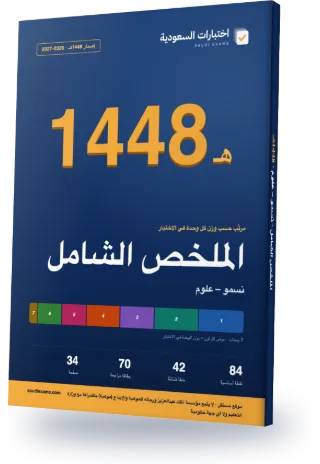 Complete Review Guide 2026–2027 included (PDF)Ordered by the weight of each unit in the examBuy now · SAR 34or 7 days for SAR 26
See everything included
Full mock exams like the real one and 514 explained questions that find your weak spots and train them
- Unlimited full mock exams to practise your pace and check your performance across the whole exam
- Practise 10 weak-area questions, starting where you lose the most marks
- 514 questions explaining why every option is right or wrong
- Arabic and English with one pass
- Unit notes and flashcards, then questions to check your understanding
The Cities and Provinces test is the first gate on the NSMO path: students who pass it train and continue through the later stages to the finals and then the national-team programs for the international olympiads. Source Last verified: 2026-11-18
Sources and references
- موهبة: أولمبياد الموهبة الوطني (المسار العلمي نسمو) mawhiba.sa
- موهبة: الحقيبة العلمية للمرحلة الأولى – العلوم mawhiba.sa
- موهبة: نموذج اختبار العلوم 2026 mawhiba.sa
- موهبة: مفتاح إجابات نموذج العلوم mawhiba.sa