Try the questions in the test above first, then open each one here to see the correct answer and why every other option is wrong.
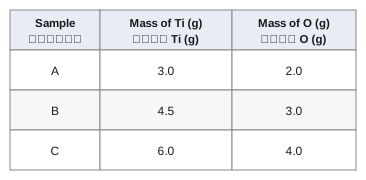
01A plant in Jubail is developing a high-temperature resistant ceramic material based on titanium oxide to be used in furnace linings and solar power plants. To check the consistency of the composition of this oxide from two different production lines, the quality control department analysed three pure samples and obtained the data in the table (sample A: 3.0 g Ti, 2.0 g O; sample B: 4.5 g Ti, 3.0 g O; sample C: 6.0 g Ti, 4.0 g O). Assume the approximate molar masses: Ti = 48 g/mol, O = 16 g/mol. Do the data support the law of definite proportions for a single compound of Ti and O, and what is the simplest empirical formula of this oxide?
Past exam question Unit: Atomic Structure and the Periodic Table
AThe data do not support the law of definite proportions, and the likely formula is Ti₂O₃.
The samples all share Ti:O mass ratio 1.5, so composition is fixed; Ti₂O₃ would require a different 2:3 ratio.
BThe data support the law of definite proportions, and the likely empirical formula is TiO₂. ✓ Correct answer
3.0/48 = 0.0625 mol Ti and 2.0/16 = 0.125 mol O, giving a 1:2 formula ratio.
CThe data support the presence of two different compounds, TiO and TiO₂.
Same Ti:O mass ratios in all samples show one compound, not two; identical proportions do not imply mixed oxides.
DNo conclusion about the law of definite proportions can be drawn without knowing the ionization energies of titanium.
Ionization energies are irrelevant here; definite proportions are judged from constant mass ratios, not from how easily atoms lose electrons.
Reference: NSMO Cities and Provinces Test – Science (Mawhiba, 2026), Chemistry section, Question 1, with the published answer key
02Which of the following ions would have the most unpaired electrons?
Past exam question Unit: Atomic Structure and the Periodic Table
AMn²⁺ ✓ Correct answer
Mn²⁺ is [Ar]3d⁵, so five d electrons remain unpaired by Hund’s rule, more than the others.
BNi³⁺
Ni³⁺ becomes [Ar]3d⁷, giving three unpaired electrons; students often overcount because they forget 4s electrons are removed first.
CTi²⁺
Ti²⁺ is [Ar]3d², so only two electrons are unpaired; this is fewer than in Mn²⁺.
DCr⁶⁺
Cr⁶⁺ loses all valence electrons and becomes [Ar], so there are no unpaired electrons left.
Reference: NSMO Cities and Provinces Test – Science (Mawhiba, 2026), Chemistry section, Question 5, with the published answer key
Ask a friend
03Which of the following compounds exhibits the strongest ionic attraction?
Past exam question Unit: Chemical Bonding
ALiI
LiI has only 1+ and 1− ions, and its large iodide ion weakens attraction, so it is not the strongest lattice.
BNaCl
NaCl is strongly ionic, but it still uses 1+ and 1− ions; the charges are smaller than in magnesium fluoride.
CMgF₂ ✓ Correct answer
MgF₂ has a 2+ cation and very small F− ions, so electrostatic attraction is greatest here.
DKBr
KBr is an ionic compound, but both ions are relatively large and singly charged, giving weaker attraction than MgF₂.
Reference: NSMO Cities and Provinces Test – Science (Mawhiba, 2026), Chemistry section, Question 6, with the published answer key
Ask a friend
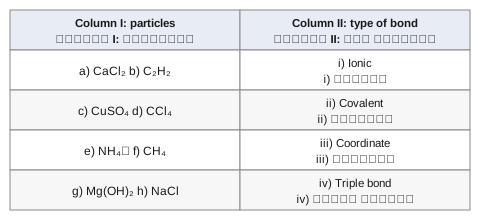
04Match the particles in column I with the types of internal bonds they contain in column II, then choose the correct answer. Note: there may be more than one correct match. Column I: a) CaCl₂, b) C₂H₂, c) CuSO₄, d) CCl₄, e) NH₄⁺, f) CH₄, g) Mg(OH)₂, h) NaCl. Column II: i) ionic, ii) covalent, iii) coordinate, iv) triple bond.
Past exam question Unit: Chemical Bonding
Ai: a, c, h | ii: b, d, e, g | iii: c, e | iv: a
This misses Mg(OH)₂ as ionic, wrongly labels CuSO₄ as coordinate, and even puts CaCl₂ in the triple-bond group.
Bi: a, c, g, h | ii: b, c, d, e, f, g | iii: e | iv: b ✓ Correct answer
This matches all four types: ionic salts include CaCl₂, CuSO₄, Mg(OH)₂, NaCl; NH₄⁺ is coordinate; C₂H₂ has a triple bond.
Ci: a, c, g, h | ii: b, c, d | iii: d | iv: g
It wrongly treats CCl₄ as coordinate and Mg(OH)₂ as triple-bonded, while excluding several covalent species such as NH₄⁺ and CH₄.
Di: a, h | ii: b, d, e, h | iii: b | iv: c
NaCl is not covalent, and CuSO₄ has no triple bond; this choice also leaves out Mg(OH)₂ from the ionic group.
Reference: NSMO Cities and Provinces Test – Science (Mawhiba, 2026), Chemistry section, Question 8, with the published answer key
05During an experiment to measure the dimensions of a sample, a student decided to convert the unit of measurement from metres to centimetres when recording the length of the object. Which of the following statements correctly describes what happens when the unit is changed?
Past exam question Unit: Physics and Measurement
AThe physical value of the length itself changes because of changing the unit.
The actual length does not change; only the unit changes, so this reverses the idea of measurement.
BThe measured quantity changes while the numerical value remains the same.
The measured quantity is still the same length, but the numerical value changes when centimetres replace metres.
CThe physical quantity remains the same, but the numerical value changes according to the new unit. ✓ Correct answer
A measurement is number times unit; changing from m to cm changes the number, not the physical length.
DThe type of physical quantity changes, becoming a derived quantity instead of a fundamental one.
Length stays a fundamental quantity; changing units never turns it into a derived quantity.
Reference: NSMO Cities and Provinces Test – Science (Mawhiba, 2026), Physics section, Question 6, with the published answer key
Ask a friend
06A body has a mass of m = 2.0 kg and a density of ρ_b = 800 kg/m³. When it is fully submerged in a fluid, its apparent weight becomes half of its weight in air. What is the density of the fluid?
Past exam question Unit: Introduction to Fluids
A200 kg/m³
If the fluid were 200 kg/m³, buoyancy would be only one-quarter of the weight, leaving three-quarters apparent weight.
B400 kg/m³ ✓ Correct answer
Here the buoyant force equals half the weight, so ρfluid/ρbody = 1/2 and ρfluid = 400 kg/m³.
C600 kg/m³
A 600 kg/m³ fluid would give buoyancy equal to three-quarters of the weight, not one-half.
D800 kg/m³
If the fluid density were 800 kg/m³, the body would be neutrally buoyant when fully submerged, so apparent weight would vanish.
Reference: NSMO Cities and Provinces Test – Science (Mawhiba, 2026), Physics section, Question 7, with the published answer key
Ask a friend
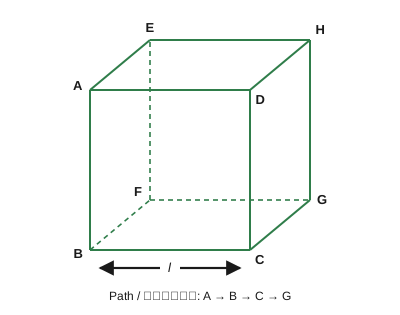
07A cube has a side length of l. What is the magnitude of the displacement of an ant that moved from point A to point G via the path A → B → C → G shown in the figure?
Past exam question Unit: Motion in One Dimension
A3l
3l is the total path length A→B→C→G, not the straight-line displacement between the starting and ending points.
B2l
2l is too short for a body moving from one cube corner to the opposite corner; the diagonal is longer.
Cl√3 ✓ Correct answer
A and G are opposite corners, so displacement is the space diagonal: √(l²+l²+l²) = l√3.
Dl√2
l√2 is a face diagonal, not the full three-dimensional diagonal from A to G across the cube.
Reference: NSMO Cities and Provinces Test – Science (Mawhiba, 2026), Physics section, Question 4, with the published answer key
08A scientist is researching plant growth in a greenhouse. She is aiming to produce fast-growing plants that can be used for the production of carbon-neutral biofuel. She is concerned that her greenhouse is getting too hot from too much light. She decides to shade the greenhouse with coloured translucent plastic sheets. What colour of sheets should she choose to reduce the overall light energy entering the greenhouse, while maximising plant growth?
Past exam question Unit: The Cell: Structure, Chemistry and Energy
AGreen
Green passes mainly green light, which chlorophyll uses poorly, so it reduces energy less effectively than blue.
BBlue ✓ Correct answer
Blue light is strongly absorbed by chlorophyll, while a blue sheet blocks much of the rest, reducing total energy and supporting growth.
COrange
Orange lets through wavelengths plants use less efficiently than blue; it is not the best choice for growth.
DAny colour will do
Any colour is not equivalent: different colours transmit different wavelengths, and plant absorption depends strongly on wavelength.
Reference: NSMO Cities and Provinces Test – Science (Mawhiba, 2026), Biology section, Question 2, with the published answer key
Ask a friend
09The diagram represents the cell cycle of a human cell (G1, S, G2, mitosis M and cytokinesis C). During the cell cycle the number of chromatids changes. Which row is correct for the number of chromatids in M, G1 and G2?
Past exam question Unit: Cell Division and Ecology
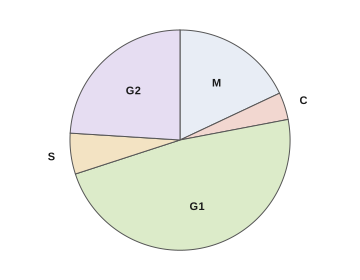
AG2: 92, G1: 46, M: 46
G1 is not 46 and M is not 46 here; after DNA replication, G2 and M contain doubled chromatids.
BG2: 92, G1: 92, M: 46
G1 has 46 chromatids, but G1 is not 92; only after S phase does the chromosome duplicate.
CG2: 92, G1: 46, M: 92 ✓ Correct answer
G1 has 46 chromatids, G2 has 92, and M still has 92 chromatids before sister chromatids separate.
DG2: 92, G1: 92, M: 92
G1 is not 92 chromatids; that would require prior DNA replication, which happens only after G1.
Reference: NSMO Cities and Provinces Test – Science (Mawhiba, 2026), Biology section, Question 8, with the published answer key
10During meiosis, the cell undergoes a series of precise changes in chromosome structure and centriole number. A researcher examined a cell in anaphase II and found that it contains 12 chromosomes resulting from separated sister chromatids. What is the number of chromosomes and the number of centrioles in a cell of the same organism at the end of prophase I?
Past exam question Unit: Cell Division and Ecology
A12 chromosomes, 4 centrioles ✓ Correct answer
At anaphase II, 12 chromosomes means the organism has 2n = 12, so prophase I still has 12 duplicated chromosomes and 4 centrioles.
B6 chromosomes, 4 centrioles
Six chromosomes would be the haploid number, but prophase I is diploid, so this choice halves the chromosome count incorrectly.
C12 chromosomes, 2 centrioles
Two centrioles ignores centrosome duplication before meiosis I; by prophase I, each centrosome has duplicated, giving four centrioles.
D6 chromosomes, 2 centrioles
This mixes up haploid and diploid numbers; prophase I is still 2n, not 6 chromosomes, even though chromatids have duplicated.
Reference: NSMO Cities and Provinces Test – Science (Mawhiba, 2026), Biology section, Question 4, with the published answer key
Ask a friend