Bebras Mawhiba Computational Thinking Challenge
Bebras Mawhiba Computational Thinking Challenge — Number of questions: 10 questions. Exam time: 60 minutes. Pass mark: There is no pass mark; gold, silver and bronze medals are awarded by cut scores out of 400 for each grade. Exam fee: SAR 60 guardian contribution at registration. Next test: 5 December 2026. Source: King Abdulaziz & His Companions Foundation for Giftedness and Creativity (Mawhiba), in partnership with the Ministry of Education (Last verified: 2026-11-18). Question bank: full mock exams of 10 questions in 60 minutes, like the real test with a result for every unit, plus 503 explained questions across 4 units, every option explained, a review of your mistakes, and two ways to practise: see the answer right away, or sit a full timed mock. Free questions: a 10-question diagnostic test covering the main units, no sign-up; at the end you get your score and your weakest units. With lifetime access: the Complete Review Guide, a 22-page PDF ordered by unit weight; chapter 1 is free to read on the guide page.
Last verified on the King Abdulaziz & His Companions Foundation for Giftedness and Creativity (Mawhiba), in partnership with the Ministry of Education website: 18 November 2026
If you sat the exam today, what would you score?
10 free questions · no sign-up · your score as soon as you finish
Question 1 of 10
Five friends meet, and every two of them shake hands exactly once. How many handshakes are there?
All 10 free questions with answers and an explanation for every option
Where the questions come from
- Algorithms and Programming3 questions
- Data and Representation2 questions
- Graphs and Networks3 questions
- Logic and Evaluation2 questions
Exam facts
- Exam language
- Arabic or English
- Number of questions
- 10 questions Source
- Exam time
- 60 minutes Source
- Pass mark
- There is no pass mark; gold, silver and bronze medals are awarded by cut scores out of 400 for each grade Source
- Exam fee
- SAR 60 guardian contribution at registration Source
- Registration
- Registration on the contest website bebrasksa.org from 6 October to 22 November 2026 Source
- Results
- Results are announced on 5 January 2027, and medals are handed to the gifted-education offices in the education departments on 5 February 2027 Source
Last verified: 2026-11-18
Where other sources differ
- The real contest uses interactive tasks (drag, drop and click on screen) with four levels each. Our questions are written as multiple choice to train the same way of thinking; they do not copy the contest's format.
- The question language is chosen once at the start and cannot be changed, so practise in the language your student will pick.
- Cut scores differ by grade; Mawhiba has not confirmed whether the tasks themselves differ between grades.
- 10 tasks × 40 points = 400; each level is worth 10 points, and solving level 4 directly earns all 40
Exam body
King Abdulaziz & His Companions Foundation for Giftedness and Creativity (Mawhiba), in partnership with the Ministry of Education: Official website: King Abdulaziz & His Companions Foundation for Giftedness and Creativity (Mawhiba), in partnership with the Ministry of Education
How to register
- Open the official contest website bebrasksa.org and register the student during the registration period (6 October to 22 November 2026).
- The contest is for general-education students in Saudi Arabia from grade 3 primary to grade 3 secondary, and the guardian contribution is paid at registration.
- The student code arrives after registration; the practice test on the website is open until 29 November 2026.
- On contest day (5 December 2026 at 2:00 pm) enter from Google Chrome, click “Compete”, enter the student code and choose the question language (Arabic or English), which cannot be changed later.
- Results are announced on 5 January 2027, and medals are sent to the education departments on 5 February 2027.
Study guides (1)
Frequently asked questions
How many tasks are in Bebras Mawhiba and how long is it?
10 interactive tasks in 60 minutes; each task has 4 levels worth 10 points each, for a full score of 400, according to the 2026 contest manual. Our questions are written as multiple choice.
Can I try Bebras Mawhiba questions for free?
Yes. Free questions: a 10-question diagnostic test covering the main units, no sign-up; at the end you get your score and your weakest units. The free practice test page lists the same questions with answers and an explanation for every option. The rest of the questions and the full mock exams come with a pass from SAR 26.
What makes this Bebras Mawhiba question bank different?
Question bank: full mock exams of 10 questions in 60 minutes, like the real test with a result for every unit, plus 503 explained questions across 4 units, every option explained, a review of your mistakes, and two ways to practise: see the answer right away, or sit a full timed mock. Practice questions and explanations are ready to use on your phone. Try the free questions and read the explanations before you buy.
Is there a PDF review guide for Bebras Mawhiba?
Yes. "Bebras Mawhiba Complete Review Guide 2026–2027" is a 22-page Arabic PDF: 4 units ordered from the heaviest in the exam to the lightest, each chapter with key points, common mistakes and review cards, plus a 7-day plan. Chapter 1 is free to read on the guide page; the full guide comes with lifetime access to this exam and is not part of 7-day access. The guide has no questions: scoring, practice and mock exams are on the site.
Who can take part?
General-education students in Saudi Arabia from grade 3 primary to grade 3 secondary, registered through the contest website bebrasksa.org.
When is the contest and how do I register?
Registration runs from 6 October to 22 November 2026, the contest is on 5 December 2026 at 2:00 pm online, and results come on 5 January 2027. Check the contest website for any update.
What topics do the tasks cover?
Bebras tasks measure computational thinking without programming: algorithms, data representation, graphs and networks, and logic. Our question bank is split across these four areas.
What score do I need for a medal?
There is no pass mark; Mawhiba sets cut scores for each grade. In 2025, for example, gold was 310 for grade 3 primary and 390 for grade 3 secondary, out of 400.
Is the mock score here an official score?
No. This is an independent website with no link to Mawhiba, the Ministry of Education or any government body. Our questions are practice questions written in the style of Bebras tasks, and the result is an estimate of your level, not an official result.
Is this an official site, and how do I pay?
It is an independent site, not part of Qiyas, this exam's regulator or any government body, with practice questions and answer explanations. You pay once, with no automatic renewal, through Waffo Pancake (the merchant of record) by Visa, Mastercard, Apple Pay or Google Pay, and your statement shows "WAFFO". If you were charged twice or the pass did not open, email support@saudiexams.com.
Bebras Mawhiba Complete Review Guide 2026–2027
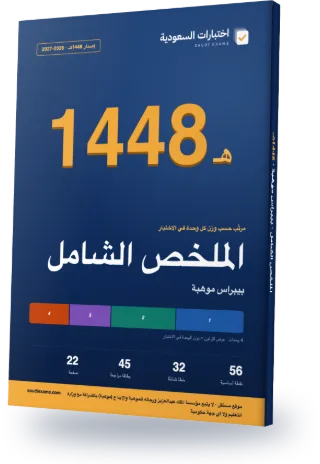
22-page · 56 key points · 32 common mistakes · 45 review cards
The first three chapters alone cover about 80% of the exam. Short on time? Start there.
About the question bank
Bebras Mawhiba: 10 interactive tasks in 60 minutes, each with 4 levels, a full score of 400, and medals awarded by cut scores for each grade. We picked 503 questions on algorithms, data, graphs and logic so your student practises the way of thinking before contest day.
- 503 questions in the bank
- 10 questions in 60 min per mock
- 45 flashcards
Every option explained so you understand why
What you get
- 503questions in the bankPractise with the answer shown right away, or sit a full timed mock
- 4unitsSplit by the exam syllabus
- 45flashcardsTo lock in terms and definitions
- 56quick review pointsEach unit in a few key lines
Study material sample: Algorithms and Programming
Summary
Algorithms and Programming is the largest unit in our practice, and we estimate it matches about 3 of the 10 contest tasks. It starts with following instructions step by step: a robot moving on a grid, a machine changing a number, or a recipe that must run in order. Then come loops and conditions: how many times an action repeats and when it stops. Then searching and sorting: halving a sorted list, counting swaps and comparing methods. It ends with functions, arrays and remainders, recursion such as the Tower of Hanoi, and splitting a big problem into smaller parts. Most mistakes come from skipping a step or counting off by one, so write the state after every step in a small table.
What the exam focuses on · Common traps · Try the flashcards
What the exam focuses on
- Tracing an algorithm means running it exactly as written, not as you expect it to work; record the values after every step.
- A loop “repeat n times” runs its body n times; a “repeat until” loop stops as soon as the condition holds, and may run only once.
- Binary search in a sorted list halves the range each time, so a list of 100 items needs at most 7 guesses.
Show 5 more
- The number of adjacent swaps needed to sort equals the number of pairs that are out of order.
- Remainders describe repeating cycles: the weekday 100 days from now depends on the remainder of 100 divided by 7.
- A function takes an input and returns an output; when two functions are combined, apply the inner one first.
- Recursion solves a problem by solving a smaller copy of it: moving n discs in the Tower of Hanoi takes 2 to the power n minus 1 moves.
- Decomposition: split a big task into small independent tasks, then order them by which depends on which.
Common traps
- Off-by-one counting: from step 3 to step 10 there are 8 steps, not 7.
- Forgetting the loop's final check, so it stops one round early or runs one round too many.
- Mixing up right and left turns when the robot is facing down.
Show 5 more
- Assuming binary search works on an unsorted list.
- Counting comparisons instead of swaps, or the reverse, when the question asks about only one.
- Forgetting that remainders start at 0: the remainder when dividing by 7 is between 0 and 6.
- In recursion, ignoring the base case where the calls stop.
- Applying two combined functions in the wrong order.
Try the flashcards
Tap a card to see the answer
How many guesses always suffice to find a number from 1 to 100 by halving?
7 guesses, because 2 to the power 7 = 128 is more than 100.
How many moves to move 4 discs in the Tower of Hanoi?
15 moves.
An outer loop of 3 with an inner loop of 4: how many times does the inner command run?
12 times.
What is the remainder of 100 divided by 7?
2, because 7 × 14 = 98.
How many comparisons to compare every pair of 6 items?
15, that is 6 × 5 ÷ 2.
The list 3, 1, 2: how many adjacent swaps sort it in ascending order?
2, because it has two out-of-order pairs: (3, 1) and (3, 2).
When does binary search not work?
When the list is not sorted.
The colour pattern “red, blue, green” repeats: what colour is item 10?
Red, because the remainder of 10 divided by 3 is 1.
Why you can trust these questions
- Published questions: 503. Read the explanations and references, and report any error from the question.
- Exam facts last checked against the organiser’s website: 2026-11-18. We check them again every three months and two weeks before each test.
- Found a mistake? Tap "Report an error" under any question in the practice area, or email us at support@saudiexams.com
- Independent website. Not affiliated with ETEC (Qiyas), the Financial Academy, ACAMS, the ACFE, DAMA, CompTIA, Saudi Aramco or any government body.
Update log
- 2026-11-18 Added Bebras Mawhiba 2026 facts from the official contest website and the 2026 contest manual.
Full prep for this exam
All of this in one purchase.
- Full mock exam, same as the real one10 questions in 60 minutes. You get a total score and a score for every unit.
- Practice unit by unit503 questions, every option explained with its source. Starts with your weakest units.
- Complete Review Guide 2026–2027 (PDF)Ordered by each unit's weight in the exam. With lifetime access only.
Choose your access
Continue with your Google account and you go straight to the payment page.