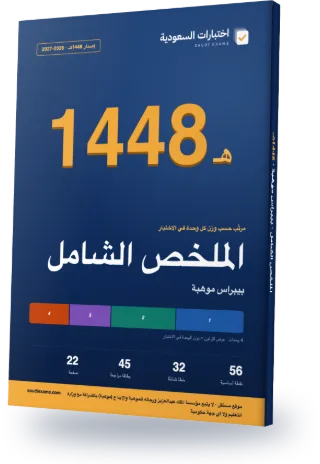
Bebras Mawhiba Complete Review Guide 2026–2027
Every exam topic in a 22-page Arabic PDF, ordered from the heaviest unit to the lightest. The first three chapters alone cover about 80% of the exam questions.
- 22Pages
- 56Key points
- 32Common mistakes
- 45Flashcards
Guide map
Each chapter is one exam unit, ordered by its weight in the real exam.
| Chapter | Unit | Weight | Exam questions | Key points |
|---|---|---|---|---|
| 1 | Algorithms and Programming | 30% | 3 | 15 |
| 2 | Graphs and Networks | 30% | 3 | 14 |
| 3 | Data and Representation | 20% | 2 | 14 |
| 4 | Logic and Evaluation | 20% | 2 | 13 |
Chapter 1 in full: Algorithms and Programming
30% of the exam, about 3 questions. These are its key points, as in the guide.
- (Tracing algorithms and planning) Make a table with a column per variable and a row per step; it is faster than tracing in your head.
- (Tracing algorithms and planning) In grid tasks, note the current direction before every “turn” command.
- (Tracing algorithms and planning) To work backwards, start from the result and undo each step in reverse order.
The rest of chapter 1, on this page
- (Loops and precise instructions) A nested loop runs outer count × inner count times.
- (Loops and precise instructions) Look for the repeating pattern in a list of commands and write it as a loop to shorten it.
- (Loops and precise instructions) Precise instructions leave the follower no choice; if two outcomes are possible, the instructions are incomplete.
- (Searching and sorting) Linear search in n items needs n comparisons in the worst case; binary search needs about the number of times n can be halved.
- (Searching and sorting) Selection sort puts the smallest remaining item in place in each round.
- (Searching and sorting) Comparing every pair of n items takes n × (n − 1) ÷ 2 comparisons.
- (Functions, arrays and remainders) Array slots are numbered in order; check whether the question starts numbering at 0 or at 1.
- (Functions, arrays and remainders) To find item number n in a pattern of length k, use the remainder of n divided by k.
- (Functions, arrays and remainders) The same function always gives the same output for the same input.
- (Recursion and decomposition) Tower of Hanoi: 1, 3, 7, 15, 31 moves for one to five discs.
- (Recursion and decomposition) In nested patterns, work out the smallest level first, then build on it.
- (Recursion and decomposition) Independent tasks can run at the same time; dependent tasks wait for the tasks before them.
Common mistakes in this chapter
- Off-by-one counting: from step 3 to step 10 there are 8 steps, not 7.
- Forgetting the loop's final check, so it stops one round early or runs one round too many.
- Mixing up right and left turns when the robot is facing down.
- Assuming binary search works on an unsorted list.
- Counting comparisons instead of swaps, or the reverse, when the question asks about only one.
- Forgetting that remainders start at 0: the remainder when dividing by 7 is between 0 and 6.
- In recursion, ignoring the base case where the calls stop.
- Applying two combined functions in the wrong order.
The other chapters are in the full guide
One purchase · lifetime access · review guide included
7-day review plan
The chapters are spread over 6 days by weight so each day carries a similar load. Day 7 is a full exam.
Day 1 · 30% of the exam
Chapter 1: Algorithms and Programming
Day 2 · 30% of the exam
Chapter 2: Graphs and Networks
Day 3 · 20% of the exam
Chapter 3: Data and Representation
Day 4 · 20% of the exam
Chapter 4: Logic and Evaluation
Day 5
Full mock exam: 10 questions in 60 minutes, then review the common mistakes in the units where you lost marks.
Before you read: see your score today
10 free questions from the main units, no sign-up. Then you know which chapter to start with.
Try 10 free questions and see your levelA look at each chapter
The first three key points of each chapter, as they appear in the guide (in Arabic in the PDF).
Chapter 1: Algorithms and Programming
- (Tracing algorithms and planning) Make a table with a column per variable and a…
- (Tracing algorithms and planning) In grid tasks, note the current direction before every “turn”…
- (Tracing algorithms and planning) To work backwards, start from the result and undo each…
Chapter 2: Graphs and Networks
- (Graph basics and modelling) Turn the text into a graph
- (Graph basics and modelling) Separate groups
- (Graph basics and modelling) Map colouring
Chapter 3: Data and Representation
- (Stacks and queues) Trace a stack by writing it in a row with the…
- (Stacks and queues) Reverse a word with a stack
- (Stacks and queues) In a circular queue, the new front = (old front +…
Chapter 4: Logic and Evaluation
- (Logic gates) A truth table for two inputs has 4 rows
- (Logic gates) With n inputs, the truth table has 2 to the power n…
- (Logic gates) Work through a circuit from the inputs to the output, one gate…
The full guide comes with lifetime access
The full guide (22 pages) is included with lifetime access to this exam, together with every question and full mock exam. Chapter 1 is free for everyone.
Questions about the guide
Is the guide free?
Chapter 1 is free to read on the guide page. The full guide comes with lifetime access to this exam; 7-day access does not include it.
Is it up to date for 2026–2027?
Yes. Unit weights and exam facts follow what the exam body last published, and the last check date is printed in the guide. If the standards change we update the file and buyers download the new version.
Does the guide have questions?
No. The guide covers key points and common mistakes; scoring, weak-area practice and full mock exams are on the site.
Can I read it on my phone?
Yes. A5 pages in a single column, with chapters linked from the contents.
- Pages
- 22
- Edition
- 1448 AH · 2026–2027
- Language
- Arabic
- Last updated
Full prep for this exam
All of this in one purchase.
- Full mock exam, same as the real one10 questions in 60 minutes. You get a total score and a score for every unit.
- Practice unit by unit503 questions, every option explained with its source. Starts with your weakest units.
- Complete Review Guide 2026–2027 (PDF)Ordered by each unit's weight in the exam. With lifetime access only.
Choose your access
Continue with your Google account and you go straight to the payment page.