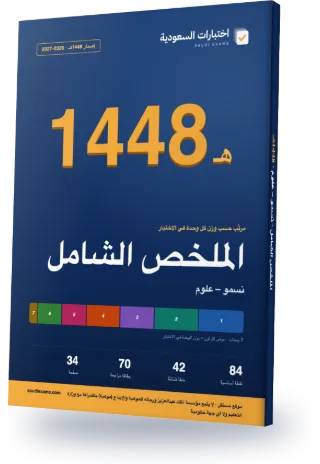
NSMO Science Complete Review Guide 2026–2027
Every exam topic in a 34-page Arabic PDF, ordered from the heaviest unit to the lightest. The first three chapters alone cover about 56% of the exam questions.
- 34Pages
- 84Key points
- 42Common mistakes
- 70Flashcards
Guide map
Each chapter is one exam unit, ordered by its weight in the real exam.
| Chapter | Unit | Weight | Exam questions | Key points |
|---|---|---|---|---|
| 1 | Atomic Structure and the Periodic Table | 20% | 5 | 12 |
| 2 | Cell Division and Ecology | 20% | 5 | 12 |
| 3 | Chemical Bonding | 16% | 4 | 12 |
| 4 | Motion in One Dimension | 16% | 4 | 12 |
| 5 | Introduction to Fluids | 12% | 3 | 12 |
| 6 | The Cell: Structure, Chemistry and Energy | 12% | 3 | 12 |
| 7 | Physics and Measurement | 4% | 1 | 12 |
Chapter 1 in full: Atomic Structure and the Periodic Table
20% of the exam, about 5 questions. These are its key points, as in the guide.
- (Dalton) Matter is made of atoms; atoms of one element are alike, and atoms combine in whole-number ratios.
- (Conservation of mass) In a closed system the total mass of the products equals the total mass of the reactants.
- (Definite proportions) A pure compound always contains the same elements in the same mass ratio, whatever its source.
The rest of chapter 1, on this page
- (Multiple proportions) When two elements form more than one compound, the masses of one that combine with a fixed mass of the other are in a small whole-number ratio.
- (Atomic models) Thomson's model, then Rutherford's nucleus from the gold-foil experiment, then Bohr's energy levels.
- (Particles) Proton +1 and neutron 0 in the nucleus, each about 1 u; the electron −1 with almost no mass.
- (Numbers) Atomic number Z = protons; mass number A = protons + neutrons; neutrons = A − Z.
- (Isotopes) Atoms of one element with different numbers of neutrons, such as carbon-12 and carbon-14.
- (Average atomic mass) Sum of (isotope mass × fractional abundance) over all isotopes.
- (Configuration) Electrons fill levels in order; for example Na is 2, 8, 1 and Na⁺ is 2, 8, like neon.
- (Periodic table) Rows are periods (number of occupied levels); columns are groups with similar outer electrons and properties.
- (Classes) Metals on the left and centre, non-metals on the upper right, metalloids along the staircase, noble gases in group 18.
Common mistakes in this chapter
- Forgetting the gas: a burning metal gains mass because oxygen from the air joins it, and mass is still conserved.
- Treating two compounds of the same elements as one: different mass ratios mean different compounds (multiple proportions).
- Getting the electrons of an ion backwards: X⁻ has one more electron than protons, X²⁺ has two fewer.
- Taking a simple mean of isotope masses instead of weighting each one by its abundance.
- Thinking isotopes differ in protons; they differ only in neutrons, so they have the same chemistry.
- Ordering the table by atomic mass: argon (Z = 18) comes before potassium (Z = 19) although it is heavier.
The other chapters are in the full guide
One purchase · lifetime access · review guide included
7-day review plan
The chapters are spread over 6 days by weight so each day carries a similar load. Day 7 is a full exam.
Day 1 · 20% of the exam
Chapter 1: Atomic Structure and the Periodic Table
Day 2 · 20% of the exam
Chapter 2: Cell Division and Ecology
Day 3 · 16% of the exam
Chapter 3: Chemical Bonding
Day 4 · 16% of the exam
Chapter 4: Motion in One Dimension
Day 5 · 16% of the exam
Chapter 5: Introduction to Fluids
Chapter 7: Physics and MeasurementDay 6 · 12% of the exam
Chapter 6: The Cell: Structure, Chemistry and Energy
Day 7
Full mock exam: 25 questions in 120 minutes, then review the common mistakes in the units where you lost marks.
Before you read: see your score today
10 free questions from the main units, no sign-up. Then you know which chapter to start with.
Try 10 free questions and see your levelA look at each chapter
The first three key points of each chapter, as they appear in the guide (in Arabic in the PDF).
Chapter 1: Atomic Structure and the Periodic Table
- (Dalton) Matter is made of atoms; atoms of one element are alike, and atoms…
- (Conservation of mass) In a closed system the total mass of the products equals…
- (Definite proportions) A pure compound always contains the same elements in the same mass…
Chapter 2: Cell Division and Ecology
- (Cell cycle) Interphase (G1, S, G2) then mitosis and cytokinesis; most of the cycle…
- (Mitosis) Prophase, metaphase, anaphase, telophase; it gives two identical diploid cells.
- (Regulation) Checkpoints and proteins such as cyclins control the cycle; uncontrolled division leads to…
Chapter 3: Chemical Bonding
- (Ions) Metals lose electrons to form cations; non-metals gain electrons to form anions with…
- (Ionic bond) Electrostatic attraction between oppositely charged ions in a repeating crystal lattice.
- (Lattice strength) Higher charges and smaller ions give a stronger attraction and a higher…
Chapter 4: Motion in One Dimension
- (Scalars and vectors) A scalar has size only (distance, speed); a vector has size…
- (Displacement) Δx = x_final − x_initial; it can be negative or zero even when…
- (Average speed) Total distance ÷ total time.
Chapter 5: Introduction to Fluids
- (Density) ρ = m/V; water is 1000 kg/m³ = 1 g/cm³.
- (Irregular volume) The rise in water level in a measuring cylinder equals the object's…
- (Pressure) P = F/A, measured in pascals
Chapter 6: The Cell: Structure, Chemistry and Energy
- (Cell theory) All living things are made of cells; the cell is the basic…
- (Cell types) Prokaryotes have no nucleus or membrane-bound organelles; eukaryotes have both.
- (Plant cells) Have a cell wall, chloroplasts and a large central vacuole as well…
Chapter 7: Physics and Measurement
- (Physics and mathematics) Physics describes nature with equations; check every answer for sensible size…
- (Rearranging) Do the same operation to both sides to isolate the unknown.
- (Quadratics) ax² + bx + c = 0 is solved by factorising or by…
The full guide comes with lifetime access
The full guide (34 pages) is included with lifetime access to this exam, together with every question and full mock exam. Chapter 1 is free for everyone.
Questions about the guide
Is the guide free?
Chapter 1 is free to read on the guide page. The full guide comes with lifetime access to this exam; 7-day access does not include it.
Is it up to date for 2026–2027?
Yes. Unit weights and exam facts follow what the exam body last published, and the last check date is printed in the guide. If the standards change we update the file and buyers download the new version.
Does the guide have questions?
No. The guide covers key points and common mistakes; scoring, weak-area practice and full mock exams are on the site.
Can I read it on my phone?
Yes. A5 pages in a single column, with chapters linked from the contents.
- Pages
- 34
- Edition
- 1448 AH · 2026–2027
- Language
- Arabic
- Last updated
All School Student Exams review guides
Back to National Science and Mathematics Olympiad (NSMO) – Cities and Provinces Test: Science
Full prep for this exam
All of this in one purchase.
- Full mock exam, same as the real one25 questions in 120 minutes. You get a total score and a score for every unit.
- Practice unit by unit514 questions, every option explained with its source. Starts with your weakest units.
- Complete Review Guide 2026–2027 (PDF)Ordered by each unit's weight in the exam. With lifetime access only.
Choose your access
Continue with your Google account and you go straight to the payment page.