GRCP
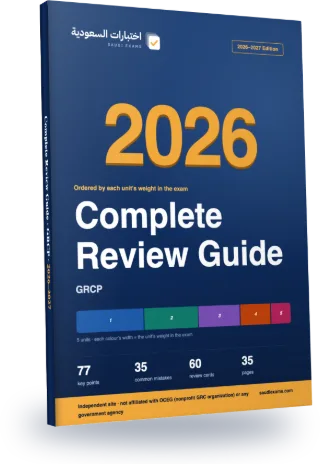
GRCP Complete Review Guide 2026–2027
Every exam topic in a 35-page Arabic PDF, ordered from the heaviest unit to the lightest. The first three chapters alone cover about 75% of the exam questions.
- 35Pages
- 77Key points
- 35Common mistakes
- 60Flashcards
Guide map
Each chapter is one exam unit, ordered by its weight in the real exam.
| Chapter | Unit | Weight | Exam questions | Key points |
|---|---|---|---|---|
| 1 | GRC Key Concepts | 30% | 30 | 15 |
| 2 | Perform: Actions and Controls | 25% | 25 | 17 |
| 3 | Align: Direction, Objectives and Strategy | 20% | 20 | 15 |
| 4 | Learn: Context and Culture | 15% | 15 | 15 |
| 5 | Review: Monitoring, Assurance and Improvement | 10% | 10 | 15 |
Chapter 1 in full: GRC Key Concepts
30% of the exam, about 30 questions. These are its key points, as in the guide.
- (Governance) Governance links objectives, strategy, oversight, and accountability so the organization is directed and controlled in a coherent way.
- (Objectives) Clear objectives are the starting point for performance, risk assessment, and control design.
- (Strategy) Strategy choices and risk choices are connected; major strategic decisions should consider uncertainty, trade-offs, and capacity.
The rest of chapter 1, on this page
- (Risk) Risk is meaningful only in relation to objectives, because uncertainty matters when it can affect what the organization is trying to achieve.
- (Risk appetite) Risk appetite expresses the amount and type of risk the organization is willing to pursue or retain in support of objectives.
- (Risk tolerance) Risk tolerance sets more specific acceptable variation or limits around objectives, activities, or measures.
- (Inherent and residual risk) Inherent risk is the level of risk before responses or controls; residual risk is what remains after them.
- (Risk owner) A risk owner is the person or role accountable for managing a specific risk and for ensuring responses are carried out.
- (Three lines) In the three lines model, the first line manages, the second line advises and oversees, and the third line provides independent assurance.
- (Internal control) Internal control is a process used to provide reasonable assurance that objectives will be achieved in operations, reporting, and compliance.
- (Control environment) The control environment includes integrity, values, oversight, structure, authority, responsibility, competence, and accountability.
- (Control types) A strong control set usually mixes ضابط وقائي, ضابط كشفي, and ضابط تصحيحي controls rather than relying on one type alone.
- (Segregation of duties) Segregation of duties reduces the chance that one person can initiate, approve, execute, and hide an improper action.
- (Compliance program) An effective compliance program is risk-based and includes standards, training, reporting channels, investigation, discipline, due diligence, monitoring, and remediation.
- (Effectiveness and indicators) KPI measures performance, KRI signals changing exposure, and effectiveness testing checks whether the process or control actually works; maturity shows how developed the capability is.
Common mistakes in this chapter
- Wrong belief: Governance is only a board matter. Correct view: Governance involves the board, management, information flows, oversight, and accountability across the organization.
- Wrong belief: Good risk management means taking as little risk as possible. Correct view: Good risk management supports objectives by taking, avoiding, reducing, sharing, or accepting risk in a deliberate way.
- Wrong belief: Compliance is the job of the legal or compliance team only. Correct view: Management and staff in the business own day-to-day compliance, while compliance specialists support, advise, and oversee.
- Wrong belief: Internal audit owns risk management and controls. Correct view: Management owns risks and controls; internal audit provides independent assurance on governance, risk management, and control.
- Wrong belief: More controls always mean better control. Correct view: Controls should be proportionate, targeted, and workable. Too many poorly designed controls can hide responsibility and create workarounds.
- Wrong belief: If training was completed and policies exist, the compliance program is effective. Correct view: Effectiveness depends on whether the program works in practice, finds issues, responds, and improves behavior.
- Wrong belief: A mature process is automatically effective. Correct view: Maturity and effectiveness are related but different. A process can look formal and still fail to achieve objectives or control risk.
The other chapters are in the full guide
One purchase · lifetime access · review guide included
7-day review plan
The chapters are spread over 6 days by weight so each day carries a similar load. Day 7 is a full exam.
Day 1 · 30% of the exam
Chapter 1: GRC Key Concepts
Day 2 · 25% of the exam
Chapter 2: Perform: Actions and Controls
Day 3 · 20% of the exam
Chapter 3: Align: Direction, Objectives and Strategy
Day 4 · 15% of the exam
Chapter 4: Learn: Context and Culture
Day 5 · 10% of the exam
Chapter 5: Review: Monitoring, Assurance and Improvement
Day 6
Full mock exam: 100 questions in 120 minutes, then review the common mistakes in the units where you lost marks.
How many correct answers do you need?
- Pass mark 70%70 correct out of 100
Before you read: see your score today
10 free questions from the main units, no sign-up. Then you know which chapter to start with.
Try 10 free questions and see your levelA look at each chapter
The first three key points of each chapter, as they appear in the guide (in Arabic in the PDF).
Chapter 1: GRC Key Concepts
- (Governance) Governance links objectives, strategy, oversight, and accountability so the organization is directed and…
- (Objectives) Clear objectives are the starting point for performance, risk assessment, and control design.
- (Strategy) Strategy choices and risk choices are connected; major strategic decisions should consider uncertainty…
Chapter 2: Perform: Actions and Controls
- (Implementing controls) Controls can be manual, automated, or hybrid. The choice depends on risk…
- (Implementing controls) A well-designed control states who performs it, when it happens, what evidence…
- (Policies and procedures) Policies set mandatory expectations. Procedures translate those expectations into steps that…
Chapter 3: Align: Direction, Objectives and Strategy
- (Mission and values) Objective setting should flow from the mission, vision, values, and strategy.
- (Mission and values) Clear objectives are a prerequisite for sound risk assessment and internal…
- (Mission and values) Incentives should support ethical behavior, compliance, and the long-term objectives of…
Chapter 4: Learn: Context and Culture
- (External context) Legal and regulatory requirements are only one part of external context; market…
- (External context) Enforcement trends can change risk even when the written rule has not…
- (Internal context) Strategy choices affect risk exposure, control needs, and compliance priorities.
Chapter 5: Review: Monitoring, Assurance and Improvement
- (Monitoring) Ongoing evaluations are built into normal operations and use routine information from the…
- (Monitoring) Separate evaluations are periodic or ad hoc reviews used when risk, change, or…
- (Monitoring) The frequency and scope of monitoring should be risk-based, not uniform across all…
The full guide comes with lifetime access
The full guide (35 pages) is included with lifetime access to this exam, together with every question and full mock exam. Chapter 1 is free for everyone.
Questions about the guide
Is the guide free?
Chapter 1 is free to read on the guide page. The full guide comes with lifetime access to this exam; 7-day access does not include it.
Is it up to date for 2026–2027?
Yes. Unit weights and exam facts follow what the exam body last published, and the last check date is printed in the guide. If the standards change we update the file and buyers download the new version.
Does the guide have questions?
No. The guide covers key points and common mistakes; scoring, weak-area practice and full mock exams are on the site.
Can I read it on my phone?
Yes. A5 pages in a single column, with chapters linked from the contents.
- Pages
- 35
- Edition
- 1448 AH · 2026–2027
- Language
- Arabic
- Last updated
Full prep for this exam
All of this in one purchase.
- Full mock exam, same as the real one100 questions in 120 minutes. You get a total score and a score for every unit.
- Practice unit by unit624 questions, every option explained with its source. Starts with your weakest units.
- Complete Review Guide 2026–2027 (PDF)Ordered by each unit's weight in the exam. With lifetime access only.
Choose your access
Continue with your Google account and you go straight to the payment page.