Saudi Board Part One Examination – Neurology
Saudi Board Part One Examination – Neurology — Number of questions: 150 questions. Exam time: Confirm with the exam body. Pass mark: 65%. Exam fee: Registration is automatic and free for eligible trainees. Source: Saudi Commission for Health Specialties (SCFHS) (Last verified: 2026-11-25). Question bank: A site supplementary practice session of 150 questions in 90 minutes with a result for every unit, plus 624 explained questions across 8 units, every option explained, a review of your mistakes, and two ways to practise: see the answer right away, or sit a full timed mock. Free questions: a 10-question diagnostic test covering the main units, no sign-up; at the end we compare your score with the pass mark and show your weakest units. With lifetime access: the Complete Review Guide, a 65-page PDF ordered by unit weight; chapter 1 is free to read on the guide page.
Last verified on the Saudi Commission for Health Specialties (SCFHS) website: 25 November 2026
If you sat the exam today, what would you score?
10 free questions · no sign-up · your score as soon as you finish
Question 1 of 10
A 110-kg man with acute ischaemic stroke 2 hours from onset is eligible for intravenous alteplase. Which dosing regimen is correct?
All 10 free questions with answers and an explanation for every option
Where the questions come from
- Cerebrovascular Diseases24 questions
- Epilepsy, Psychiatry, Sleep and Paediatric Neurology24 questions
- Neuromuscular and Related Disorders24 questions
- Demyelinating Disease, Multiple Sclerosis and Spinal Cord17 questions
- Movement Disorders and Neuro-ophthalmology17 questions
- Dementia, Neoplasia and Paraneoplastic Disorders16 questions
- Pain, Headache and Neurology of Systemic Disease16 questions
- CNS Infection12 questions
Exam facts
- Exam language
- English
- Number of questions
- 150 questions Source
- Exam time
- Confirm with the exam body
- Pass mark
- 65% Source
- Exam fee
- Registration is automatic and free for eligible trainees Source
Last verified: 2026-11-25
Where other sources differ
- The current blueprint covers 2024–2027 (v.1); each section may vary by ±5%. Research, ethics, professionalism and patient safety are incorporated within the various domains.
Exam body
Saudi Commission for Health Specialties (SCFHS): Official website: Saudi Commission for Health Specialties (SCFHS)
How to register
- The system registers you automatically once you have completed nine months of training in a Saudi Board programme with valid registration.
- You are notified of the date and city on Mumaris+.
- The exam is held once a year, and you have a maximum of four attempts.
Study guides (3)
Frequently asked questions
How many questions are in Part One and what is the pass mark?
150 single-best-answer questions, plus up to 10% unscored pretest items. The pass mark is 65%; it can be lowered one mark at a time to a floor of 60% if fewer than 70% pass, according to the published blueprint.
Can I try Saudi Board Neurology Part 1 questions for free?
Yes. Free questions: a 10-question diagnostic test covering the main units, no sign-up; at the end we compare your score with the pass mark and show your weakest units. The free practice test page lists the same questions with answers and an explanation for every option. The rest of the questions and the full mock exams come with a pass from SAR 26.
What makes this Saudi Board Neurology Part 1 question bank different?
Question bank: A site supplementary practice session of 150 questions in 90 minutes with a result for every unit, plus 624 explained questions across 8 units, every option explained, a review of your mistakes, and two ways to practise: see the answer right away, or sit a full timed mock. Practice questions and explanations are ready to use on your phone. Try the free questions and read the explanations before you buy.
Is there a PDF review guide for Saudi Board Neurology Part 1?
Yes. "Saudi Board Neurology Part 1 Complete Review Guide 2026–2027" is a 65-page Arabic PDF: 8 units ordered from the heaviest in the exam to the lightest, each chapter with key points, common mistakes and review cards, plus a 7-day plan. Chapter 1 is free to read on the guide page; the full guide comes with lifetime access to this exam and is not part of 7-day access. The guide has no questions: scoring, practice and mock exams are on the site.
What does Saudi Board Neurology Part 1 cover, and how is it split by section?
150 questions, split by the published weights as follows: Cerebrovascular Diseases (24); Epilepsy, Psychiatry, Sleep and Paediatric Neurology (24); Neuromuscular and Related Disorders (24); Demyelinating Disease, Multiple Sclerosis and Spinal Cord (17); Movement Disorders and Neuro-ophthalmology (17); Dementia, Neoplasia and Paraneoplastic Disorders (16); Pain, Headache and Neurology of Systemic Disease (16); CNS Infection (12). Source: SCFHS published blueprint. Counts are rounded from the percentages and each section may vary by up to 5%.
Which language is Saudi Board Neurology Part 1 in?
SCFHS does not state the exam language, but all of its listed references are English textbooks, so our questions are in English. Explanations are in Arabic and English, and you can switch language on any question with one tap.
How do I register for Saudi Board Neurology Part 1?
The system registers you automatically once you have completed nine months of training in a Saudi Board programme with valid registration, and you are notified of the date and city on Mumaris+. The registration service is free.
How many times can I sit the Part One exam?
It is held once a year, and you have a maximum of four attempts, after which the trainee is removed from the programme, according to the SCFHS executive assessment rules.
Is this an official site, and how do I pay?
It is an independent site, not part of Qiyas, this exam's regulator or any government body, with practice questions and answer explanations. You pay once, with no automatic renewal, through Waffo Pancake (the merchant of record) by Visa, Mastercard, Apple Pay or Google Pay, and your statement shows "WAFFO". If you were charged twice or the pass did not open, email support@saudiexams.com.
Saudi Board Neurology Part 1 Complete Review Guide 2026–2027
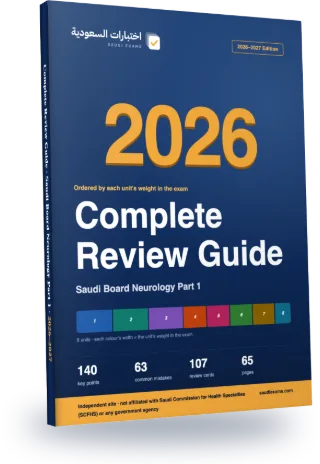
65-page · 140 key points · 63 common mistakes · 107 review cards
The first three chapters alone cover about 48% of the exam. Short on time? Start there.
About the question bank
624 Saudi Board Neurology Part 1 questions across 8 domains. The largest is Cerebrovascular Diseases, 16% of the exam. Every question comes with an answer explanation.
- 150 questions in 90 minutes per site supplementary practice session
- 624 questions covering the main scoring topics, with explanations
- 65% pass mark, with targeted practice on your weak spots
See the gap to your target score Practise the units costing you the most marks Supplementary practice
Every option explained so you understand why
What you get
- 624questions in the bankPractise with the answer shown right away, or sit a full timed mock
- 8unitsSplit by the exam syllabus
- 107flashcardsTo lock in terms and definitions
- 140quick review pointsEach unit in a few key lines
Study material sample: Cerebrovascular Diseases
Summary
This unit covers cerebrovascular diseases and carries about 24 questions, 16% of the exam. It has five sections: ischaemic stroke syndromes, causes and localisation (brainstem, posterior circulation and lacunar strokes); acute management of ischaemic stroke (alteplase, mechanical thrombectomy and blood pressure targets); secondary prevention (atrial fibrillation, anticoagulants, statins and carotid stenosis); intracerebral and subarachnoid haemorrhage; and cerebral venous thrombosis, arterial dissection and stroke in the young. Questions are usually clinical vignettes that ask for the affected artery or the next step in management, so link signs to lesion site and memorise the numeric thresholds.
What the exam focuses on · Common traps · Try the flashcards
What the exam focuses on
- Brainstem syndromes: lateral medullary (PICA), medial medullary, lateral pontine (AICA), top-of-the-basilar and locked-in syndrome.
- Separating peripheral from central vertigo: a normal head impulse test with skew deviation points to a central cause.
- Alteplase rules: within 4.5 hours of onset, haemorrhage excluded on CT, blood pressure 185/110 mmHg or lower before treatment and 180/105 or lower afterwards.
Show 5 more
- Mechanical thrombectomy: within 6 hours for proximal anterior circulation occlusion, and 6 to 24 hours when imaging shows salvageable tissue.
- Secondary prevention: NOACs are preferred over warfarin in non-valvular atrial fibrillation; warfarin with INR 2 to 3 is used for moderate to severe mitral stenosis or mechanical valves.
- Symptomatic carotid stenosis: endarterectomy for 50 to 99% by NASCET or 70 to 99% by ECST.
- Subarachnoid haemorrhage: lumbar puncture at least 12 hours after onset to look for xanthochromia, nimodipine to improve neurological outcome, and coiling as the first choice for most ruptured aneurysms.
- Venous thrombosis and dissection: MR venography when suspected, heparin (low molecular weight preferred) as acute therapy, and dissection treated with antiplatelet or anticoagulant therapy with similar efficacy.
Common traps
- Lateral medullary syndrome causes ipsilateral facial and contralateral body pain and temperature loss; AICA infarction adds hearing loss.
- In locked-in syndrome awareness is preserved with quadriplegia and horizontal gaze paralysis; top-of-the-basilar occlusion causes somnolence, vertical gaze paralysis and hallucinosis.
- Early diffusion MRI can be falsely negative in small posterior circulation strokes, so a normal scan does not exclude stroke; repeat imaging and image the vessels.
Show 5 more
- Aspirin and statin follow different rules: aspirin 300 mg within 24 hours once haemorrhage is excluded, whereas a statin is not started immediately in acute stroke but is continued if already taken.
- Confusing the two stenosis methods: 65% by ECST does not meet the surgical threshold, whereas the NASCET threshold is 50%.
- In intracerebral haemorrhage blood pressure is lowered rapidly to 140 mmHg or lower unless a structural cause such as an AVM, tumour or aneurysm is present.
- Hyponatraemia after SAH reflects salt loss and hypovolaemia and is treated with isotonic fluid to restore volume and sodium; it should not be managed as SIADH.
- Platelet transfusion is not given in intracerebral haemorrhage on antiplatelet drugs, because the PATCH trial showed worse outcome with it.
Try the flashcards
Tap a card to see the answer
Which artery causes lateral medullary syndrome?
The posterior inferior cerebellar artery (PICA).
What central sign accompanies continuous vertigo with a normal head impulse test?
Skew deviation.
What is the latest time for IV alteplase?
4.5 hours from symptom onset.
What are the blood pressure limits before and after lysis?
185/110 mmHg or lower before, 180/105 or lower after.
What is the highest INR allowing alteplase on an anticoagulant?
1.7.
What is the late thrombectomy window?
6 to 24 hours with imaging showing salvageable tissue.
What is preferred for stroke prevention in non-valvular AF?
A NOAC at the labelled dose.
What are the symptomatic carotid surgery thresholds by NASCET and ECST?
50% by NASCET and 70% by ECST.
Why you can trust these questions
- Published questions: 624. Read the explanations and references, and report any error from the question.
- Exam facts last checked against the organiser’s website: 2026-11-25. We check them again every three months and two weeks before each test.
- Found a mistake? Tap "Report an error" under any question in the practice area, or email us at support@saudiexams.com
- Independent website. Not affiliated with ETEC (Qiyas), the Financial Academy, ACAMS, the ACFE, DAMA, CompTIA, Saudi Aramco or any government body.
Full prep for this exam
All of this in one purchase.
- Timed supplemental practice sessions150 questions in 90 minutes. You get a total score and a score for every unit.
- Practice unit by unit624 questions, every option explained with its source. Starts with your weakest units.
- Complete Review Guide 2026–2027 (PDF)Ordered by each unit's weight in the exam. With lifetime access only.
Choose your access
Continue with your Google account and you go straight to the payment page.