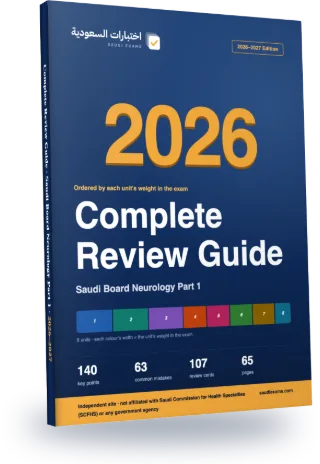
Saudi Board Neurology Part 1 Complete Review Guide 2026–2027
A 65-page PDF ordered by unit weight. The first three chapters cover 48% of the published syllabus weight.
- 65Pages
- 140Key points
- 63Common mistakes
- 107Flashcards
Guide map
Each chapter is one exam unit, ordered by its weight in the real exam.
| Chapter | Unit | Weight | Key points |
|---|---|---|---|
| 1 | Cerebrovascular Diseases | 16% | 18 |
| 2 | Epilepsy, Psychiatry, Sleep and Paediatric Neurology | 16% | 18 |
| 3 | Neuromuscular and Related Disorders | 16% | 18 |
| 4 | Demyelinating Disease, Multiple Sclerosis and Spinal Cord | 11% | 17 |
| 5 | Movement Disorders and Neuro-ophthalmology | 11% | 18 |
| 6 | Dementia, Neoplasia and Paraneoplastic Disorders | 11% | 18 |
| 7 | Pain, Headache and Neurology of Systemic Disease | 11% | 17 |
| 8 | CNS Infection | 8% | 16 |
Chapter 1 in full: Cerebrovascular Diseases
This chapter accounts for 16% of the published syllabus weight. These are its key points.
- (Ischaemic stroke syndromes, causes and localisation) Lateral medullary infarction (PICA): vertigo, vomiting, hoarseness and dysphagia with ipsilateral facial numbness, Horner's syndrome and dysmetria, and contralateral body pain and temperature loss.
- (Ischaemic stroke syndromes, causes and localisation) Top-of-the-basilar occlusion: somnolence, hallucinosis, vertical gaze paralysis, eyelid retraction and convergence nystagmus; proximal basilar occlusion gives the locked-in syndrome.
- (Ischaemic stroke syndromes, causes and localisation) Continuous vertigo with a normal head impulse test and skew deviation indicates brainstem stroke, even when early diffusion MRI is negative.
The rest of chapter 1, on this page
- (Ischaemic stroke syndromes, causes and localisation) Lacunar infarcts are subcortical and under 15 mm in TOAST and arise from lipohyalinosis of penetrating arteries linked to hypertension.
- (Acute management of ischaemic stroke) IV alteplase (0.9 mg/kg, maximum 90 mg): 10% as a 1-minute bolus and the rest over 60 minutes, given up to 4.5 hours once haemorrhage is excluded.
- (Acute management of ischaemic stroke) Blood pressure must be 185/110 mmHg or lower before lysis and 180/105 or lower after; otherwise it is treated acutely only in a hypertensive emergency.
- (Acute management of ischaemic stroke) Sudden deterioration with headache and vomiting during infusion means stopping alteplase and urgent CT; orolingual angioedema with ACE inhibitors is treated by stopping alteplase and giving steroid and antihistamines.
- (Acute management of ischaemic stroke) Thrombectomy is offered within 6 hours for proximal anterior occlusion, with thrombolysis when possible, and at 6 to 24 hours with imaging showing salvageable tissue; it is considered up to 24 hours for basilar or posterior cerebral occlusion.
- (Secondary stroke prevention) Atrial fibrillation after a disabling stroke: aspirin 300 mg daily for the first 2 weeks, then consider anticoagulation; NOACs are preferred over warfarin and antiplatelets are not an alternative.
- (Secondary stroke prevention) Statins cut recurrent ischaemic stroke by about a fifth; an existing statin is continued, and with clarithromycin simvastatin is switched to pravastatin or rosuvastatin.
- (Secondary stroke prevention) Symptomatic carotid stenosis of 50 to 99% (NASCET) or 70 to 99% (ECST) is referred urgently for endarterectomy with medical therapy; below 50% medical therapy suffices, and after stenting dual antiplatelet therapy is given for at least 1 month.
- (Intracerebral and subarachnoid haemorrhage) Subarachnoid haemorrhage: sudden severe headache; if CT is normal at 12 hours or more do lumbar puncture for xanthochromia, and if CT angiography shows no source do digital subtraction angiography.
- (Intracerebral and subarachnoid haemorrhage) Nimodipine is the only drug shown to improve neurological outcome; delayed cerebral ischaemia is managed first with induced hypertension titrated stepwise, and hyponatraemia with isotonic fluid.
- (Intracerebral and subarachnoid haemorrhage) Intracerebral haemorrhage: the ICH score uses GCS, volume, intraventricular extension, age 80 or over and infratentorial origin; target systolic 140 mmHg or lower within 6 hours, with a fall of no more than 60 in the first hour.
- (Intracerebral and subarachnoid haemorrhage) Reversal in intracerebral haemorrhage: prothrombin complex concentrate with IV vitamin K for warfarin, idarucizumab for dabigatran; platelets are not transfused for antiplatelet use.
- (Cerebral venous thrombosis, arterial dissection and stroke in the young) Cerebral venous thrombosis can mimic migraine in a combined contraceptive user or after delivery, and a normal CT does not exclude it, so MR venography is needed.
- (Cerebral venous thrombosis, arterial dissection and stroke in the young) CVT treatment: LMWH is favoured over unfractionated heparin, then oral anticoagulant for 3 to 12 months; start an antiseizure drug with a seizure or supratentorial lesion.
- (Cerebral venous thrombosis, arterial dissection and stroke in the young) Cervical artery dissection: neck or facial pain after neck manipulation with a painful Horner syndrome; high-resolution wall MRI shows the mural haematoma; causes include connective tissue disorders such as vascular Ehlers-Danlos syndrome.
Common mistakes in this chapter
- Lateral medullary syndrome causes ipsilateral facial and contralateral body pain and temperature loss; AICA infarction adds hearing loss.
- In locked-in syndrome awareness is preserved with quadriplegia and horizontal gaze paralysis; top-of-the-basilar occlusion causes somnolence, vertical gaze paralysis and hallucinosis.
- Early diffusion MRI can be falsely negative in small posterior circulation strokes, so a normal scan does not exclude stroke; repeat imaging and image the vessels.
- Aspirin and statin follow different rules: aspirin 300 mg within 24 hours once haemorrhage is excluded, whereas a statin is not started immediately in acute stroke but is continued if already taken.
- Confusing the two stenosis methods: 65% by ECST does not meet the surgical threshold, whereas the NASCET threshold is 50%.
- In intracerebral haemorrhage blood pressure is lowered rapidly to 140 mmHg or lower unless a structural cause such as an AVM, tumour or aneurysm is present.
- Hyponatraemia after SAH reflects salt loss and hypovolaemia and is treated with isotonic fluid to restore volume and sodium; it should not be managed as SIADH.
- Platelet transfusion is not given in intracerebral haemorrhage on antiplatelet drugs, because the PATCH trial showed worse outcome with it.
The other chapters are in the full guide
One purchase · lifetime access · review guide included
7-day review plan
The chapters are spread over 6 days by weight so each day carries a similar load. Day 7 is a full exam.
Day 1 · 16% of the exam
Chapter 1: Cerebrovascular Diseases
Day 2 · 16% of the exam
Chapter 2: Epilepsy, Psychiatry, Sleep and Paediatric Neurology
Day 3 · 16% of the exam
Chapter 3: Neuromuscular and Related Disorders
Day 4 · 22% of the exam
Chapter 4: Demyelinating Disease, Multiple Sclerosis and Spinal Cord
Chapter 7: Pain, Headache and Neurology of Systemic DiseaseDay 5 · 19% of the exam
Chapter 5: Movement Disorders and Neuro-ophthalmology
Chapter 8: CNS InfectionDay 6 · 11% of the exam
Chapter 6: Dementia, Neoplasia and Paraneoplastic Disorders
Day 7
Complete a timed supplementary practice set and review the units where you lost marks.
How many correct answers do you need?
- Pass mark 65%98 correct out of 150
Before you read: see your score today
10 free questions from the main units, no sign-up. Then you know which chapter to start with.
Try 10 free questions and see your levelA look at each chapter
The first three key points of each chapter, as they appear in the guide (in Arabic in the PDF).
Chapter 1: Cerebrovascular Diseases
- (Ischaemic stroke syndromes, causes and localisation) Lateral medullary infarction (PICA): vertigo, vomiting, hoarseness and…
- (Ischaemic stroke syndromes, causes and localisation) Top-of-the-basilar occlusion: somnolence, hallucinosis, vertical gaze paralysis, eyelid…
- (Ischaemic stroke syndromes, causes and localisation) Continuous vertigo with a normal head impulse test…
Chapter 2: Epilepsy, Psychiatry, Sleep and Paediatric Neurology
- (Classification of seizures and epilepsy, and EEG) EEG is best done as soon as…
- (Classification of seizures and epilepsy, and EEG) Juvenile myoclonic epilepsy shows irregular generalised polyspike…
- (Classification of seizures and epilepsy, and EEG) Insular seizures start with throat constriction, hypersalivation…
Chapter 3: Neuromuscular and Related Disorders
- (Peripheral neuropathy and Guillain–Barré syndrome) CSF protein is normal in roughly 30–50% of patients…
- (Peripheral neuropathy and Guillain–Barré syndrome) The typical conduction pattern is a normal sural sensory…
- (Peripheral neuropathy and Guillain–Barré syndrome) A patient who cannot walk 10 m is treated…
Chapter 4: Demyelinating Disease, Multiple Sclerosis and Spinal Cord
- (Diagnosis and pathogenesis of multiple sclerosis) Dissemination in time can be shown on a…
- (Diagnosis and pathogenesis of multiple sclerosis) Dissemination in space needs at least one T2…
- (Diagnosis and pathogenesis of multiple sclerosis) Primary progressive MS: one year of progression plus…
Chapter 5: Movement Disorders and Neuro-ophthalmology
- (Parkinson disease and parkinsonian syndromes) Carbidopa and benserazide inhibit dopa decarboxylase only peripherally because…
- (Parkinson disease and parkinsonian syndromes) Motor signs of Parkinson disease appear after 70–80% of…
- (Parkinson disease and parkinsonian syndromes) Reduced uptake on DAT-SPECT occurs in all degenerative parkinsonisms…
Chapter 6: Dementia, Neoplasia and Paraneoplastic Disorders
- (Dementia and its types) The four core clinical features of DLB are fluctuations, recurrent…
- (Dementia and its types) RBD is a core feature because it is far more…
- (Dementia and its types) Indicative biomarkers for DLB are reduced basal ganglia DAT uptake…
Chapter 7: Pain, Headache and Neurology of Systemic Disease
- (Migraine and primary headaches) Migraine aura per NICE
- (Migraine and primary headaches) If the patient falls asleep during an attack and wakes…
- (Migraine and primary headaches) Hemiplegic migraine
Chapter 8: CNS Infection
- (Bacterial meningitis and CSF analysis) Viral meningitis typically shows fewer than 1,000 cells with…
- (Bacterial meningitis and CSF analysis) In the clinical score, CSF protein of 80 mg/dL…
- (Bacterial meningitis and CSF analysis) Adjunctive dexamethasone reduces hearing loss in high-income settings, and…
The full guide comes with lifetime access
Lifetime access includes the full guide (65 pages), all questions and supplementary practice. Chapter 1 is free for everyone.
Questions about the guide
Is the guide free?
Chapter 1 is free to read on the guide page. The full guide comes with lifetime access to this exam; 7-day access does not include it.
Is it up to date for 2026–2027?
Yes. Unit weights and exam facts follow what the exam body last published, and the last check date is printed in the guide. If the standards change we update the file and buyers download the new version.
Does the guide have questions?
No. The guide covers key points and common mistakes; scoring, weak-area practice and full mock exams are on the site.
Can I read it on my phone?
Yes. A5 pages in a single column, with chapters linked from the contents.
- Pages
- 65
- Edition
- 1448 AH · 2026–2027
- Language
- English
- Last updated
Full prep for this exam
All of this in one purchase.
- Timed supplemental practice sessions150 questions in 90 minutes. You get a total score and a score for every unit.
- Practice unit by unit624 questions, every option explained with its source. Starts with your weakest units.
- Complete Review Guide 2026–2027 (PDF)Ordered by each unit's weight in the exam. With lifetime access only.
Choose your access
Continue with your Google account and you go straight to the payment page.