KAUST Mathematics Competition (KMC) – Phase One – Grades 8–9
KAUST Mathematics Competition (KMC) – Phase One – Grades 8–9 — Number of questions: 24 questions. Exam time: 120 minutes. Pass mark: No pass mark; about 250 students from Phase One qualify for the finals at KAUST, and the qualifying score is not published. Calculator: Not allowed. Exam fee: SAR 100 (non-refundable). Next test: 23 January 2027. Source: KAUST Academy – King Abdullah University of Science and Technology (Last verified: 2026-11-25). Question bank: full mock exams of 24 questions in 120 minutes, like the real test with a result for every unit, plus 164 explained questions across 4 units, every option explained, a review of your mistakes, and two ways to practise: see the answer right away, or sit a full timed mock. Free questions: a 10-question diagnostic test covering the main units, no sign-up; at the end you get your score and your weakest units. With lifetime access: the Complete Review Guide, a 24-page PDF ordered by unit weight; chapter 1 is free to read on the guide page.
Last verified on the KAUST Academy – King Abdullah University of Science and Technology website: 25 November 2026
If you sat the exam today, what would you score?
10 free questions · no sign-up · your score as soon as you finish
Question 1 of 10
A contest contains 30 problems. Each correct answer is worth 4 points, and 1 point is deducted for each incorrect answer. No points are given for unanswered problems. Salma scored 86 points and left exactly one problem unanswered. How many problems did she answer incorrectly?
All 10 free questions with answers and an explanation for every option
Where the questions come from
- Algebra and Arithmetic10 questions
- Number Theory5 questions
- Geometry4 questions
- Combinatorics and Logic5 questions
Exam facts
- Exam language
- Arabic or English
- Number of questions
- 24 questions Source
- Exam time
- 120 minutes Source
- Pass mark
- No pass mark; about 250 students from Phase One qualify for the finals at KAUST, and the qualifying score is not published Source
- Calculator
- Not allowed Source
- Exam fee
- SAR 100 (non-refundable) Source
- Registration
- Registration is open from 6 October to 12 December 2026 on the competition page of the KAUST Academy website. Phase One is an in-person, proctored written test at about 50 centres in education departments across the Kingdom, plus Jubail and Yanbu, with questions in Arabic and English together. Source
- Results
- About 250 students qualify for the final phase at KAUST, Thuwal, on 2–4 April 2027: a 4-hour test with 6 to 8 written-response questions, with travel and accommodation paid by KAUST. Source
Last verified: 2026-11-25
Where other sources differ
- In the first edition (2026) more than 7,640 students took part, and 241 students from grades 8 to 11 reached the finals.
Exam body
KAUST Academy – King Abdullah University of Science and Technology: Official website: KAUST Academy – King Abdullah University of Science and Technology
How to register
- Open the competition page on the KAUST Academy website and press Apply now.
- Fill in the registration form and choose the track for your grade.
- Pay the SAR 100 registration fee by bank card; it is non-refundable. Registration is confirmed as soon as you pay, and the invoice goes to the email used for payment (check spam); no separate confirmation email is sent.
- After registration closes on 12 December 2026, Phase One details and test centres are emailed to registered students.
Study guides (1)
Frequently asked questions
How many questions are in Phase One for grades 8–9 and how long is it?
24 multiple-choice questions, each with five choices (A–E) and one correct answer, in two hours, with no calculator of any kind. Questions are printed in Arabic and English together. Our full mock exams use the same number of questions and time.
Can I try KMC Grades 8–9 questions for free?
Yes. Free questions: a 10-question diagnostic test covering the main units, no sign-up; at the end you get your score and your weakest units. The free practice test page lists the same questions with answers and an explanation for every option. The rest of the questions and the full mock exams come with a pass from SAR 26.
What makes this KMC Grades 8–9 question bank different?
Question bank: full mock exams of 24 questions in 120 minutes, like the real test with a result for every unit, plus 164 explained questions across 4 units, every option explained, a review of your mistakes, and two ways to practise: see the answer right away, or sit a full timed mock. Practice questions and explanations are ready to use on your phone. Try the free questions and read the explanations before you buy.
Is there a PDF review guide for KMC Grades 8–9?
Yes. "KMC Grades 8–9 Complete Review Guide 2026–2027" is a 24-page Arabic PDF: 4 units ordered from the heaviest in the exam to the lightest, each chapter with key points, common mistakes and review cards, plus a 7-day plan. Chapter 1 is free to read on the guide page; the full guide comes with lifetime access to this exam and is not part of 7-day access. The guide has no questions: scoring, practice and mock exams are on the site.
What is the pass mark in the KAUST Mathematics Competition?
There is no pass mark because it is a competition. About 250 students from the three tracks together qualify for the finals, and KAUST Academy has not published the qualifying score or how many qualify from each track. It has also not said whether wrong answers lose marks.
When is Phase One and how do I register?
Phase One is on 23 January 2027 at test centres in the education departments. Registration runs from 6 October to 12 December 2026 on the competition page of the KAUST Academy website, and the fee is SAR 100, non-refundable. The finals are at KAUST on 2–4 April 2027.
What topics does the competition cover?
Algebra, number theory, geometry and combinatorics, as KAUST stated for the first edition. The questions reward reasoning more than memorization, and run roughly from easier to harder.
Are your questions from the real competition?
Questions marked past questions are the 2026 Phase One questions of the Juniors track (grades 8–9) that KAUST Academy published with solutions; the explanations are in our own words. We do not claim the next edition will use them. This is an independent site with no connection to KAUST or KAUST Academy.
Is this an official site, and how do I pay?
It is an independent site, not part of Qiyas, this exam's regulator or any government body, with practice questions and answer explanations. You pay once, with no automatic renewal, through Waffo Pancake (the merchant of record) by Visa, Mastercard, Apple Pay or Google Pay, and your statement shows "WAFFO". If you were charged twice or the pass did not open, email support@saudiexams.com.
KMC Grades 8–9 Complete Review Guide 2026–2027
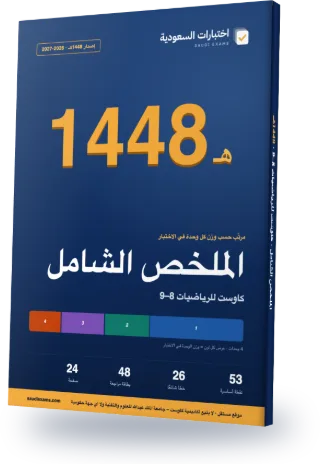
24-page · 53 key points · 26 common mistakes · 48 review cards
The first three chapters alone cover about 84% of the exam. Short on time? Start there.
About the question bank
Phase One of the KAUST Mathematics Competition for grades 8–9: 24 multiple-choice questions in two hours with no calculator, across algebra, number theory, geometry and combinatorics. We collected 164 explained questions in the same mix, so you can see before the test how many you would solve today and which unit costs you most.
- 164 questions in the bank
- 24 questions in 120 min per mock
- 48 flashcards
Past exam questions with every option explained
What you get
- 164questions in the bankPractise with the answer shown right away, or sit a full timed mock
- 4unitsSplit by the exam syllabus
- 48flashcardsTo lock in terms and definitions
- 53quick review pointsEach unit in a few key lines
Study material sample: Algebra and Arithmetic
Summary
The Algebra and Arithmetic unit takes about 10 of the 24 questions in a paper, going by our grouping of the 2026 Phase One questions for this track (our estimate). Questions cover ratios, percentages and everyday word problems; equations, systems and inequalities; clever simplification of expressions, powers and roots; and sequences, functions and averages. Most need only a few short steps, and the difficulty is in choosing the right idea (adding two equations, factoring a difference of squares, spotting a pattern), not in long calculation, and there is no calculator in the room. This is the largest unit, so start with its early questions, which are usually the easiest, and give it about 45 of the 120 minutes. If the idea does not appear within two minutes, mark the question and move on.
What the exam focuses on · Common traps · Try the flashcards
What the exam focuses on
- When you see a ratio or percentage, turn it into multiplication: 20\% means \times 0.2, and an increase of 20\% means \times 1.2.
- In ratio problems give each part one unit: 3:5 means 3k and 5k, then use the given sum or difference to find k.
- In systems of equations try adding and subtracting before substituting; adding often gives x+y directly and subtracting gives x-y.
Show 4 more
- If you see big numbers such as 101^2-99^2, look for a difference of squares or a common factor instead of computing directly.
- The five choices help you: estimate the answer roughly and cross out far-off choices, or substitute choices into the equation when each check is short.
- For sequences write the first four terms and compute the differences; if the differences are constant the sequence is arithmetic and a_n=a_1+(n-1)d applies.
- After finding the unknown, reread the question: does it ask for x, for 2x+1, or for the difference of two numbers?
Common traps
- Adding percentages instead of multiplying: a 20\% rise followed by a 20\% fall does not return the original number; the result is 1.2\times 0.8=0.96.
- Mixing up ratio parts and the total: in 3:5 the total is 8 parts, so do not divide the whole by 3 or by 5.
- Forgetting to flip the inequality when multiplying or dividing by a negative number: -2x>6 gives x<-3.
Show 4 more
- Treating (a+b)^2 as a^2+b^2; the correct expansion is a^2+2ab+b^2, and likewise \sqrt{a^2+b^2}\neq a+b.
- Averaging two speeds directly: for equal distances at 40 and 60 the average speed is \frac{2\cdot 40\cdot 60}{100}=48, not 50.
- Being off by one in the number of terms: in 5,8,\dots the nth term is 5+(n-1)\cdot 3, not 5+3n.
- When counting integers that satisfy an inequality, forgetting that open ends are excluded: 2<x<6 has 3 integers, not 5.
Try the flashcards
Tap a card to see the answer
What is 25\% of 80 plus 80\% of 25?
40, because each is 20; a\% of b equals b\% of a.
A price of 200 riyals is cut by 10\%, then by 10\% of the result. What is the final price?
162 riyals, because 200\times 0.9\times 0.9=162.
Split 40 in the ratio 3:5. What are the parts?
15 and 25, because 40\div 8=5, then 3\times 5 and 5\times 5.
One pipe fills a tank in 12 hours and another in 6 hours. How long if both are open?
4 hours, because \frac1{12}+\frac16=\frac14 of the tank per hour.
Solve 3x-7=2x+5.
x=12, by moving 2x and -7 to the right sides.
If x+y=9 and x-y=3, what are x and y?
x=6 and y=3; adding gives 2x=12.
Compute 51^2-49^2 without a calculator.
200, because (51-49)(51+49)=2\times 100.
If a+b=6 and ab=4, what is a^2+b^2?
28, because 36-2\times 4.
Why you can trust these questions
- Published questions: 164. Read the explanations and references, and report any error from the question.
- Exam facts last checked against the organiser’s website: 2026-11-25. We check them again every three months and two weeks before each test.
- Found a mistake? Tap "Report an error" under any question in the practice area, or email us at support@saudiexams.com
- Independent website. Not affiliated with ETEC (Qiyas), the Financial Academy, ACAMS, the ACFE, DAMA, CompTIA, Saudi Aramco or any government body.
Update log
- 2026-11-25 Published the second-edition facts from the KAUST Academy page (registration, dates and question format).
Full prep for this exam
All of this in one purchase.
- Full mock exam, same as the real one24 questions in 120 minutes. You get a total score and a score for every unit.
- Practice unit by unit164 questions, every option explained with its source. Starts with your weakest units.
- Complete Review Guide 2026–2027 (PDF)Ordered by each unit's weight in the exam. With lifetime access only.
Choose your access
Continue with your Google account and you go straight to the payment page.