Saudi Board Part One Examination – Family Dentistry
Saudi Board Part One Examination – Family Dentistry — Number of questions: 150 questions. Exam time: Confirm with the exam body. Pass mark: 65%. Exam fee: Registration is automatic and free for eligible trainees. Source: Saudi Commission for Health Specialties (SCFHS) (Last verified: 2026-11-25). Question bank: A site supplementary practice session of 150 questions in 90 minutes with a result for every unit, plus 538 explained questions across 7 units, every option explained, a review of your mistakes, and two ways to practise: see the answer right away, or sit a full timed mock. Free questions: a 10-question diagnostic test covering the main units, no sign-up; at the end we compare your score with the pass mark and show your weakest units. With lifetime access: the Complete Review Guide, a 59-page PDF ordered by unit weight; chapter 1 is free to read on the guide page.
Last verified on the Saudi Commission for Health Specialties (SCFHS) website: 25 November 2026
If you sat the exam today, what would you score?
10 free questions · no sign-up · your score as soon as you finish
Question 1 of 10
A 66-year-old man is to receive a two-implant mandibular overdenture. The two implants are placed axially parallel, the ridge is V-shaped, and the interarch space is limited. Which attachment system is most appropriate?
All 10 free questions with answers and an explanation for every option
Where the questions come from
- Basic Science15 questions
- Cariology23 questions
- Operative Dentistry38 questions
- Endodontics30 questions
- Prosthodontics22 questions
- Periodontics15 questions
- Dental Implants7 questions
Exam facts
- Exam language
- English
- Number of questions
- 150 questions Source
- Exam time
- Confirm with the exam body
- Pass mark
- 65% Source
- Exam fee
- Registration is automatic and free for eligible trainees Source
Last verified: 2026-11-25
Where other sources differ
- The current blueprint covers 2024–2027 (v.1) in seven sections: basic science, cariology, operative dentistry, endodontics, prosthodontics, periodontics and dental implants. Each section may vary by ±5%; research, ethics, professionalism and patient safety are incorporated within the domains.
Exam body
Saudi Commission for Health Specialties (SCFHS): Official website: Saudi Commission for Health Specialties (SCFHS)
How to register
- The system registers you automatically once you have completed nine months of training in a Saudi Board programme with valid registration.
- You are notified of the date and city on Mumaris+.
- The exam is held once a year, and you have a maximum of four attempts.
Study guides (3)
Frequently asked questions
How many questions are in Part One and what is the pass mark?
150 single-best-answer questions, plus up to 10% unscored pretest items. The pass mark is 65%; it can be lowered one mark at a time to a floor of 60% if fewer than 70% pass, according to the published blueprint.
Can I try Saudi Board Family Dentistry Part 1 questions for free?
Yes. Free questions: a 10-question diagnostic test covering the main units, no sign-up; at the end we compare your score with the pass mark and show your weakest units. The free practice test page lists the same questions with answers and an explanation for every option. The rest of the questions and the full mock exams come with a pass from SAR 26.
What makes this Saudi Board Family Dentistry Part 1 question bank different?
Question bank: A site supplementary practice session of 150 questions in 90 minutes with a result for every unit, plus 538 explained questions across 7 units, every option explained, a review of your mistakes, and two ways to practise: see the answer right away, or sit a full timed mock. Practice questions and explanations are ready to use on your phone. Try the free questions and read the explanations before you buy.
Is there a PDF review guide for Saudi Board Family Dentistry Part 1?
Yes. "Saudi Board Family Dentistry Part 1 Complete Review Guide 2026–2027" is a 59-page Arabic PDF: 7 units ordered from the heaviest in the exam to the lightest, each chapter with key points, common mistakes and review cards, plus a 7-day plan. Chapter 1 is free to read on the guide page; the full guide comes with lifetime access to this exam and is not part of 7-day access. The guide has no questions: scoring, practice and mock exams are on the site.
What does Saudi Board Family Dentistry Part 1 cover, and how is it split by section?
150 questions, split by the published weights as follows: Basic Science (15); Cariology (23); Operative Dentistry (38); Endodontics (30); Prosthodontics (22); Periodontics (15); Dental Implants (7). Source: SCFHS published blueprint. Counts are rounded from the percentages and each section may vary by up to 5%.
Which language is Saudi Board Family Dentistry Part 1 in?
SCFHS does not state the exam language, but all of its listed references are English textbooks, so our questions are in English. Explanations are in Arabic and English, and you can switch language on any question with one tap.
How do I register for Saudi Board Family Dentistry Part 1?
The system registers you automatically once you have completed nine months of training in a Saudi Board programme with valid registration, and you are notified of the date and city on Mumaris+. The registration service is free.
How many times can I sit the Part One exam?
It is held once a year, and you have a maximum of four attempts, after which the trainee is removed from the programme, according to the SCFHS executive assessment rules.
Is this an official site, and how do I pay?
It is an independent site, not part of Qiyas, this exam's regulator or any government body, with practice questions and answer explanations. You pay once, with no automatic renewal, through Waffo Pancake (the merchant of record) by Visa, Mastercard, Apple Pay or Google Pay, and your statement shows "WAFFO". If you were charged twice or the pass did not open, email support@saudiexams.com.
Saudi Board Family Dentistry Part 1 Complete Review Guide 2026–2027
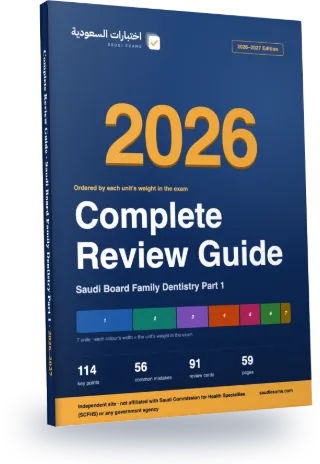
59-page · 114 key points · 56 common mistakes · 91 review cards
The first three chapters alone cover about 60% of the exam. Short on time? Start there.
About the question bank
538 Saudi Board Family Dentistry Part 1 questions across 7 domains. The largest is Operative Dentistry, 25% of the exam. Every question comes with an answer explanation.
- 150 questions in 90 minutes per site supplementary practice session
- 538 questions covering the main scoring topics, with explanations
- 65% pass mark, with targeted practice on your weak spots
See the gap to your target score Practise the units costing you the most marks Supplementary practice
Every option explained so you understand why
What you get
- 538questions in the bankPractise with the answer shown right away, or sit a full timed mock
- 7unitsSplit by the exam syllabus
- 91flashcardsTo lock in terms and definitions
- 114quick review pointsEach unit in a few key lines
Study material sample: Basic Science
Summary
This unit covers the basic sciences behind clinical practice and carries about 15 questions, 10% of the exam. It has six sections: head and neck anatomy (inferior alveolar nerve block, nerve injury and the temporomandibular joint); pharmacology (antibiotic prophylaxis, analgesics and local anesthetics); oral radiology (cone-beam CT); oral biology and microbiology (biofilm and the ecological plaque hypothesis); dental biomaterials (glass ionomer, amalgam and zirconia); and research, biostatistics and infection control. Questions are usually clinical vignettes that ask for a mechanism or the best next step, so link each fact to its reason and learn the specific doses and numbers.
What the exam focuses on · Common traps · Try the flashcards
What the exam focuses on
- Inferior alveolar nerve block: insertion beyond about 25 mm means the needle drifted posteriorly toward the parotid, giving transient facial palsy; the buccal nerve (anterior division) needs a separate injection, and the mylohyoid nerve can escape the block.
- Inferior alveolar nerve injury after third molar surgery or implants: most recover within weeks to months and a deficit beyond 6 months is regarded as permanent; when panoramic signs show roots close to the canal, a CBCT is requested.
- Temporomandibular joint disorders: painless disc displacement with reduction is reassured and not treated; acute displacement without reduction with opening under 40 mm is managed by manual manipulation to recapture the disc.
Show 5 more
- Endocarditis prophylaxis: given to patients with a prosthetic valve (mechanical or biological), previous endocarditis or surgical shunts; prosthetic joints do not need prophylaxis before dental procedures.
- Analgesics: acetaminophen for patients on aspirin or with an ulcer; aspirin inhibits platelets irreversibly for 5 to 7 days; ibuprofen raises lithium levels; codeine is restricted at 12 years or younger.
- Cone-beam CT: used with a limited field of view for specific indications (sinus augmentation, missed canals and root fractures, facial trauma, nerve injury after implants); routine peri-implant bone follow-up uses a paralleled periapical film.
- Biofilm: it starts with the acquired pellicle, then primary colonizers (Streptococcus and Actinomyces), then Fusobacterium nucleatum bridges to late species; the ecological plaque hypothesis explains caries by a shift in balance rather than a single species.
- Glass ionomer: tartaric acid delays setting, the surface is protected with varnish or petroleum jelly, it tolerates moisture and suits atraumatic restorative treatment (about 90% success in Class I); high-translucency zirconia is weaker and suits sites up to the first premolar.
Common traps
- The buccal nerve is not in the posterior division: an inferior alveolar block numbs the lip and teeth, but buccal gingiva needs a separate buccal injection.
- Prophylaxis is not for every patient with an implant in the heart or a joint: a prosthetic valve yes, a knee replacement no, even with immunosuppression.
- Stopping aspirin the evening before surgery does not restore platelet function; aspirin is taken at least 30 minutes before ibuprofen because ibuprofen can block its effect.
Show 5 more
- Failed anesthesia in an abscess is not necessarily technique error: acidity raises the ionized fraction, so less unionized base crosses the nerve membrane.
- A confidence interval that includes 1 means benefit is unproven, not that there is no effect; likewise RT-qPCR viral load does not measure infectivity.
- The lowest possible dose is not the goal: the refined ALADAIP principle accepts the lowest dose that keeps the image diagnostically adequate for the indication and patient.
- A low tensile bond strength of glass ionomer to dentine does not mean poor adhesion: failure is cohesive inside the cement and values rise with maturation.
- Chlorhexidine rinse should not be used indefinitely: it stains, irritates and shifts biofilm toward caries-associated taxa, and may raise blood pressure by suppressing nitrate-reducing bacteria.
Try the flashcards
Tap a card to see the answer
What error explains facial palsy after an inferior alveolar block with a 30 mm insertion?
The needle went too far posteriorly, so solution reached the parotid region and the facial nerve.
When is sensory deficit after inferior alveolar nerve injury regarded as permanent?
When it persists beyond 6 months.
Which patient needs endocarditis prophylaxis before extraction?
A patient with a prosthetic valve (mechanical or biological), previous endocarditis or a surgical shunt.
How long does aspirin inhibit platelets?
About 5 to 7 days, because it inhibits COX irreversibly.
Why does local anesthesia fail in an acute abscess?
Acidity raises the ionized fraction, so less unionized base crosses the nerve membrane.
How many articaine 4% cartridges (68 mg each) are allowed for a 55-kg adult?
Five cartridges (limit 7 mg/kg = 385 mg).
When is a limited-field CBCT requested?
For sinus augmentation, missed canals and root fractures, nerve injury after implants, and facial trauma.
Why can CBCT grey values not be compared between two scans?
They are not standardised between devices.
Why you can trust these questions
- Published questions: 538. Read the explanations and references, and report any error from the question.
- Exam facts last checked against the organiser’s website: 2026-11-25. We check them again every three months and two weeks before each test.
- Found a mistake? Tap "Report an error" under any question in the practice area, or email us at support@saudiexams.com
- Independent website. Not affiliated with ETEC (Qiyas), the Financial Academy, ACAMS, the ACFE, DAMA, CompTIA, Saudi Aramco or any government body.
Full prep for this exam
All of this in one purchase.
- Timed supplemental practice sessions150 questions in 90 minutes. You get a total score and a score for every unit.
- Practice unit by unit538 questions, every option explained with its source. Starts with your weakest units.
- Complete Review Guide 2026–2027 (PDF)Ordered by each unit's weight in the exam. With lifetime access only.
Choose your access
Continue with your Google account and you go straight to the payment page.