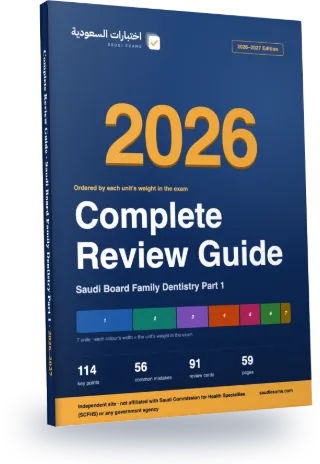
Saudi Board Family Dentistry Part 1 Complete Review Guide 2026–2027
A 59-page PDF ordered by unit weight. The first three chapters cover 60% of the published syllabus weight.
- 59Pages
- 114Key points
- 56Common mistakes
- 91Flashcards
Guide map
Each chapter is one exam unit, ordered by its weight in the real exam.
| Chapter | Unit | Weight | Key points |
|---|---|---|---|
| 1 | Operative Dentistry | 25% | 16 |
| 2 | Endodontics | 20% | 16 |
| 3 | Cariology | 15% | 16 |
| 4 | Prosthodontics | 15% | 18 |
| 5 | Basic Science | 10% | 18 |
| 6 | Periodontics | 10% | 16 |
| 7 | Dental Implants | 5% | 14 |
Chapter 1 in full: Operative Dentistry
This chapter accounts for 25% of the published syllabus weight. These are its key points.
- (Adhesion to enamel and dentin) Universal adhesive with MDP: etch enamel only with phosphoric acid, then use self-etch mode on dentin; acid depletes dentin calcium so MDP cannot form its MDP–calcium nanolayers, which is linked to more nanoleakage.
- (Adhesion to enamel and dentin) Etch-and-rinse system: etching dentin with phosphoric acid for about 15 seconds exposes a collagen network 5–8 micrometres deep; dry gently without desiccation because strong drying collapses collagen, and scrub the adhesive actively throughout its application time.
- (Adhesion to enamel and dentin) A 2-step etch-and-rinse system with primer and resin in one bottle lacks a separate hydrophobic resin layer, so its interface is more permeable and clinically worse than a 3-step system; a mild 2-step self-etch with MDP leaves hydroxyapatite for chemical bonding.
The rest of chapter 1, on this page
- (Adhesion to enamel and dentin) Hybrid layer degradation: acid activates MMPs through the cysteine switch and cathepsins (notably K) join in collagen digestion; chlorhexidine is cationic and binds dentin by reversible electrostatic attraction so its effect fades; HEMA improves wetting and prevents phase separation but increases water sorption and hydrolysis.
- (Resin composite) Bulk-fill composite: translucency and extra photoinitiators allow curing at 4–5 mm depth, with outcomes similar to layering; the flowable type has low filler and is capped with conventional composite to limit wear, and large fillers can dislodge when polished, so multistep polishing is advised.
- (Resin composite) Shrinkage stress: a high configuration factor (C-factor) leaves little free surface for flow, so stress concentrates at the bonded walls and can exceed bond strength to create gaps; an elastic modulus near dentin with slow modulus development helps, and a low degree of conversion (below about 55–65%) is linked to microleakage and marginal breakdown.
- (Resin composite) Failure of direct restorations: fracture and secondary caries are the leading causes; fracture is seen in bruxists and secondary caries reflects caries risk; rubber dam isolation reduces failure compared with cotton rolls and saliva ejector, and saliva contamination is tied to secondary caries.
- (Cavity preparation, non-carious cervical lesions and hypersensitivity) Mechanism of pain: hydrodynamic theory. Test by drawing an explorer gently or with an air blast while covering adjacent soft tissue (which can trigger a neuralgic trigger point); chemical wear (dietary or gastric acid) is directly linked to pain, whereas mechanical wear is not.
- (Cavity preparation, non-carious cervical lesions and hypersensitivity) Stepwise treatment: desensitizing toothpaste with diet advice and soft-brush brushing before acid; then in the office high-fluoride varnish (occludes tubules), glutaraldehyde (precipitates albumin) or 5% calcium sodium phosphosilicate (hydroxycarbonate apatite layer); potassium salts do not beat placebo.
- (Cavity preparation, non-carious cervical lesions and hypersensitivity) Direct composite or glass ionomer with an occlusal guard for clenching is used for a visible defect or when non-restorative care has failed; if sensitivity persists after gingival surgery, treat the remaining exposed dentin with an occlusive restoration. Gastric reflux calls for medical referral, and suspected sleep apnea needs a sleep study before any appliance.
- (Bleaching, restoration failure and cracked tooth) Bleaching chemistry: reactive oxygen species break down conjugated chromophores; peroxide gel is mixed with an alkalinizing agent immediately before use because at pH 9.5–10.8 it forms the more reactive but unstable hydroperoxyl anion; prophylaxis beforehand removes saliva and tannins that inactivate reactive species.
- (Bleaching, restoration failure and cracked tooth) Light-assisted bleaching: clear gel absorbs no light, so a wavelength-matched chromophore is added to boost radical formation and reduce light reaching the pulp; green light, the least absorbed, suits tetracycline complexes; excess heat dehydrates enamel and can injure the pulp irreversibly, and peroxide can worsen existing hypersensitivity.
- (Bleaching, restoration failure and cracked tooth) Cracked tooth: bite-and-release and transillumination (the crack has a different refractive index); a narrow deep isolated pocket over 4 mm suggests a subgingival crack with a poorer prognosis; a fragment held only by gingiva is removed; a stainless steel band for 2–4 weeks serves as diagnosis and protection, relief supports the diagnosis and a crown follows; asymptomatic enamel craze lines are monitored.
- (Light curing, isolation and shade selection) Irradiance = power ÷ area (for example, 1,000 mW through an 8 mm tip is about 1,990 mW/cm²); exposure = irradiance × time, and a layer needs about 8–50 J/cm²; irradiance below 300–400 mW/cm² means incomplete conversion; QTH lights deteriorate within about 50–100 hours while LEDs last thousands of hours.
- (Light curing, isolation and shade selection) Camphorquinone is yellow and absorbs blue light; TPO and PPD are used in whiter shades and need shorter violet wavelengths, so multi-peak units are used when initiators are mixed. A handheld radiometer tracks the same unit with a constant guide position and angle; a laboratory-grade power meter is the reference for comparing units; remove cured resin from the tip.
- (Light curing, isolation and shade selection) Select shade before the rubber dam because dehydration makes the tooth lighter; use daylight-simulating light, a light-grey background and remove lipstick; in the squint test, the tab that fades first is the best match; the first number of a 3D-Master tab is the lightness group (higher is darker); digital photographs with the tab, cross-polarizing filter and manual white balance support visual selection; a spectrophotometer records reflectance at each wavelength.
Common mistakes in this chapter
- Confusing enamel etching with dentin etching for a universal adhesive: dentin is not phosphoric-acid etched before an MDP adhesive, while enamel is etched to improve the etch pattern and bonding.
- Blasting etched dentin dry with air: the collagen (about 30% collagen and 70% water) collapses and blocks resin infiltration; dry gently without desiccation and scrub the adhesive actively.
- Treating marginal staining as secondary caries automatically: staining can be an early sign of failure from deficient bonding or adaptation, and radiographs can miss an early lesion, so monitoring and preventive care come before replacement.
- Using a flowable bulk-fill alone in a posterior tooth: its low filler content gives poor wear resistance, so it needs a cap of conventional composite.
- Diagnosing hypersensitivity without excluding other causes: lingering pain, or pain on release of biting, leads to a crack, pulpitis or a defective restoration; and potassium salts have shown no benefit beyond placebo, with no gold-standard treatment.
- Assuming brushing right after acid protects the tooth: brushing immediately after an acid source with a hard brush abrades the softened dentin; brush before the acidic intake with a soft brush and non-abrasive paste.
- Mixing up heat with bleaching efficacy: heat speeds peroxide breakdown but can dehydrate enamel and injure the pulp; clear gel absorbs no light, so a matched chromophore is needed, and green light suits tetracycline stain.
- Matching shade after placing the rubber dam or under the warm dental unit lamp: dehydration makes the tooth look lighter, so a tab that is too light is chosen; select the shade before isolation, under daylight-simulating light and a light-grey background.
The other chapters are in the full guide
One purchase · lifetime access · review guide included
7-day review plan
The chapters are spread over 6 days by weight so each day carries a similar load. Day 7 is a full exam.
Day 1 · 25% of the exam
Chapter 1: Operative Dentistry
Day 2 · 20% of the exam
Chapter 2: Endodontics
Day 3 · 15% of the exam
Chapter 3: Cariology
Day 4 · 15% of the exam
Chapter 4: Prosthodontics
Day 5 · 15% of the exam
Chapter 5: Basic Science
Chapter 7: Dental ImplantsDay 6 · 10% of the exam
Chapter 6: Periodontics
Day 7
Complete a timed supplementary practice set and review the units where you lost marks.
How many correct answers do you need?
- Pass mark 65%98 correct out of 150
Before you read: see your score today
10 free questions from the main units, no sign-up. Then you know which chapter to start with.
Try 10 free questions and see your levelA look at each chapter
The first three key points of each chapter, as they appear in the guide (in Arabic in the PDF).
Chapter 1: Operative Dentistry
- (Adhesion to enamel and dentin) Universal adhesive with MDP
- (Adhesion to enamel and dentin) Etch-and-rinse system
- (Adhesion to enamel and dentin) A 2-step etch-and-rinse system with primer and resin in…
Chapter 2: Endodontics
- (Pulp biology and pulpitis diagnosis) Thermal pain lasting 30 seconds or more, with spontaneous…
- (Pulp biology and pulpitis diagnosis) Pulpal defence
- (Pulp biology and pulpitis diagnosis) Carious lesions accelerate with depth because tubule diameter and…
Chapter 3: Cariology
- (Caries pathogenesis) Organic acids from carbohydrate fermentation break the mineral equilibrium so loss outpaces…
- (Caries pathogenesis) Sucrose is fuel fermented to acids and a substrate that GtfB, GtfC…
- (Caries pathogenesis) S. mutans first attaches through surface protein P1 binding salivary lectins in…
Chapter 4: Prosthodontics
- (Complete and removable partial dentures) Newton classifies denture stomatitis in three types; a granular…
- (Complete and removable partial dentures) Treat denture stomatitis through modifiable factors first: remove the…
- (Complete and removable partial dentures) Low salivary flow removes cleansing and antimicrobial components and…
Chapter 5: Basic Science
- (Head and neck anatomy) An inferior alveolar block with insertion beyond about 25 mm…
- (Head and neck anatomy) Inferior alveolar nerve injury
- (Head and neck anatomy) Temporomandibular joint
Chapter 6: Periodontics
- (Classification and pathogenesis of periodontal disease) Extent: localized when fewer than 30% of teeth…
- (Classification and pathogenesis of periodontal disease) Grade C is assigned by smoking more than…
- (Classification and pathogenesis of periodontal disease) Grade forecasts faster progression and highlights modifiable risks…
Chapter 7: Dental Implants
- (Osseointegration, planning and bone augmentation) Distance osteogenesis: osteoblasts migrate from the osteotomy wall and…
- (Osseointegration, planning and bone augmentation) When the cavity matches the outer thread diameter, voids…
- (Osseointegration, planning and bone augmentation) To raise implant stability, diameter matters more than length…
The full guide comes with lifetime access
Lifetime access includes the full guide (59 pages), all questions and supplementary practice. Chapter 1 is free for everyone.
Questions about the guide
Is the guide free?
Chapter 1 is free to read on the guide page. The full guide comes with lifetime access to this exam; 7-day access does not include it.
Is it up to date for 2026–2027?
Yes. Unit weights and exam facts follow what the exam body last published, and the last check date is printed in the guide. If the standards change we update the file and buyers download the new version.
Does the guide have questions?
No. The guide covers key points and common mistakes; scoring, weak-area practice and full mock exams are on the site.
Can I read it on my phone?
Yes. A5 pages in a single column, with chapters linked from the contents.
- Pages
- 59
- Edition
- 1448 AH · 2026–2027
- Language
- English
- Last updated
Full prep for this exam
All of this in one purchase.
- Timed supplemental practice sessions150 questions in 90 minutes. You get a total score and a score for every unit.
- Practice unit by unit538 questions, every option explained with its source. Starts with your weakest units.
- Complete Review Guide 2026–2027 (PDF)Ordered by each unit's weight in the exam. With lifetime access only.
Choose your access
Continue with your Google account and you go straight to the payment page.