KAUST Mathematics Competition (KMC) – Phase One – Grades 6–7
KAUST Mathematics Competition (KMC) – Phase One – Grades 6–7 — Number of questions: 24 questions. Exam time: 120 minutes. Pass mark: No pass mark; about 250 students from Phase One qualify for the finals at KAUST, and the qualifying score is not published. Calculator: Not allowed. Exam fee: SAR 100 (non-refundable). Next test: 23 January 2027. Source: KAUST Academy – King Abdullah University of Science and Technology (Last verified: 2026-11-25). Question bank: full mock exams of 24 questions in 120 minutes, like the real test with a result for every unit, plus 166 explained questions across 4 units, every option explained, a review of your mistakes, and two ways to practise: see the answer right away, or sit a full timed mock. Free questions: a 10-question diagnostic test covering the main units, no sign-up; at the end you get your score and your weakest units. With lifetime access: the Complete Review Guide, a 26-page PDF ordered by unit weight; chapter 1 is free to read on the guide page.
Last verified on the KAUST Academy – King Abdullah University of Science and Technology website: 25 November 2026
If you sat the exam today, what would you score?
10 free questions · no sign-up · your score as soon as you finish
Question 1 of 10
Four identical cubes, each with edge 2 cm, are glued face to face in a row to form a cuboid. What is the total surface area of the cuboid, in cm²?
All 10 free questions with answers and an explanation for every option
Where the questions come from
- Algebra and Arithmetic8 questions
- Number Theory3 questions
- Geometry7 questions
- Combinatorics and Logic6 questions
Exam facts
- Exam language
- Arabic or English
- Number of questions
- 24 questions Source
- Exam time
- 120 minutes Source
- Pass mark
- No pass mark; about 250 students from Phase One qualify for the finals at KAUST, and the qualifying score is not published Source
- Calculator
- Not allowed Source
- Exam fee
- SAR 100 (non-refundable) Source
- Registration
- Registration is open from 6 October to 12 December 2026 on the competition page of the KAUST Academy website. Phase One is an in-person, proctored written test at about 50 centres in education departments across the Kingdom, plus Jubail and Yanbu, with questions in Arabic and English together. Source
- Results
- About 250 students qualify for the final phase at KAUST, Thuwal, on 2–4 April 2027: a 4-hour test with 6 to 8 written-response questions, with travel and accommodation paid by KAUST. Source
Last verified: 2026-11-25
Where other sources differ
- In the first edition (2026) more than 7,640 students took part, and 241 students from grades 8 to 11 reached the finals.
Exam body
KAUST Academy – King Abdullah University of Science and Technology: Official website: KAUST Academy – King Abdullah University of Science and Technology
How to register
- Open the competition page on the KAUST Academy website and press Apply now.
- Fill in the registration form and choose the track for your grade.
- Pay the SAR 100 registration fee by bank card; it is non-refundable. Registration is confirmed as soon as you pay, and the invoice goes to the email used for payment (check spam); no separate confirmation email is sent.
- After registration closes on 12 December 2026, Phase One details and test centres are emailed to registered students.
Study guides (1)
Frequently asked questions
How many questions are in Phase One for grades 6–7 and how long is it?
24 multiple-choice questions, each with five choices (A–E) and one correct answer, in two hours, with no calculator of any kind. Questions are printed in Arabic and English together. Our full mock exams use the same number of questions and time.
Can I try KMC Grades 6–7 questions for free?
Yes. Free questions: a 10-question diagnostic test covering the main units, no sign-up; at the end you get your score and your weakest units. The free practice test page lists the same questions with answers and an explanation for every option. The rest of the questions and the full mock exams come with a pass from SAR 26.
What makes this KMC Grades 6–7 question bank different?
Question bank: full mock exams of 24 questions in 120 minutes, like the real test with a result for every unit, plus 166 explained questions across 4 units, every option explained, a review of your mistakes, and two ways to practise: see the answer right away, or sit a full timed mock. Practice questions and explanations are ready to use on your phone. Try the free questions and read the explanations before you buy.
Is there a PDF review guide for KMC Grades 6–7?
Yes. "KMC Grades 6–7 Complete Review Guide 2026–2027" is a 26-page Arabic PDF: 4 units ordered from the heaviest in the exam to the lightest, each chapter with key points, common mistakes and review cards, plus a 7-day plan. Chapter 1 is free to read on the guide page; the full guide comes with lifetime access to this exam and is not part of 7-day access. The guide has no questions: scoring, practice and mock exams are on the site.
What is the pass mark in the KAUST Mathematics Competition?
There is no pass mark because it is a competition. About 250 students from the three tracks together qualify for the finals, and KAUST Academy has not published the qualifying score or how many qualify from each track. It has also not said whether wrong answers lose marks.
When is Phase One and how do I register?
Phase One is on 23 January 2027 at test centres in the education departments. Registration runs from 6 October to 12 December 2026 on the competition page of the KAUST Academy website, and the fee is SAR 100, non-refundable. The finals are at KAUST on 2–4 April 2027.
What topics does the competition cover?
Algebra, number theory, geometry and combinatorics, as KAUST stated for the first edition. The questions reward reasoning more than memorization, and run roughly from easier to harder.
Are your questions from the real competition?
This track opens for the first time in the 2027 edition, so it has no past papers; all our questions are practice questions in the style of the official sample exam and practice sets for this track. We do not claim the next edition will use them. This is an independent site with no connection to KAUST or KAUST Academy.
Is this an official site, and how do I pay?
It is an independent site, not part of Qiyas, this exam's regulator or any government body, with practice questions and answer explanations. You pay once, with no automatic renewal, through Waffo Pancake (the merchant of record) by Visa, Mastercard, Apple Pay or Google Pay, and your statement shows "WAFFO". If you were charged twice or the pass did not open, email support@saudiexams.com.
KMC Grades 6–7 Complete Review Guide 2026–2027
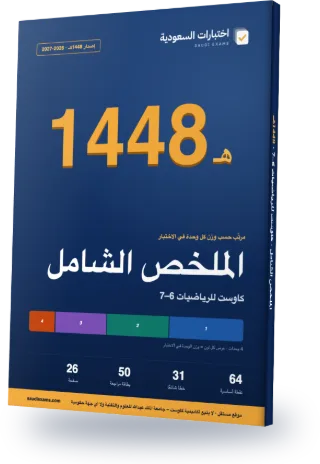
26-page · 64 key points · 31 common mistakes · 50 review cards
The first three chapters alone cover about 87% of the exam. Short on time? Start there.
About the question bank
Phase One of the KAUST Mathematics Competition for grades 6–7: 24 multiple-choice questions in two hours with no calculator, across algebra, number theory, geometry and combinatorics. We collected 166 explained questions in the same mix, so you can see before the test how many you would solve today and which unit costs you most.
- 166 questions in the bank
- 24 questions in 120 min per mock
- 50 flashcards
Every option explained so you understand why
What you get
- 166questions in the bankPractise with the answer shown right away, or sit a full timed mock
- 4unitsSplit by the exam syllabus
- 50flashcardsTo lock in terms and definitions
- 64quick review pointsEach unit in a few key lines
Study material sample: Algebra and Arithmetic
Summary
Our grouping of the published sample paper for this grade puts about 8 of the 24 questions in Unit 1; this split is our own, not a published list. The questions cover ratios, percentages and fractions; equations, systems and inequalities; clever simplification with powers, roots and identities; and sequences, averages and functions. Most are short word problems solved in two or three steps, and the difficulty lies in the idea (factorising instead of calculating, drawing a bar for fractions, building an equation) rather than in long arithmetic. No calculator is allowed. This is usually the fastest unit, so give it about 35 of the 120 minutes and start here to collect the easy marks before geometry and counting.
What the exam focuses on · Common traps · Try the flashcards
What the exam focuses on
- In word problems, name the unknown with a letter first, and turn each sentence into an equation before you calculate anything.
- When you see a fraction of what is left, draw a bar and split it into equal parts; the picture is faster than algebra.
- When you see big, similar numbers (such as 51^2-49^2), look for an identity or a common factor before multiplying.
Show 5 more
- With successive percentages, multiply the factors (1.2\times0.8); do not add the percentages.
- In a system of two equations, pick the unknown whose coefficients match in both equations and eliminate it by subtracting or adding.
- For averages, write sum = mean × count, then work with sums, not with means.
- Estimate the answer roughly before calculating; two or three of the five choices often drop out for free.
- If a solution runs past five minutes, mark the question and move on; later questions may be easier.
Common traps
- Treating a rise and a fall by the same percentage as returning to the start: +20\% then -20\% ends at 96%, not 100%.
- Taking the second fraction of the whole instead of the remainder in problems like "then spent a quarter of what was left".
- Finding average speed by averaging the two speeds; the right method is total distance over total time.
Show 5 more
- Forgetting to flip an inequality when multiplying or dividing by a negative number.
- Writing (a+b)^2=a^2+b^2 and dropping the middle term 2ab.
- Miscounting terms in a sequence: from 7 to 102 in steps of 5 there are 20 terms, not 19; remember the +1.
- Adding unlike roots: \sqrt2+\sqrt3\neq\sqrt5; only like roots add, such as 3\sqrt2+2\sqrt2.
- Not checking the answer; sign slips show up when you substitute into the original wording of the problem.
Try the flashcards
Tap a card to see the answer
What is 15% of 240?
36, because 10% is 24 and 5% is 12.
A price of 200 riyals is cut by 25% then raised by 20%. What is the final price?
180, because 200\times0.75=150 then 150\times1.2=180.
90 is shared in the ratio 2:3:4. What are the shares?
20, 30 and 40, because there are 9 parts and each part is 10.
Solve 5x-3=2x+12.
x=5, because 3x=15.
The mean of 6,8,10,x is 9. What is x?
12, because the needed sum is 4\times9=36 and 36-24=12.
Compute 99^2-1 without squaring.
9800, because (99-1)(99+1)=98\times100.
Simplify \sqrt{72}.
6\sqrt2, because 72=36\times2.
What is the 20th term of 4,9,14,\dots?
99, because 4+19\times5=99.
Why you can trust these questions
- Published questions: 166. Read the explanations and references, and report any error from the question.
- Exam facts last checked against the organiser’s website: 2026-11-25. We check them again every three months and two weeks before each test.
- Found a mistake? Tap "Report an error" under any question in the practice area, or email us at support@saudiexams.com
- Independent website. Not affiliated with ETEC (Qiyas), the Financial Academy, ACAMS, the ACFE, DAMA, CompTIA, Saudi Aramco or any government body.
Update log
- 2026-11-25 Published the second-edition facts from the KAUST Academy page (registration, dates and question format).
Full prep for this exam
All of this in one purchase.
- Full mock exam, same as the real one24 questions in 120 minutes. You get a total score and a score for every unit.
- Practice unit by unit166 questions, every option explained with its source. Starts with your weakest units.
- Complete Review Guide 2026–2027 (PDF)Ordered by each unit's weight in the exam. With lifetime access only.
Choose your access
Continue with your Google account and you go straight to the payment page.