KMC Grades 6–7: 24 Questions, 2 Hours, Examples
24 multiple-choice questions in two hours with no calculator: the four units with a worked example each, the dates and a weekly plan until 23 January.
- Next test
- 23 January 2027 Add the date to your calendar
- Questions and time
- 24 questions · 120 minutes
- Pass mark
- No pass mark; about 250 students from Phase One qualify for the finals at KAUST, and the qualifying score is not published
- Exam fee
- SAR 100 (non-refundable)
Start with 10 free questions to find what needs more work. No sign-up, with answer explanations.
Try 10 free questions and see your levelPut what you just read into practice
Start with 10 free questions to find what needs more work. No sign-up, with answer explanations.
Try 10 free questions and see your levelLast verified: 25 November 2026. The specifications, dates and fee come from the competition page on the KAUST Academy website, and the spread of questions across units from the published sample paper for grades 6–7. This is a guide on an independent website, not affiliated with KAUST Academy or any government body, and it does not promise any score. Check the official page before the test, as details may change.
What is this competition?
The KAUST Mathematics Competition is run by KAUST Academy for students in grades 6 to 11 who are Saudi nationals or live in the Kingdom. It has three tracks: grades 6–7, grades 8–9 and grades 10–11. This guide covers the first track. Phase One is a proctored, in-person written test, and about 250 students from the three tracks together qualify for the finals at KAUST, Thuwal, on 2–4 April 2027.
The key numbers
| Item | Details |
|---|---|
| Questions | 24, each with five choices (A–E) and one correct answer |
| Duration | Two hours, which is 5 minutes per question on average |
| Calculator | Not allowed, of any kind |
| Language | Questions in Arabic and English together |
| Registration | 6 October to 12 December 2026, with a non-refundable fee of SAR 100 |
| Phase One | 23 January 2027 |
| Finals | 2–4 April 2027 at KAUST |
| Pass mark | None; about 250 students from the three tracks together qualify |
The questions get harder gradually, from easy to hard. The Academy has not said whether a wrong answer loses marks, so check the test instructions and do not build your plan on random guessing.
The four units and their questions
The Academy does not publish how many questions each part has, so we grouped the questions of the published sample paper (24 questions) ourselves. The numbers below are our own split, not a published list.
| Unit | Questions (about) | Share | Topics |
|---|---|---|---|
| Algebra and Arithmetic | 8 | 33% | Ratios and fractions; equations and inequalities; powers, roots and simplification; sequences and averages |
| Number Theory | 3 | 12% | Divisibility and primes; GCD, LCM and remainders; digits |
| Geometry | 7 | 29% | Angles and triangles; perimeter and area; circles, coordinates and solids |
| Combinatorics and Logic | 6 | 25% | Counting; probability; patterns, reasoning and puzzles |
1. Algebra and Arithmetic
Short word problems that need an idea rather than long calculation. Name the unknown, then build the equation.
Example: A shop raises the price of an item by 20% and then cuts it by 25%. If the original price was 200 riyals, what is the final price?
Solution: Multiplying by 1.2 then by 0.75 is the same as multiplying by 0.9, so the price is 200\times0.9=180 riyals.
2. Number Theory
A few questions with a clean idea: divisibility, prime factors and remainders.
Example: What is the smallest number greater than 3 that leaves remainder 3 when divided by 4, by 5 and by 6?
Solution: The number is a common multiple of 4, 5 and 6 plus 3. The LCM is 60, so the number is 60+3=63.
3. Geometry
Many questions come with a figure. Redraw it and mark the lengths and angles.
Example: A right triangle has legs 9 and 12. What is the length of the altitude to the hypotenuse?
Solution: The hypotenuse is \sqrt{81+144}=15 and the area is \frac{9\cdot12}{2}=54. Since the area also equals \frac{15\cdot h}{2}, we get h=\frac{108}{15}=7.2.
4. Combinatorics and Logic
Organised counting, probability and puzzles. Write the cases in an ordered list.
Example: In how many ways can we choose a captain and a deputy from 6 students?
Solution: There are 6 choices for the captain and 5 for the deputy from the rest, so 6\times5=30.
A study plan until 23 January
- Weeks 1–2 (until 8 December): Algebra and Arithmetic. Solve ratio, equation and average problems every day, and practise identities and simplification. Finish registration before 12 December.
- Week 3: Number Theory: divisibility rules, factorization, GCD, LCM and remainders.
- Weeks 4–5: Geometry: angles, areas, circles, coordinates and solids, drawing every figure yourself.
- Week 6: Combinatorics and Logic: counting, probability, the pigeonhole principle and puzzles.
- Week 7: Two full two-hour tests with no calculator, then review your mistakes and sort them by unit.
- Last week: Focus on the unit where you lost the most, redo the questions you got wrong, and sleep well before the test.
Time in the exam room
- Two hours for 24 questions is 5 minutes per question on average, and the early questions are easier, so solve them faster.
- Pass through all the questions first and solve the ones that look clear, marking the hard ones to return to.
- If 5 minutes pass on a question with no progress, move on.
- Keep the last 10 minutes to check signs and numbers and to fill in the answer sheet carefully.
- Estimate the answer roughly to rule out two or three choices before calculating; calculators are not allowed anyway.
Finished reading? Try a set of questions
Start with 10 free questions to find your weakest units. Keep practising with the full question bank and mock exams from SAR 26.
Put the plan to work here
SAR 34 $9
One purchase · lifetime access · review guide included
- 166 questions, every option explained with its source
- Full mock exams: 24 questions in 120 minutes, like the real one
- Practice that starts with your weakest units, plus a review of your mistakes
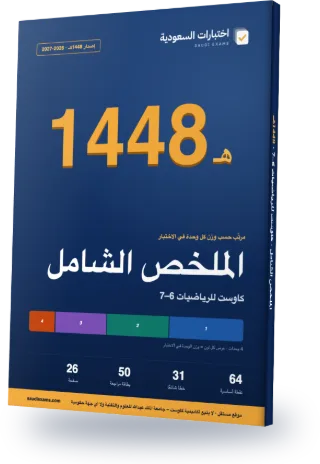 Complete Review Guide 2026–2027 included (PDF)Ordered by the weight of each unit in the examBuy now · SAR 34or 7 days for SAR 26
See everything included
Full mock exams like the real one and 166 explained questions that find your weak spots and train them
- Unlimited full mock exams to practise your pace and check your performance across the whole exam
- Practise 10 weak-area questions, starting where you lose the most marks
- 166 questions explaining why every option is right or wrong
- Arabic and English with one pass
- Unit notes and flashcards, then questions to check your understanding
The competition is not an entry requirement: Phase One is an elimination round, and qualifiers compete in the finals at KAUST. Special prizes for the grades 6–7 winners, plus free places in KAUST Academy programs. Source Last verified: 2026-11-25
Sources and references
- KAUST Academy – KAUST Mathematics Competition academy.kaust.edu.sa
- KAUST Academy – KMC Grades 6–7 Sample Exam academy.kaust.edu.sa
- KAUST Academy – KMC Grades 6–7 Sample Exam Solutions academy.kaust.edu.sa