RMFS
Foundation Risk Management in Financial Services (RMFS)
Foundation Risk Management in Financial Services (RMFS) — Number of questions: Confirm the question count at booking. Exam time: 120 minutes. Pass mark: 70 points. Calculator: Check the booking instructions. Exam fee: SAR 1,552.50. Source: The Financial Academy (Last verified: 2026-11-25). Question bank: A site supplementary practice session of 100 questions in 120 minutes with a result for every unit, plus 522 explained questions across 5 units, every option explained, a review of your mistakes, and two ways to practise: see the answer right away, or sit a full timed mock. Free questions: a 10-question diagnostic test covering the main units, no sign-up; at the end you get your score and your weakest units. With lifetime access: the Complete Review Guide, a 35-page PDF ordered by unit weight; chapter 1 is free to read on the guide page.
Last verified on the The Financial Academy website: 25 November 2026
If you sat the exam today, what would you score?
10 free questions · no sign-up · your score as soon as you finish
Question 1 of 10
A bank is forming a seven-member risk committee. What is the smallest number of independent members that meets the learning material's requirement of a majority of independent members?
All 10 free questions with answers and an explanation for every option
Where the questions come from
- Risk Management Fundamentals35 questions
- Measuring Risk12 questions
- Risk Appetite13 questions
- Risk Governance, Culture and Stress Testing15 questions
- Relevant Laws, Regulations and Issues25 questions
Exam facts
- Exam code
- RMFS
- Exam language
- Arabic or English
- Number of questions
- Confirm the question count at booking
- Exam time
- 120 minutes Source
- Pass mark
- 70 points Source
- Calculator
- Check the booking instructions
- Exam fee
- SAR 1,552.50 Source
- Retakes
- Up to six attempts in the 12 months starting with your first sitting. Each attempt carries a fee. Allow two calendar weeks between attempts after the third. Source
Last verified: 2026-11-25
Exam body
The Financial Academy: Official website: The Financial Academy
How to register
- Open the RMFS exam page on the Financial Academy website and choose Register. The Academy lists no prerequisite certificate or training.
- Sign in to your personal account if you register independently, or coordinate with your employer if it registers you through its account.
- Choose Arabic or English, pay the SAR 1,552.50 registration fee and keep your booking confirmation.
- Arrive at least 30 minutes before the start with a valid national ID, iqama or passport.
Study guides (3)
Frequently asked questions
How long is RMFS and what is the pass mark?
The Financial Academy lists 120 minutes and a pass mark of 70 points. It has not published the question count, so confirm it when you book.
Can I try RMFS Risk Management questions for free?
Yes. Free questions: a 10-question diagnostic test covering the main units, no sign-up; at the end you get your score and your weakest units. The free practice test page lists the same questions with answers and an explanation for every option. The rest of the questions and the full mock exams come with a pass from SAR 26.
What makes this RMFS Risk Management question bank different?
Question bank: A site supplementary practice session of 100 questions in 120 minutes with a result for every unit, plus 522 explained questions across 5 units, every option explained, a review of your mistakes, and two ways to practise: see the answer right away, or sit a full timed mock. Practice questions and explanations are ready to use on your phone. Try the free questions and read the explanations before you buy.
Is there a PDF review guide for RMFS Risk Management?
Yes. "RMFS Risk Management Complete Review Guide 2026–2027" is a 35-page Arabic PDF: 5 units ordered from the heaviest in the exam to the lightest, each chapter with key points, common mistakes and review cards, plus a 7-day plan. Chapter 1 is free to read on the guide page; the full guide comes with lifetime access to this exam and is not part of 7-day access. The guide has no questions: scoring, practice and mock exams are on the site.
How are the RMFS chapters weighted?
Risk management fundamentals 35%, measuring risk 12%, risk appetite 13%, governance, culture and stress testing 15%, and relevant laws, regulations and issues 25%.
Which languages is the exam offered in?
Arabic or English. The study material is available in both languages on the exam page.
Is this an official site, and how do I pay?
It is an independent site, not part of Qiyas, this exam's regulator or any government body, with practice questions and answer explanations. You pay once, with no automatic renewal, through Waffo Pancake (the merchant of record) by Visa, Mastercard, Apple Pay or Google Pay, and your statement shows "WAFFO". If you were charged twice or the pass did not open, email support@saudiexams.com.
RMFS Risk Management Complete Review Guide 2026–2027
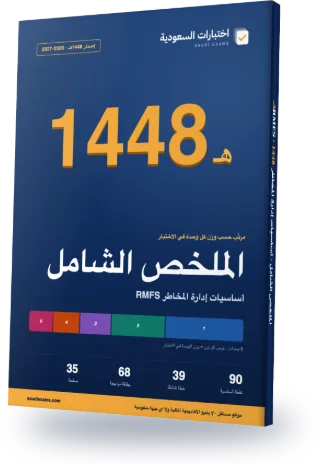
35-page · 90 key points · 39 common mistakes · 68 review cards
The first three chapters alone cover about 75% of the exam. Short on time? Start there.
About the question bank
Practise in Arabic or English: identifying and measuring risk, risk appetite, governance, Basel, money laundering and cyber crime.
- 522 questions in the bank
- 100 questions in 120 minutes per site supplementary practice session
- 68 flashcards
Every option explained so you understand why
What you get
- 522questions in the bankPractise with the answer shown right away, or sit a full timed mock
- 5unitsSplit by the exam syllabus
- 68flashcardsTo lock in terms and definitions
- 90quick review pointsEach unit in a few key lines
Study material sample: Risk Management Fundamentals
Summary
Risk Management Fundamentals is the largest unit in the exam, worth about 35 of every 100 questions (35%). It has five sections. The first defines risk as a bad thing that might happen, and covers the objective of risk management, the ways to reduce risk, the three risk types and the continuous risk management process. The second separates risks from causes and consequences, and shows how to identify all risks by drawing the process and testing it against six objectives. The third covers controls and key controls: evidencing them and testing them for adequacy and effectiveness. The fourth covers key risk indicators, the most useful being control effectiveness. The fifth covers enterprise risk management, why it goes beyond silo-based management, and the roles of the board and executive management. The reference is the workbook, Section 1.
What the exam focuses on · Common traps · Try the flashcards
What the exam focuses on
- The simple definition of risk, a bad thing that might happen, and the purpose of risk management: making good business decisions (1.1.1, 1.1.4).
- Only three risk types exist: credit, market and operational. Reputation, conduct, model and liquidity are causes or consequences, not risk types (1.1.5).
- Telling risk, cause and consequence apart, and using the ‘so what?’ test to reach the real risk (1.3).
Show 5 more
- How to identify all risks: draw the process steps, then test each step against six objectives: accurately, completely, on time, securely, per the laws, per the regulations (1.3).
- The four attributes of a key control: it prevents, detects or reduces the risk; can be evidenced; is tested for adequacy; is tested for effectiveness (1.4).
- Calculating control effectiveness from samples (typically 1% to 5%) and the difference between inherent and residual risk (1.4).
- The three key risk indicators: values, volumes and control effectiveness, with control effectiveness the most powerful (1.5).
- Enterprise risk management: its aim is a top-down holistic view; it is a continuous process that starts with what drives value, and the board's role is oversight (1.6).
Common traps
- Mixing up risk and cause: ‘technology failure’, ‘hacker’ or ‘human error’ are causes. The risk is what they lead to, such as paying the wrong amount.
- Treating reputation, liquidity, financial or compliance as a stand-alone risk. In the workbook these are consequences or causes, and there are only three risk types.
- Choosing ‘eliminate risk’ or ‘reduce risk as far as possible’ as the objective. The right answer is good business decisions that balance risk against cost.
Show 5 more
- Counting policies, procedures and training as controls to rely on. The workbook says they neither prevent nor detect errors, so they should not be called controls.
- Assuming a preventative control is always better than a detective one. The answer is ‘it depends’: a preventative control may be costly or harm other risks, such as timeliness.
- Confusing adequacy with effectiveness. Adequacy means the control would address the risk if run as designed; effectiveness measures the share of errors it actually catches.
- Confusing inherent risk (before controls) with residual risk (after controls are applied).
- Thinking values and volumes alone are enough as indicators. They can stay flat while control effectiveness falls, so the risk rises unseen.
Try the flashcards
Tap a card to see the answer
How does the workbook define risk?
A bad thing that might happen. Definitions built on ‘uncertainty’ or ‘probability’ muddy risk identification.
What are the three ways to reduce risk?
Avoidance (stop the activity), transference (for example insurance) and mitigation (introduce controls).
What is the purpose of risk management?
To make good business decisions by balancing risk against cost, not to eliminate risk.
What are the three risk types?
Credit, market and operational. Every other ‘type’ derives from these or is a cause or consequence.
What is the difference between risk, cause and consequence?
Risk: the bad thing that might happen. Cause: why it might happen. Consequence: what it might lead to.
What is the ‘so what?’ test?
Ask what happens if an item such as ‘technology fails’ occurs; the answer is the risk (a late or wrong payment) and the item is the cause.
What six objectives is each process step tested against?
Accurately, completely, on time, securely, per the relevant laws, per the relevant regulations.
What are the attributes of a key control?
It prevents, detects or reduces the risk, can be evidenced, is tested for adequacy and tested for effectiveness.
Why you can trust these questions
- Published questions: 522. Read the explanations and references, and report any error from the question.
- Exam facts last checked against the organiser’s website: 2026-11-25. We check them again every three months and two weeks before each test.
- Found a mistake? Tap "Report an error" under any question in the practice area, or email us at support@saudiexams.com
- Independent website. Not affiliated with ETEC (Qiyas), the Financial Academy, ACAMS, the ACFE, DAMA, CompTIA, Saudi Aramco or any government body.
Full prep for this exam
All of this in one purchase.
- Timed supplemental practice sessions100 questions in 120 minutes. You get a total score and a score for every unit.
- Practice unit by unit522 questions, every option explained with its source. Starts with your weakest units.
- Complete Review Guide 2026–2027 (PDF)Ordered by each unit's weight in the exam. With lifetime access only.
Choose your access
Continue with your Google account and you go straight to the payment page.