RMFS
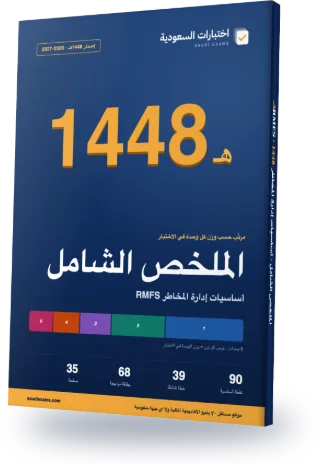
RMFS Risk Management Complete Review Guide 2026–2027
A 41-page PDF ordered by unit weight. The first three chapters cover 75% of the published syllabus weight.
- 41Pages
- 90Key points
- 39Common mistakes
- 68Flashcards
Guide map
Each chapter is one exam unit, ordered by its weight in the real exam.
| Chapter | Unit | Weight | Key points |
|---|---|---|---|
| 1 | Risk Management Fundamentals | 35% | 18 |
| 2 | Relevant Laws, Regulations and Issues | 25% | 18 |
| 3 | Risk Governance, Culture and Stress Testing | 15% | 18 |
| 4 | Risk Appetite | 13% | 18 |
| 5 | Measuring Risk | 12% | 18 |
Chapter 1 in full: Risk Management Fundamentals
This chapter accounts for 35% of the published syllabus weight. These are its key points.
- The workbook defines risk as a bad thing that might happen. Other common definitions (a state of uncertainty, probability and impact of an event) muddy risk identification (1.1.1, 1.3).
- Three ways to reduce risk: avoidance (stop the activity or exit a jurisdiction), transference (for example insurance) and mitigation (automated or manual controls) (1.1.3).
- Three risk types: credit (a debt not repaid in full and on time), market (an investment or exchange rate moves against the firm) and operational (failure of processes, people or systems) (1.1.5).
The rest of chapter 1, on this page
- Risk: the bad thing that might happen. Cause: why it might happen. Consequence: what it might result in. Each is listed separately (1.3).
- The ‘so what?’ test: if technology fails, what is the bad outcome? A delayed or wrong payment. That is the risk; the technology failure is the cause (1.3).
- Risk identification takes two steps: draw the process, then test each step against six objectives: accurately, completely, on time, securely, per the laws, per the regulations (1.3).
- Inherent risk is the level of risk without controls; residual risk is what remains after the controls are applied (1.4).
- A key control prevents, detects or reduces the risk, can be evidenced, is tested for adequacy and is tested for effectiveness. What cannot be evidenced cannot be tested or relied upon (1.4).
- W5H1 articulation: who, what exactly, why, where, when, and how it is evidenced. A clear statement helps the adequacy review and effectiveness testing (1.4).
- Effectiveness by sampling: 2 errors in a sample of 100 means a 2% error rate; if the rate without the control was 10%, the control is 98% effective (1.4).
- Controls are preventative (stop the risk happening) or detective (identify that it has). Neither is always better; the choice depends on cost and the effect on other risks (1.4).
- A key risk indicator shows when a risk is more or less likely, or its consequence larger or smaller. More offers raises likelihood; higher value per offer raises impact (1.5).
- The three most useful indicators: values, volumes and the effectiveness rating of each control, monitored over time to show the trend, not at a single point (1.5).
- ERM gives a top-down, holistic view of the risks affecting strategic objectives, instead of each unit managing its own risks in a silo (1.6).
- Five limits of the traditional approach: risks fall between silos, risks hit several units, one unit's response triggers risk elsewhere, an internal-only lens, and weak links to strategic planning (1.6).
- The ERM process is ongoing, not a project that ends. It starts from what drives value today and what the strategic plan adds, then identifies, assesses, responds to and monitors risks (1.6).
- In a Bow-Tie analysis, the left side of the knot (the risk event) lowers the probability of occurrence and the right side lowers the impact if it occurs (1.6).
- ERM is led by executive management and the board: management designs and implements the process; the board oversees it by understanding and approving it and checking risks stay within risk appetite (1.6).
Common mistakes in this chapter
- Mixing up risk and cause: ‘technology failure’, ‘hacker’ or ‘human error’ are causes. The risk is what they lead to, such as paying the wrong amount.
- Treating reputation, liquidity, financial or compliance as a stand-alone risk. In the workbook these are consequences or causes, and there are only three risk types.
- Choosing ‘eliminate risk’ or ‘reduce risk as far as possible’ as the objective. The right answer is good business decisions that balance risk against cost.
- Counting policies, procedures and training as controls to rely on. The workbook says they neither prevent nor detect errors, so they should not be called controls.
- Assuming a preventative control is always better than a detective one. The answer is ‘it depends’: a preventative control may be costly or harm other risks, such as timeliness.
- Confusing adequacy with effectiveness. Adequacy means the control would address the risk if run as designed; effectiveness measures the share of errors it actually catches.
- Confusing inherent risk (before controls) with residual risk (after controls are applied).
- Thinking values and volumes alone are enough as indicators. They can stay flat while control effectiveness falls, so the risk rises unseen.
The other chapters are in the full guide
One purchase · lifetime access · review guide included
7-day review plan
The chapters are spread over 6 days by weight so each day carries a similar load. Day 7 is a full exam.
Day 1 · 35% of the exam
Chapter 1: Risk Management Fundamentals
Day 2 · 25% of the exam
Chapter 2: Relevant Laws, Regulations and Issues
Day 3 · 15% of the exam
Chapter 3: Risk Governance, Culture and Stress Testing
Day 4 · 13% of the exam
Chapter 4: Risk Appetite
Day 5 · 12% of the exam
Chapter 5: Measuring Risk
Day 6
Review the common mistakes and flashcards.
Day 7
Complete a timed supplementary practice set and review the units where you lost marks.
Before you read: see your score today
10 free questions from the main units, no sign-up. Then you know which chapter to start with.
Try 10 free questions and see your levelA look at each chapter
The first three key points of each chapter, as they appear in the guide (in Arabic in the PDF).
Chapter 1: Risk Management Fundamentals
- The workbook defines risk as a bad thing that might happen. Other common definitions…
- Three ways to reduce risk
- Three risk types
Chapter 2: Relevant Laws, Regulations and Issues
- The Basel Committee on Banking Supervision (BCBS) is a group of international supervisory bodies…
- Committee activities
- Basel Accords
Chapter 3: Risk Governance, Culture and Stress Testing
- The first line of defence is each business area
- The second line is the risk and compliance oversight functions: it sets policies and…
- When the first line fails to identify or measure risks or decide well, the…
Chapter 4: Risk Appetite
- Risk appetite is a decision about how much risk the bank is willing to…
- Taking more risk can be quite right in some situations
- The term "risk limits" has been common in fund management since 2000. It sets…
Chapter 5: Measuring Risk
- We measure to make a decision
- Before measuring, define the specific risk; a risk that is not clearly defined cannot…
- Probability is the likelihood of the bad thing happening and impact is the consequence…
The full guide comes with lifetime access
Lifetime access includes the full guide (41 pages), all questions and supplementary practice. Chapter 1 is free for everyone.
Questions about the guide
Is the guide free?
Chapter 1 is free to read on the guide page. The full guide comes with lifetime access to this exam; 7-day access does not include it.
Is it up to date for 2026–2027?
Yes. Unit weights and exam facts follow what the exam body last published, and the last check date is printed in the guide. If the standards change we update the file and buyers download the new version.
Does the guide have questions?
No. The guide covers key points and common mistakes; scoring, weak-area practice and full mock exams are on the site.
Can I read it on my phone?
Yes. A5 pages in a single column, with chapters linked from the contents.
- Pages
- 41
- Edition
- 1448 AH · 2026–2027
- Language
- English
- Last updated
All Finance & Insurance Exams review guides
Back to Foundation Risk Management in Financial Services (RMFS)
Full prep for this exam
All of this in one purchase.
- Timed supplemental practice sessions100 questions in 120 minutes. You get a total score and a score for every unit.
- Practice unit by unit522 questions, every option explained with its source. Starts with your weakest units.
- Complete Review Guide 2026–2027 (PDF)Ordered by each unit's weight in the exam. With lifetime access only.
Choose your access
Continue with your Google account and you go straight to the payment page.