Saudi Board Part One Examination – Urology
Saudi Board Part One Examination – Urology — Number of questions: 150 questions. Exam time: Confirm with the exam body. Pass mark: 65%. Exam fee: Registration is automatic and free for eligible trainees. Source: Saudi Commission for Health Specialties (SCFHS) (Last verified: 2026-11-25). Question bank: A site supplementary practice session of 150 questions in 90 minutes with a result for every unit, plus 604 explained questions across 8 units, every option explained, a review of your mistakes, and two ways to practise: see the answer right away, or sit a full timed mock. Free questions: a 10-question diagnostic test covering the main units, no sign-up; at the end we compare your score with the pass mark and show your weakest units. With lifetime access: the Complete Review Guide, a 59-page PDF ordered by unit weight; chapter 1 is free to read on the guide page.
Last verified on the Saudi Commission for Health Specialties (SCFHS) website: 25 November 2026
If you sat the exam today, what would you score?
10 free questions · no sign-up · your score as soon as you finish
Question 1 of 10
A 72-year-old woman on warfarin for atrial fibrillation has hypertension, type 2 diabetes and a previous transient ischaemic attack. She has no heart failure or vascular disease. What is her CHA2DS2-VASc score?
All 10 free questions with answers and an explanation for every option
Where the questions come from
- Genitourinary Anatomy17 questions
- Trauma, Shock and Monitoring23 questions
- Haemostasis and Genitourinary Physiology26 questions
- Infections and Inflammation28 questions
- Wound Healing10 questions
- Oncology and Molecular Biology12 questions
- Basics of Urologic Surgery25 questions
- Basics of Renal Insufficiency and Transplantation9 questions
Exam facts
- Exam language
- English
- Number of questions
- 150 questions Source
- Exam time
- Confirm with the exam body
- Pass mark
- 65% Source
- Exam fee
- Registration is automatic and free for eligible trainees Source
Last verified: 2026-11-25
Where other sources differ
- The current blueprint covers 2024–2027 (v.1); each section may vary by ±5%. Research, ethics, professionalism and patient safety are incorporated within the various domains.
Exam body
Saudi Commission for Health Specialties (SCFHS): Official website: Saudi Commission for Health Specialties (SCFHS)
How to register
- The system registers you automatically once you have completed nine months of training in a Saudi Board programme with valid registration.
- You are notified of the date and city on Mumaris+.
- The exam is held once a year, and you have a maximum of four attempts.
Study guides (3)
Frequently asked questions
How many questions are in Part One and what is the pass mark?
150 single-best-answer questions, plus up to 10% unscored pretest items. The pass mark is 65%; it can be lowered one mark at a time to a floor of 60% if fewer than 70% pass, according to the published blueprint.
Can I try Saudi Board Urology Part 1 questions for free?
Yes. Free questions: a 10-question diagnostic test covering the main units, no sign-up; at the end we compare your score with the pass mark and show your weakest units. The free practice test page lists the same questions with answers and an explanation for every option. The rest of the questions and the full mock exams come with a pass from SAR 26.
What makes this Saudi Board Urology Part 1 question bank different?
Question bank: A site supplementary practice session of 150 questions in 90 minutes with a result for every unit, plus 604 explained questions across 8 units, every option explained, a review of your mistakes, and two ways to practise: see the answer right away, or sit a full timed mock. Practice questions and explanations are ready to use on your phone. Try the free questions and read the explanations before you buy.
Is there a PDF review guide for Saudi Board Urology Part 1?
Yes. "Saudi Board Urology Part 1 Complete Review Guide 2026–2027" is a 59-page Arabic PDF: 8 units ordered from the heaviest in the exam to the lightest, each chapter with key points, common mistakes and review cards, plus a 7-day plan. Chapter 1 is free to read on the guide page; the full guide comes with lifetime access to this exam and is not part of 7-day access. The guide has no questions: scoring, practice and mock exams are on the site.
What does Saudi Board Urology Part 1 cover, and how is it split by section?
150 questions, split by the published weights as follows: Genitourinary Anatomy (17); Trauma, Shock and Monitoring (23); Haemostasis and Genitourinary Physiology (26); Infections and Inflammation (28); Wound Healing (10); Oncology and Molecular Biology (12); Basics of Urologic Surgery (25); Basics of Renal Insufficiency and Transplantation (9). Source: SCFHS published blueprint. Counts are rounded from the percentages and each section may vary by up to 5%.
Which language is Saudi Board Urology Part 1 in?
SCFHS does not state the exam language, but all of its listed references are English textbooks, so our questions are in English. Explanations are in Arabic and English, and you can switch language on any question with one tap.
How do I register for Saudi Board Urology Part 1?
The system registers you automatically once you have completed nine months of training in a Saudi Board programme with valid registration, and you are notified of the date and city on Mumaris+. The registration service is free.
How many times can I sit the Part One exam?
It is held once a year, and you have a maximum of four attempts, after which the trainee is removed from the programme, according to the SCFHS executive assessment rules.
Is this an official site, and how do I pay?
It is an independent site, not part of Qiyas, this exam's regulator or any government body, with practice questions and answer explanations. You pay once, with no automatic renewal, through Waffo Pancake (the merchant of record) by Visa, Mastercard, Apple Pay or Google Pay, and your statement shows "WAFFO". If you were charged twice or the pass did not open, email support@saudiexams.com.
Saudi Board Urology Part 1 Complete Review Guide 2026–2027
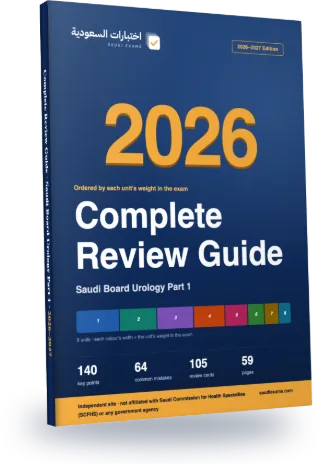
59-page · 140 key points · 64 common mistakes · 105 review cards
The first three chapters alone cover about 53% of the exam. Short on time? Start there.
About the question bank
604 Saudi Board Urology Part 1 questions across 8 domains. The largest is Infections and Inflammation, 19% of the exam. Every question comes with an answer explanation.
- 150 questions in 90 minutes per site supplementary practice session
- 604 questions covering the main scoring topics, with explanations
- 65% pass mark, with targeted practice on your weak spots
See the gap to your target score Practise the units costing you the most marks Supplementary practice
Every option explained so you understand why
What you get
- 604questions in the bankPractise with the answer shown right away, or sit a full timed mock
- 8unitsSplit by the exam syllabus
- 105flashcardsTo lock in terms and definitions
- 140quick review pointsEach unit in a few key lines
Study material sample: Genitourinary Anatomy
Summary
This unit covers genitourinary anatomy and carries about 11% of the exam, roughly 17 questions. It has five sections: kidney, adrenal gland and retroperitoneum (renal fascia, renal trauma grading, adrenal management at nephrectomy, aldosterone); ureter, bladder and pelvic floor (sites of narrowing, ureteral and bladder injury, sacral nerve roots); prostate, urethra and sphincters (zones, Denonvilliers' fascia, neurovascular bundle, artificial urinary sphincter); penis, scrotum, testis and spermatic cord (blood supply, descent, trauma); and embryology and congenital anomalies (hypospadias, undescended testis, CAKUT). Most questions are clinical and link anatomy to imaging and surgery.
What the exam focuses on · Common traps · Try the flashcards
What the exam focuses on
- The perirenal space holds the kidney, adrenal gland and ureter; the descending colon, pancreas and duodenum lie in the anterior pararenal space.
- Renal injury grade 2: non-expanding perirenal haematoma within Gerota's fascia, or a laceration under 1 cm without urinary extravasation.
- Do not remove a clinically normal adrenal at radical nephrectomy; contiguous tumour extension into the ipsilateral adrenal is T4.
Show 5 more
- Ureter: the two physiological narrowings are the upper ureter and the ureterovesical junction; most injuries are iatrogenic, and distal injuries are repaired by reimplantation with a psoas hitch.
- Bladder rupture: extraperitoneal is usually managed by catheter drainage; intraperitoneal (dome) needs surgical repair.
- Prostate: the peripheral zone is the largest, gives 70-75% of cancers and is palpable on rectal examination; Denonvilliers' fascia covers the posterior prostate and seminal vesicles.
- Continence after prostatectomy depends mainly on the distal urethral sphincter; an artificial urinary sphincter stays deactivated for at least 6 weeks.
- Testis: the right vein drains into the IVC and the left into the renal vein; Fowler-Stephens relies on the deferential and cremasteric arteries; Colles fascia links perineum, scrotum and penis.
Common traps
- Anterior pararenal versus perirenal space: colon, pancreas and duodenum lie outside the renal fascia.
- A central expanding retroperitoneal haematoma suggests renal pedicle, aortic or caval injury, and is a more serious finding than a simple renal laceration.
- A redundant kink of the proximal ureter without hydronephrosis is a normal finding in about 20% of studies and needs no intervention.
Show 5 more
- Confusing extraperitoneal rupture (drainage) with intraperitoneal rupture (surgery); bladder neck involvement or bone fragments move extraperitoneal cases to surgery.
- Confusing Denonvilliers' fascia with the neurovascular bundle: the bundle runs between levator ani fascia and prostatic fascia, with most nerve surface posterolateral.
- Assuming the bladder neck is essential for continence after prostatectomy: most continence comes from the distal urethral sphincter.
- An ectopic testis lies outside the normal path of descent, will not descend spontaneously and needs surgery.
- In boys an ectopic ureteral orifice is always above the external sphincter, so there is no continuous incontinence and epididymitis is the typical presentation.
Try the flashcards
Tap a card to see the answer
What does the perirenal space contain?
The kidney, suprarenal gland and ureter.
Which renal injury grade: non-expanding perirenal haematoma within Gerota's fascia and an 8 mm laceration without extravasation?
Grade 2.
What T stage is a renal tumour with contiguous extension into the ipsilateral adrenal?
T4.
Where do ureteral stones cluster physiologically?
The upper ureter and the ureterovesical junction.
How is a lower-third ureteral injury repaired after failed stenting?
Ureteroneocystostomy with a psoas hitch.
How is uncomplicated extraperitoneal bladder rupture managed?
Continuous catheter drainage and observation.
Which prostatic zone is palpable on rectal examination and gives most cancers?
The peripheral zone.
What does Denonvilliers' fascia cover and where does it end?
The posterior prostate and seminal vesicles; it ends at the prostatourethral junction.
Why you can trust these questions
- Published questions: 604. Read the explanations and references, and report any error from the question.
- Exam facts last checked against the organiser’s website: 2026-11-25. We check them again every three months and two weeks before each test.
- Found a mistake? Tap "Report an error" under any question in the practice area, or email us at support@saudiexams.com
- Independent website. Not affiliated with ETEC (Qiyas), the Financial Academy, ACAMS, the ACFE, DAMA, CompTIA, Saudi Aramco or any government body.
Full prep for this exam
All of this in one purchase.
- Timed supplemental practice sessions150 questions in 90 minutes. You get a total score and a score for every unit.
- Practice unit by unit604 questions, every option explained with its source. Starts with your weakest units.
- Complete Review Guide 2026–2027 (PDF)Ordered by each unit's weight in the exam. With lifetime access only.
Choose your access
Continue with your Google account and you go straight to the payment page.