Saudi Board Part One Examination – Neurosurgery
Saudi Board Part One Examination – Neurosurgery — Number of questions: 150 questions. Exam time: Confirm with the exam body. Pass mark: 65%. Exam fee: Registration is automatic and free for eligible trainees. Source: Saudi Commission for Health Specialties (SCFHS) (Last verified: 2026-11-25). Question bank: A site supplementary practice session of 150 questions in 90 minutes with a result for every unit, plus 608 explained questions across 12 units, every option explained, a review of your mistakes, and two ways to practise: see the answer right away, or sit a full timed mock. Free questions: a 10-question diagnostic test covering the main units, no sign-up; at the end we compare your score with the pass mark and show your weakest units. With lifetime access: the Complete Review Guide, a 86-page PDF ordered by unit weight; chapter 1 is free to read on the guide page.
Last verified on the Saudi Commission for Health Specialties (SCFHS) website: 25 November 2026
If you sat the exam today, what would you score?
10 free questions · no sign-up · your score as soon as you finish
Question 1 of 10
A 64-year-old hypertensive man has a large acute basal ganglia haemorrhage with drowsiness. Pressure is 220/120 mm Hg (MAP about 153), and ICP through an external ventricular drain is 28 mm Hg and rising as the haematoma expands. Which initial MAP target best fits the haemodynamics?
All 10 free questions with answers and an explanation for every option
Where the questions come from
- Fluids, Electrolytes, and Acid-Base Balance15 questions
- Shock and Hemostasis15 questions
- Surgical Infections and Antibiotics15 questions
- Perioperative Management and Surgical Critical Care15 questions
- Wounds and Wound Healing15 questions
- Neuro-anatomy15 questions
- Neurophysiology8 questions
- Neurological examination skills15 questions
- Neurochemistry and pharmacology8 questions
- Raised ICP, Cerebral Edema and Brain Herniation15 questions
- Hydrocephalus and Basic Neurosurgical approaches7 questions
- Neurotrauma7 questions
Exam facts
- Exam language
- English
- Number of questions
- 150 questions Source
- Exam time
- Confirm with the exam body
- Pass mark
- 65% Source
- Exam fee
- Registration is automatic and free for eligible trainees Source
Last verified: 2026-11-25
Where other sources differ
- The current blueprint covers 2024–2027 (v.1) in three parts: principles of surgery, basic neuroscience and basic neurosurgery. Each section may vary by ±5%; research, ethics, professionalism and patient safety are incorporated within the domains.
Exam body
Saudi Commission for Health Specialties (SCFHS): Official website: Saudi Commission for Health Specialties (SCFHS)
How to register
- The system registers you automatically once you have completed nine months of training in a Saudi Board programme with valid registration.
- You are notified of the date and city on Mumaris+.
- The exam is held once a year, and you have a maximum of four attempts.
Study guides (3)
Frequently asked questions
How many questions are in Part One and what is the pass mark?
150 single-best-answer questions, plus up to 10% unscored pretest items. The pass mark is 65%; it can be lowered one mark at a time to a floor of 60% if fewer than 70% pass, according to the published blueprint.
Can I try Saudi Board Neurosurgery Part 1 questions for free?
Yes. Free questions: a 10-question diagnostic test covering the main units, no sign-up; at the end we compare your score with the pass mark and show your weakest units. The free practice test page lists the same questions with answers and an explanation for every option. The rest of the questions and the full mock exams come with a pass from SAR 26.
What makes this Saudi Board Neurosurgery Part 1 question bank different?
Question bank: A site supplementary practice session of 150 questions in 90 minutes with a result for every unit, plus 608 explained questions across 12 units, every option explained, a review of your mistakes, and two ways to practise: see the answer right away, or sit a full timed mock. Practice questions and explanations are ready to use on your phone. Try the free questions and read the explanations before you buy.
Is there a PDF review guide for Saudi Board Neurosurgery Part 1?
Yes. "Saudi Board Neurosurgery Part 1 Complete Review Guide 2026–2027" is a 86-page Arabic PDF: 12 units ordered from the heaviest in the exam to the lightest, each chapter with key points, common mistakes and review cards, plus a 7-day plan. Chapter 1 is free to read on the guide page; the full guide comes with lifetime access to this exam and is not part of 7-day access. The guide has no questions: scoring, practice and mock exams are on the site.
What does Saudi Board Neurosurgery Part 1 cover, and how is it split by section?
150 questions, split by the published weights as follows: Fluids, Electrolytes, and Acid-Base Balance (15); Shock and Hemostasis (15); Surgical Infections and Antibiotics (15); Perioperative Management and Surgical Critical Care (15); Wounds and Wound Healing (15); Neuro-anatomy (15); Neurophysiology (8); Neurological examination skills (15); Neurochemistry and pharmacology (8); Raised ICP, Cerebral Edema and Brain Herniation (15); Hydrocephalus and Basic Neurosurgical approaches (7); Neurotrauma (7). Source: SCFHS published blueprint. Counts are rounded from the percentages and each section may vary by up to 5%.
Which language is Saudi Board Neurosurgery Part 1 in?
SCFHS does not state the exam language, but all of its listed references are English textbooks, so our questions are in English. Explanations are in Arabic and English, and you can switch language on any question with one tap.
How do I register for Saudi Board Neurosurgery Part 1?
The system registers you automatically once you have completed nine months of training in a Saudi Board programme with valid registration, and you are notified of the date and city on Mumaris+. The registration service is free.
How many times can I sit the Part One exam?
It is held once a year, and you have a maximum of four attempts, after which the trainee is removed from the programme, according to the SCFHS executive assessment rules.
Is this an official site, and how do I pay?
It is an independent site, not part of Qiyas, this exam's regulator or any government body, with practice questions and answer explanations. You pay once, with no automatic renewal, through Waffo Pancake (the merchant of record) by Visa, Mastercard, Apple Pay or Google Pay, and your statement shows "WAFFO". If you were charged twice or the pass did not open, email support@saudiexams.com.
Saudi Board Neurosurgery Part 1 Complete Review Guide 2026–2027
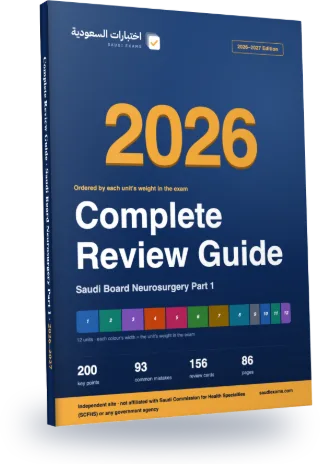
86-page · 200 key points · 93 common mistakes · 156 review cards
The first three chapters alone cover about 30% of the exam. Short on time? Start there.
About the question bank
608 Saudi Board Neurosurgery Part 1 questions across 12 domains. The largest is Fluids, Electrolytes, and Acid-Base Balance, 10% of the exam. Every question comes with an answer explanation.
- 150 questions in 90 minutes per site supplementary practice session
- 608 questions covering the main scoring topics, with explanations
- 65% pass mark, with targeted practice on your weak spots
See the gap to your target score Practise the units costing you the most marks Supplementary practice
Every option explained so you understand why
What you get
- 608questions in the bankPractise with the answer shown right away, or sit a full timed mock
- 12unitsSplit by the exam syllabus
- 156flashcardsTo lock in terms and definitions
- 200quick review pointsEach unit in a few key lines
Study material sample: Fluids, Electrolytes, and Acid-Base Balance
Summary
This unit carries about 15 exam questions (10% of the score) in three sections. Perioperative fluid therapy covers resuscitation and maintenance prescriptions, balanced fluids versus saline, and testing fluid responsiveness. Sodium and potassium disorders in surgical and neurosurgical patients covers post-pituitary diabetes insipidus, SIADH versus cerebral salt wasting, and hypo- and hyperkalaemia. Acid-base disorders covers metabolic acidosis and alkalosis, anion gap, urine electrolytes, and ventilation targets in raised intracranial pressure. Questions are clinical and ask for the best next step.
What the exam focuses on · Common traps · Try the flashcards
What the exam focuses on
- Resuscitation: crystalloid with sodium 130 to 154 mmol/L, 500 mL over under 15 minutes, then reassess (NICE).
- First-24-hour maintenance: water 25 to 30 mL/kg, sodium, potassium and chloride about 1 mmol/kg each, glucose 50 to 100 g; use less (20 to 25 mL/kg) in the elderly, frail, or those with renal or cardiac failure.
- Crystalloids are the mainstay; colloids, especially starch, raised acute kidney injury and mortality. Balanced fluids are preferred to 0.9% saline in hyperchloraemic acidosis.
Show 5 more
- Fluid responsiveness testing (passive leg raise or an adequate fluid challenge) beats static pressures; responsiveness alone does not mean a patient needs fluid if perfusion is adequate.
- Postoperative diabetes insipidus: polyuria and low specific gravity criteria, with thirst and sodium rechecked every 3 hours; the triphasic response makes desmopressin hazardous in the SIADH phase (days 5 to 8).
- SIADH versus cerebral salt wasting: salt wasting shows negative balance, weight loss and orthostasis, and treatment is salt and water, not water restriction.
- Severe hypokalaemia: replace magnesium first, then KCl in saline at 10 mmol/h (maximum 20) with ECG monitoring.
- Ventilation target in brain injury without herniation: PaCO2 35 to 45 mm Hg; hyperventilation is a temporary bridge with SjO2 monitoring.
Common traps
- Confusing the resuscitation dose (500 mL fast) with maintenance (25 to 30 mL/kg/day): the first is for shock, the second for a stable nil-by-mouth patient.
- Treating 0.9% saline as always safe: it carries chloride 154 mmol/L and causes hyperchloraemic acidosis with a normal anion gap.
- Giving fluid to every responder: responsiveness does not mean benefit, and no haemodynamic gain on leg raise means looking for another cause of oliguria.
Show 5 more
- Continuing desmopressin without review after pituitary surgery: the patient may enter an SIADH phase and become hyponatraemic, so need is rechecked periodically.
- Misreading potassium shifts: hyperchloraemic acidosis moves potassium out of cells, while insulin and beta-2 agonists move it in.
- Using a normal ECG to dismiss hyperkalaemia: sensitivity is poor and tracings can be normal in severe hyperkalaemia.
- Reading the anion gap without correcting for albumin: each 10 g/L fall lowers the gap about 2.5 mmol/L and hides the true gap.
- Relying on the urine osmolal gap when mannitol, ethanol or methanol is in the urine: they inflate the gap and it cannot be interpreted.
Try the flashcards
Tap a card to see the answer
What is the adult resuscitation fluid prescription?
Crystalloid sodium 130 to 154 mmol/L, 500 mL in under 15 minutes, then reassess.
What is the first-24-hour maintenance prescription?
25 to 30 mL/kg water, about 1 mmol/kg sodium, potassium and chloride, and 50 to 100 g glucose.
Why is starch avoided?
It raised acute kidney injury and mortality.
What does large-volume 0.9% saline cause?
Hyperchloraemic acidosis with a normal anion gap.
When does the SIADH phase start after pituitary surgery?
About days 5 to 8, and desmopressin becomes hazardous.
How is cerebral salt wasting treated?
Isotonic saline to replace salt and water, not water restriction.
How is hyponatraemia overcorrection defined?
A rise above 12 mmol/L in 24 hours.
What is the first step in severe hypokalaemia with low magnesium?
Replace magnesium, then KCl in saline at 10 mmol/h with ECG monitoring.
Why you can trust these questions
- Published questions: 608. Read the explanations and references, and report any error from the question.
- Exam facts last checked against the organiser’s website: 2026-11-25. We check them again every three months and two weeks before each test.
- Found a mistake? Tap "Report an error" under any question in the practice area, or email us at support@saudiexams.com
- Independent website. Not affiliated with ETEC (Qiyas), the Financial Academy, ACAMS, the ACFE, DAMA, CompTIA, Saudi Aramco or any government body.
Full prep for this exam
All of this in one purchase.
- Timed supplemental practice sessions150 questions in 90 minutes. You get a total score and a score for every unit.
- Practice unit by unit608 questions, every option explained with its source. Starts with your weakest units.
- Complete Review Guide 2026–2027 (PDF)Ordered by each unit's weight in the exam. With lifetime access only.
Choose your access
Continue with your Google account and you go straight to the payment page.