Saudi Board Neurosurgery Part 1 Exam Content: Sections, Weights and Format
What Saudi Board Neurosurgery Part 1 tests: the 12 sections with their weights, the exam format and what is known about the pass mark.
- Questions and time
- 150 questions · Confirm with the exam body
- Pass mark
- 65%
- Exam fee
- Registration is automatic and free for eligible trainees
Start with 10 free questions to find what needs more work. No sign-up, with answer explanations.
Try 10 free questions and see your levelPut what you just read into practice
Saudi Board Neurosurgery Part 1
Start with 10 free questions to find what needs more work. No sign-up, with answer explanations.
Try 10 free questions and see your levelLast verified: 25 November 2026. This is an independent guide; it is not affiliated with Saudi Commission for Health Specialties (SCFHS) or any government body. Exam details can change, so check the published exam blueprint before relying on any figure.
Exam format
- One paper of 150 single-best-answer questions, plus up to 10% unscored pretest items
- The duration, the number of options per question and the calculator policy are not stated in the published blueprint, so confirm them with the Commission
- Pass mark: 65%; it can be lowered one mark at a time to a floor of 60% if fewer than 70% pass
- Exam language: not stated by the Commission, but all of its listed references are English textbooks, so our questions are in English
Sections and weights
The blueprint covers three parts: principles of surgery, basic neuroscience and basic neurosurgery, split into twelve sections.
| Section | Weight | Questions |
|---|---|---|
| Fluids, Electrolytes, and Acid-Base Balance | 10% | 15 questions |
| Shock and Hemostasis | 10% | 15 questions |
| Surgical Infections and Antibiotics | 10% | 15 questions |
| Perioperative Management and Surgical Critical Care | 10% | 15 questions |
| Wounds and Wound Healing | 10% | 15 questions |
| Neuro-anatomy | 10% | 15 questions |
| Neurological examination skills | 10% | 15 questions |
| Raised ICP, Cerebral Edema and Brain Herniation | 10% | 15 questions |
| Neurophysiology | 5% | 8 questions |
| Neurochemistry and pharmacology | 5% | 8 questions |
| Hydrocephalus and Basic Neurosurgical approaches | 5% | 7 questions |
| Neurotrauma | 5% | 7 questions |
Question counts are worked out from the blueprint percentages over 150 questions by the largest-remainder method. The blueprint says each section may vary by 5%, so your actual paper can differ. The topics inside each section are our own breakdown, drawn from the blueprint and the reference list; the official blueprint gives sections and weights only.
The blueprint states that research, ethics, professionalism and patient safety are incorporated within the domains rather than being a section of their own, so expect such questions inside every section.
Recommended references
The Commission publishes a list of 8 references. It says the list is a study aid only, does not imply endorsement of these specific books, and that exam questions are not necessarily taken from them:
- Schwartz's Principles of Surgery (Basic Principles of Surgery section)
- Schwartz's Principles of Surgery, ABSITE and Board Review
- Rush University Medical Center Review of Surgery
- Handbook of Neurosurgery, 8th edition (Greenberg): anatomy, physiology and general neurosurgery sections
- Youmans Neurological Surgery (basic science and general neurosurgery sections)
- Comprehensive Neurosurgery Board Review (Citow): anatomy, physiology and critical care sections
- Professionalism and Ethics Handbook for Residents (SCFHS)
- Essentials of Patient Safety (SCFHS)
The full list is in the published blueprint.
How to use this
Eight sections carry 10% each, which is 15 questions per section: five general surgery sections (fluids and electrolytes, shock and hemostasis, infection, perioperative care, wounds) and three neuroscience sections (neuro-anatomy, neurological examination, raised ICP). Neurophysiology, neurochemistry and pharmacology, hydrocephalus with basic approaches, and neurotrauma carry 5% each. Try the 10 free questions, no sign-up, to find your weakest sections, then plan your study with the study plan; the registration guide covers booking.
Finished reading? Try a set of questions
Start with 10 free questions to find your weakest units. Keep practising with the full question bank and mock exams from SAR 26.
Put the plan to work here
SAR 34 $9
One purchase · lifetime access · review guide included
- 608 questions, every option explained with its source
- Timed supplementary practice sessions: 150 questions in 90 minutes
- Practice that starts with your weakest units, plus a review of your mistakes
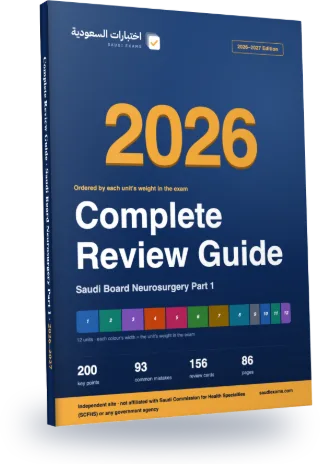 Complete Review Guide 2026–2027 included (PDF)Ordered by the weight of each unit in the examBuy now · SAR 34or 7 days for SAR 26
See everything included
Timed supplementary practice and 608 explained questions to review your weak areas
- Repeat supplementary practice sessions and review performance by unit
- Practise 10 weak-area questions, starting where you lose the most marks
- 608 questions explaining why every option is right or wrong
- Arabic and English with one pass
- Unit notes and flashcards, then questions to check your understanding
Sources and references
- Published exam blueprint scfhs.org.sa