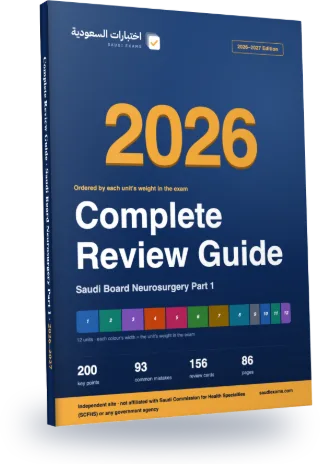
Saudi Board Neurosurgery Part 1 Complete Review Guide 2026–2027
A 86-page PDF ordered by unit weight. The first three chapters cover 30% of the published syllabus weight.
- 86Pages
- 200Key points
- 93Common mistakes
- 156Flashcards
Guide map
Each chapter is one exam unit, ordered by its weight in the real exam.
| Chapter | Unit | Weight | Key points |
|---|---|---|---|
| 1 | Fluids, Electrolytes, and Acid-Base Balance | 10% | 18 |
| 2 | Shock and Hemostasis | 10% | 17 |
| 3 | Surgical Infections and Antibiotics | 10% | 16 |
| 4 | Perioperative Management and Surgical Critical Care | 10% | 18 |
| 5 | Wounds and Wound Healing | 10% | 16 |
| 6 | Neuro-anatomy | 10% | 17 |
| 7 | Neurological examination skills | 10% | 17 |
| 8 | Raised ICP, Cerebral Edema and Brain Herniation | 10% | 16 |
| 9 | Neurophysiology | 5% | 17 |
| 10 | Neurochemistry and pharmacology | 5% | 17 |
| 11 | Hydrocephalus and Basic Neurosurgical approaches | 5% | 15 |
| 12 | Neurotrauma | 5% | 16 |
Chapter 1 in full: Fluids, Electrolytes, and Acid-Base Balance
This chapter accounts for 10% of the published syllabus weight. These are its key points.
- (Perioperative fluid therapy) for resuscitation NICE advises a crystalloid with sodium 130 to 154 mmol/L as a 500 mL bolus over under 15 minutes, then ABCDE reassessment.
- (Perioperative fluid therapy) indicators for urgent resuscitation: systolic pressure under 100, heart rate over 90, capillary refill over 2 seconds or cold peripheries.
- (Perioperative fluid therapy) first-24-hour maintenance: 25 to 30 mL/kg water, about 1 mmol/kg each of sodium, potassium and chloride, and 50 to 100 g glucose; potassium is rounded to the nearest premixed bags.
The rest of chapter 1, on this page
- (Perioperative fluid therapy) for the elderly, frail, renal or cardiac failure and refeeding risk, water falls to 20 to 25 mL/kg; in obesity dose on ideal body weight and seek expert help if BMI exceeds 40.
- (Perioperative fluid therapy) 0.9% saline (chloride 154) causes hyperchloraemic acidosis; balanced solutions are generally preferred, and in DKA resolution was about 3.5 hours shorter.
- (Perioperative fluid therapy) static pressures are not fluid targets; use an adequate fluid challenge or passive leg raise, and a challenge that fails to raise mean systemic filling pressure may be too small.
- (Sodium and potassium disorders in surgical and neurosurgical patients) postoperative diabetes insipidus needs polyuria and low specific gravity, and when unclear thirst and sodium or osmolality are repeated every 3 hours.
- (Sodium and potassium disorders in surgical and neurosurgical patients) triphasic response: vasopressin released from degenerating neurons at days 5 to 8 causes SIADH and hyponatraemia in patients on desmopressin.
- (Sodium and potassium disorders in surgical and neurosurgical patients) cerebral salt wasting shows negative balance, weight loss and orthostasis and is treated with isotonic saline; SIADH is treated with water restriction.
- (Sodium and potassium disorders in surgical and neurosurgical patients) in SIADH bicarbonate stays normal; hyponatraemia with acidosis points to another cause such as Addison disease.
- (Sodium and potassium disorders in surgical and neurosurgical patients) transcellular hypokalaemia: insulin, beta-2 agonists and thyrotoxic periodic paralysis (check TSH) move potassium into cells with low urinary potassium.
- (Sodium and potassium disorders in surgical and neurosurgical patients) severe hypokalaemia with low magnesium: replace magnesium first, then KCl in saline (not 5% glucose, which drives potassium into cells) at 10 mmol/h.
- (Sodium and potassium disorders in surgical and neurosurgical patients) the ECG is insensitive in hyperkalaemia and can be normal in severe cases, so treat by potassium level and kidney injury.
- (Acid-base disorders) hyperventilation is accepted as a temporary measure for raised ICP, with SjO2 or brain tissue oxygen monitoring.
- (Acid-base disorders) propofol infusion syndrome after high doses beyond 48 hours: hyperkalaemia, hepatomegaly, acidosis and rhabdomyolysis, so stop the drug.
- (Acid-base disorders) in gut bicarbonate loss acidosis, urine chloride exceeds sodium plus potassium because ammonium is excreted with chloride, and the urine anion gap is negative.
- (Acid-base disorders) after vomiting, sodium is excreted with bicarbonate so low urine chloride indicates low effective volume, and urine potassium/creatinine falls once bicarbonaturia stops.
- (Acid-base disorders) without herniation the goal is normoventilation with PaCO2 35 to 45 mm Hg, since PaCO2 strongly drives cerebral blood flow.
Common mistakes in this chapter
- Confusing the resuscitation dose (500 mL fast) with maintenance (25 to 30 mL/kg/day): the first is for shock, the second for a stable nil-by-mouth patient.
- Treating 0.9% saline as always safe: it carries chloride 154 mmol/L and causes hyperchloraemic acidosis with a normal anion gap.
- Giving fluid to every responder: responsiveness does not mean benefit, and no haemodynamic gain on leg raise means looking for another cause of oliguria.
- Continuing desmopressin without review after pituitary surgery: the patient may enter an SIADH phase and become hyponatraemic, so need is rechecked periodically.
- Misreading potassium shifts: hyperchloraemic acidosis moves potassium out of cells, while insulin and beta-2 agonists move it in.
- Using a normal ECG to dismiss hyperkalaemia: sensitivity is poor and tracings can be normal in severe hyperkalaemia.
- Reading the anion gap without correcting for albumin: each 10 g/L fall lowers the gap about 2.5 mmol/L and hides the true gap.
- Relying on the urine osmolal gap when mannitol, ethanol or methanol is in the urine: they inflate the gap and it cannot be interpreted.
The other chapters are in the full guide
One purchase · lifetime access · review guide included
7-day review plan
The chapters are spread over 6 days by weight so each day carries a similar load. Day 7 is a full exam.
Day 1 · 20% of the exam
Chapter 1: Fluids, Electrolytes, and Acid-Base Balance
Chapter 7: Neurological examination skillsDay 2 · 20% of the exam
Chapter 2: Shock and Hemostasis
Chapter 8: Raised ICP, Cerebral Edema and Brain HerniationDay 3 · 15% of the exam
Chapter 3: Surgical Infections and Antibiotics
Chapter 9: NeurophysiologyDay 4 · 15% of the exam
Chapter 4: Perioperative Management and Surgical Critical Care
Chapter 10: Neurochemistry and pharmacologyDay 5 · 15% of the exam
Chapter 5: Wounds and Wound Healing
Chapter 11: Hydrocephalus and Basic Neurosurgical approachesDay 6 · 15% of the exam
Chapter 6: Neuro-anatomy
Chapter 12: NeurotraumaDay 7
Complete a timed supplementary practice set and review the units where you lost marks.
How many correct answers do you need?
- Pass mark 65%98 correct out of 150
Before you read: see your score today
10 free questions from the main units, no sign-up. Then you know which chapter to start with.
Try 10 free questions and see your levelA look at each chapter
The first three key points of each chapter, as they appear in the guide (in Arabic in the PDF).
Chapter 1: Fluids, Electrolytes, and Acid-Base Balance
- (Perioperative fluid therapy) for resuscitation NICE advises a crystalloid with sodium 130 to 154…
- (Perioperative fluid therapy) indicators for urgent resuscitation: systolic pressure under 100, heart rate over…
- (Perioperative fluid therapy) first-24-hour maintenance
Chapter 2: Shock and Hemostasis
- (Types and management of shock) neurogenic shock starts with moderate fluid then a vasopressor…
- (Types and management of shock) loss of T1 to T5 sympathetic input can mask…
- (Types and management of shock) spinal shock suppresses reflexes and the bladder (acontractile, so…
Chapter 3: Surgical Infections and Antibiotics
- (Surgical site infection and antibiotic prophylaxis) give prophylaxis within 120 minutes before incision; vancomycin…
- (Surgical site infection and antibiotic prophylaxis) redose cefazolin for blood loss over 1.5 L…
- (Surgical site infection and antibiotic prophylaxis) WHO strongly recommends against prolonging prophylaxis after surgery…
Chapter 4: Perioperative Management and Surgical Critical Care
- (Preoperative assessment and VTE prophylaxis) Elective spinal surgery: mechanical prophylaxis (stockings or IPC) from…
- (Preoperative assessment and VTE prophylaxis) Cranial surgery: last preoperative LMWH dose at least 24…
- (Preoperative assessment and VTE prophylaxis) Ruptured aneurysm not yet secured: mechanical prophylaxis from admission…
Chapter 5: Wounds and Wound Healing
- (Phases of wound healing and impaired healing) Inflammation
- (Phases of wound healing and impaired healing) Proliferation
- (Phases of wound healing and impaired healing) Remodelling
Chapter 6: Neuro-anatomy
- (Cortex, tracts, cranial nerves and brainstem) Oculomotor nerve: pupillomotor fibres run in the middle…
- (Cortex, tracts, cranial nerves and brainstem) Pupil patterns: loss of the right direct and…
- (Cortex, tracts, cranial nerves and brainstem) Language tracts: the inferior fronto-occipital fasciculus carries semantics…
Chapter 7: Neurological examination skills
- (Localisation, Glasgow Coma Scale and brain death) Equal totals can hide component changes (E3…
- (Localisation, Glasgow Coma Scale and brain death) In dementia or chronic neurological disorders establish…
- (Localisation, Glasgow Coma Scale and brain death) The pupil-adjusted score (GCS-P) subtracts one point…
Chapter 8: Raised ICP, Cerebral Edema and Brain Herniation
- (ICP monitoring and management) Treatment threshold 22 mmHg, CPP target 60-70, CPP = MAP…
- (ICP monitoring and management) The EVD allows CSF drainage; the intraparenchymal device carries lower…
- (ICP monitoring and management) In severe TBI with a normal CT, place a monitor…
Chapter 9: Neurophysiology
- (Cerebral blood flow, CSF and the blood-brain barrier) The lateral choroid plexus is supplied…
- (Cerebral blood flow, CSF and the blood-brain barrier) Acetazolamide crosses membranes and inhibits choroidal…
- (Cerebral blood flow, CSF and the blood-brain barrier) Choroidal epithelial cells are joined by…
Chapter 10: Neurochemistry and pharmacology
- (Neurotransmitters and antiseizure medications) Phenytoin for 7 days lowers early seizures (within 7 days)…
- (Neurotransmitters and antiseizure medications) Listed risk factors outweigh a higher GCS: age 65 or…
- (Neurotransmitters and antiseizure medications) For head injury at age 16 and over, a post-traumatic…
Chapter 11: Hydrocephalus and Basic Neurosurgical approaches
- (Hydrocephalus and its treatment) An Evans index above 0.3 indicates ventricular enlargement; normal pressure…
- (Hydrocephalus and its treatment) In VP shunting the head is turned to tunnel behind…
- (Hydrocephalus and its treatment) A programmable valve with an anti-siphon device suits normal pressure…
Chapter 12: Neurotrauma
- (Traumatic brain injury and intracranial haematomas) Treat ICP above 22 mmHg with CPP at…
- (Traumatic brain injury and intracranial haematomas) In DECRA early secondary craniectomy lowered ICP and…
- (Traumatic brain injury and intracranial haematomas) Phenytoin only prevents early seizures within 7 days;…
The full guide comes with lifetime access
Lifetime access includes the full guide (86 pages), all questions and supplementary practice. Chapter 1 is free for everyone.
Questions about the guide
Is the guide free?
Chapter 1 is free to read on the guide page. The full guide comes with lifetime access to this exam; 7-day access does not include it.
Is it up to date for 2026–2027?
Yes. Unit weights and exam facts follow what the exam body last published, and the last check date is printed in the guide. If the standards change we update the file and buyers download the new version.
Does the guide have questions?
No. The guide covers key points and common mistakes; scoring, weak-area practice and full mock exams are on the site.
Can I read it on my phone?
Yes. A5 pages in a single column, with chapters linked from the contents.
- Pages
- 86
- Edition
- 1448 AH · 2026–2027
- Language
- English
- Last updated
Full prep for this exam
All of this in one purchase.
- Timed supplemental practice sessions150 questions in 90 minutes. You get a total score and a score for every unit.
- Practice unit by unit608 questions, every option explained with its source. Starts with your weakest units.
- Complete Review Guide 2026–2027 (PDF)Ordered by each unit's weight in the exam. With lifetime access only.
Choose your access
Continue with your Google account and you go straight to the payment page.