Saudi Board Neurosurgery Part 1 Six-Week Study Plan
What to study first for Saudi Board Neurosurgery Part 1: sections ranked by weight, and a six-week plan ending in a full practice test.
- Questions and time
- 150 questions · Confirm with the exam body
- Pass mark
- 65%
- Exam fee
- Registration is automatic and free for eligible trainees
Start with 10 free questions to find what needs more work. No sign-up, with answer explanations.
Try 10 free questions and see your levelPut what you just read into practice
Saudi Board Neurosurgery Part 1
Start with 10 free questions to find what needs more work. No sign-up, with answer explanations.
Try 10 free questions and see your levelLast verified: 25 November 2026. This is an independent guide; it is not affiliated with Saudi Commission for Health Specialties (SCFHS) or any government body. Exam details can change, so check the published exam blueprint before relying on any figure.
This guide answers one question: what do you study first for Saudi Board Neurosurgery Part 1? Section details are in the content guide; registration is in the registration guide.
The numbers behind the plan
| Fact | What it means for your study |
|---|---|
| 150 questions | The blueprint does not state a duration, so practise answering at a steady pace and confirm the time with the Commission. |
| Pass mark: 65% | It can drop to 60% if fewer than 70% pass; do not count on that, aim for 65% or more. |
| One sitting a year, four attempts at most | Missing a sitting means waiting a full year, so do not go in before you know your real level. |
| Eight sections at 10% each | The five general surgery sections hold about half the paper, so do not leave them for last because they are "not neurosurgery". |
Sections in order of weight
- Fluids, Electrolytes, and Acid-Base Balance: 15 questions (10%)
- Shock and Hemostasis: 15 questions (10%)
- Surgical Infections and Antibiotics: 15 questions (10%)
- Perioperative Management and Surgical Critical Care: 15 questions (10%)
- Wounds and Wound Healing: 15 questions (10%)
- Neuro-anatomy: 15 questions (10%)
- Neurological examination skills: 15 questions (10%)
- Raised ICP, Cerebral Edema and Brain Herniation: 15 questions (10%)
- Neurophysiology: 8 questions (5%)
- Neurochemistry and pharmacology: 8 questions (5%)
- Hydrocephalus and Basic Neurosurgical approaches: 7 questions (5%)
- Neurotrauma: 7 questions (5%)
A six-week plan
Forty-two days: five weeks for the sections in proportion to their weight, with 3 days for each 10% section and 2 days for each 5% section, then a final week for weak spots and review, with the full practice test two days before the exam. With less time, keep the same order and shorten the small sections.
- Week 1: Fluids, Electrolytes, and Acid-Base Balance (10%) for 3 days, one day per topic: Perioperative fluid therapy, then Sodium and potassium disorders in surgical and neurosurgical patients, then Acid-base disorders. Then Shock and Hemostasis (10%) for 3 days: Types and management of shock, then Coagulation, anticoagulant reversal and transfusion, then Perioperative antithrombotics and tranexamic acid. Then Surgical Infections and Antibiotics (10%) for 1 day, on its first topic. Day 1 starts with the 10 free questions.
- Week 2: Surgical Infections and Antibiotics (10%) for 2 more days on the remaining topics: Postoperative meningitis, ventriculitis and shunt or drain infection, then Spinal epidural abscess, spondylodiscitis and antimicrobial stewardship. Then Perioperative Management and Surgical Critical Care (10%) for 3 days: Preoperative assessment and VTE prophylaxis, then Ventilation and sedation in neurocritical care, then Nutrition, enhanced recovery and postoperative delirium. Then Wounds and Wound Healing (10%) for 2 days: Phases of wound healing and impaired healing, then Wound closure, dehiscence, CSF leak and pressure injury.
- Week 3: Wounds and Wound Healing (10%) for a third day of questions across the whole section, then Neuro-anatomy (10%) for 3 days: Cortex, tracts, cranial nerves and brainstem, then Cerebral arteries, veins and skull base, then Spinal cord, brachial plexus, ventricles and basal ganglia, then Neurophysiology (5%) for 2 days: Cerebral blood flow, CSF and the blood-brain barrier, then Intraoperative neuromonitoring and brain metabolism, and one day to review questions from the past weeks.
- Week 4: Neurological examination skills (10%) for 3 days: Localisation, Glasgow Coma Scale and brain death, then Spinal cord injury examination, cauda equina and radiculopathy, then Coma, cranial nerve and pupillary examination. Then Neurochemistry and pharmacology (5%) for 2 days: Neurotransmitters and antiseizure medications, then Hyperosmolar therapy, corticosteroids and nimodipine. Then Raised ICP, Cerebral Edema and Brain Herniation (10%) for 2 days, covering its first topic and starting the second.
- Week 5: Raised ICP, Cerebral Edema and Brain Herniation (10%) for 1 more day to finish Cerebral edema, herniation and decompressive craniectomy, then Hydrocephalus and Basic Neurosurgical approaches (5%) for 2 days: Hydrocephalus and its treatment, then Craniotomy approaches and patient positioning, then Neurotrauma (5%) for 2 days: Traumatic brain injury and intracranial haematomas, then Spinal cord and cervical spine injury and skull fractures, and 2 days of review.
- Week 6: Days 36 and 37: your two weakest sections. Day 38: a quick question-based pass over the first five general surgery sections (fluids and electrolytes, shock and hemostasis, infection, perioperative care, wounds). Day 39: a quick question-based pass over neuro-anatomy, neurological examination and raised ICP. Day 40: one full practice test. Day 41: go through every question you got wrong. Day 42: light review.
After each section, work its questions in the practice area and read the explanation for every option you got wrong before moving on. Start with the 10 free questions to see where you stand today.
In the final week, check your exam notice on Mumaris+: the date and city.
Finished reading? Try a set of questions
Start with 10 free questions to find your weakest units. Keep practising with the full question bank and mock exams from SAR 26.
Put the plan to work here
SAR 34 $9
One purchase · lifetime access · review guide included
- 608 questions, every option explained with its source
- Timed supplementary practice sessions: 150 questions in 90 minutes
- Practice that starts with your weakest units, plus a review of your mistakes
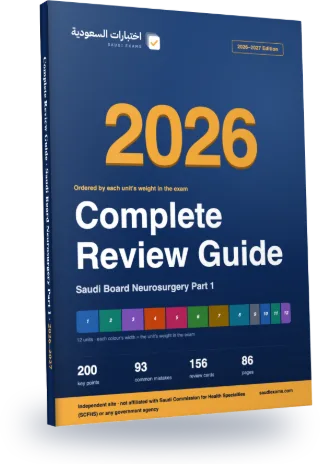 Complete Review Guide 2026–2027 included (PDF)Ordered by the weight of each unit in the examBuy now · SAR 34or 7 days for SAR 26
See everything included
Timed supplementary practice and 608 explained questions to review your weak areas
- Repeat supplementary practice sessions and review performance by unit
- Practise 10 weak-area questions, starting where you lose the most marks
- 608 questions explaining why every option is right or wrong
- Arabic and English with one pass
- Unit notes and flashcards, then questions to check your understanding
Sources and references
- Published exam blueprint scfhs.org.sa