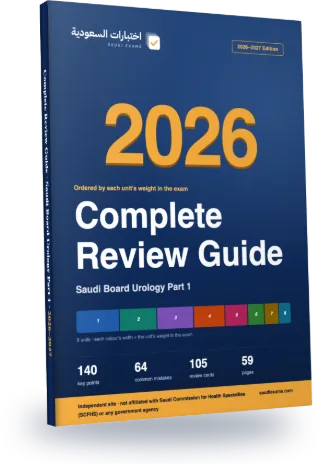
Saudi Board Urology Part 1 Complete Review Guide 2026–2027
A 59-page PDF ordered by unit weight. The first three chapters cover 53% of the published syllabus weight.
- 59Pages
- 140Key points
- 64Common mistakes
- 105Flashcards
Guide map
Each chapter is one exam unit, ordered by its weight in the real exam.
| Chapter | Unit | Weight | Key points |
|---|---|---|---|
| 1 | Infections and Inflammation | 19% | 18 |
| 2 | Haemostasis and Genitourinary Physiology | 17% | 15 |
| 3 | Basics of Urologic Surgery | 17% | 18 |
| 4 | Trauma, Shock and Monitoring | 15% | 18 |
| 5 | Genitourinary Anatomy | 11% | 17 |
| 6 | Oncology and Molecular Biology | 8% | 18 |
| 7 | Wound Healing | 7% | 18 |
| 8 | Basics of Renal Insufficiency and Transplantation | 6% | 18 |
Chapter 1 in full: Infections and Inflammation
This chapter accounts for 19% of the published syllabus weight. These are its key points.
- (Urinary tract infection and pyelonephritis) ABU: growth of 10^5 CFU/mL or more without symptoms, two consecutive samples in women and one in men; no screening or treatment in healthy non-pregnant women.
- (Urinary tract infection and pyelonephritis) Treat ABU in pregnancy (fosfomycin) and before TURP or other mucosa-breaching procedures; do not treat in well-controlled diabetes, before joint replacement, or with clean intermittent catheterisation.
- (Urinary tract infection and pyelonephritis) Recurrent cystitis: three or more episodes a year or two in six months, diagnosed by urine culture without routine cystoscopy or imaging when no risk factors exist.
The rest of chapter 1, on this page
- (Urinary tract infection and pyelonephritis) Outpatient pyelonephritis: short-course fluoroquinolone if resistance is below 10%, or a cephalosporin; at least two weeks in men, preferably a fluoroquinolone.
- (Antimicrobial prophylaxis and catheter-associated infection) CA-UTI: symptoms in a catheterised patient or within 48 hours of removal with growth of 10^3 CFU/mL or more; the main risk factor is catheter duration (3 to 8% per day).
- (Antimicrobial prophylaxis and catheter-associated infection) In symptomatic CA-UTI replace or remove the catheter before antibiotics and culture the new catheter; seven days if symptoms resolve promptly; hydrophilic-coated catheters lower infection with intermittent catheterisation.
- (Antimicrobial prophylaxis and catheter-associated infection) No prophylaxis with sterile urine for cystoscopy, urodynamics or shockwave lithotripsy (except suspected infected stones); a weak recommendation for ureteroscopy.
- (Antimicrobial prophylaxis and catheter-associated infection) PCNL and TURP: strong recommendation for prophylaxis (single dose in PCNL); TURB only in high-risk patients (weak); no routine prophylaxis at catheter removal after radical prostatectomy.
- (Prostatitis, epididymo-orchitis and urethritis) Chronic bacterial: fluoroquinolone first, then macrolide or tetracycline for intracellular organisms, and metronidazole 500 mg three times daily for T. vaginalis.
- (Prostatitis, epididymo-orchitis and urethritis) Epididymitis: non-sexually transmitted cases are caused by Enterobacterales (E. coli) in older men; likely gonococcal cases get single-dose ceftriaxone plus doxycycline for 10 to 14 days; low-risk cases get levofloxacin for 10 to 14 days.
- (Prostatitis, epididymo-orchitis and urethritis) Urethritis: intracellular Gram-negative diplococci mean gonorrhoea (ceftriaxone plus doxycycline); chlamydia gets doxycycline for 7 days; macrolide-resistant Mycoplasma genitalium gets moxifloxacin for 7 days.
- (Genitourinary tuberculosis, schistosomiasis and complicated infection) GUTB: sterile pyuria with calyceal deformity or hydrocalycosis; three early-morning urine samples for culture and NAAT; Xpert MTB/RIF (sensitivity about 85%, specificity 97%).
- (Genitourinary tuberculosis, schistosomiasis and complicated infection) Drug-susceptible TB: isoniazid, rifampicin, pyrazinamide and ethambutol for two months, then isoniazid and rifampicin for four; MDR-TB needs at least five effective drugs; drugs first, surgery individualised.
- (Genitourinary tuberculosis, schistosomiasis and complicated infection) Urogenital schistosomiasis is caused by Schistosoma haematobium and treated with praziquantel; it is an established cause of bladder cancer (squamous cell) and presents with haematuria.
- (Genitourinary tuberculosis, schistosomiasis and complicated infection) Fungal infection: risk factors are age, female sex, diabetes, catheters and broad-spectrum antibiotics; fluconazole for two weeks with a double first dose, amphotericin B bladder instillation if resistant, echinocandins for the kidney; drain if obstructed.
- (Urosepsis, Fournier gangrene and interstitial cystitis) Urosepsis: ultrasound first, then CT or MRI for hydronephrosis or suspected obstruction; drain obstruction alongside antibiotics; cover ESBL with a carbapenem after prior ESBL, add vancomycin for MRSA when needed.
- (Urosepsis, Fournier gangrene and interstitial cystitis) Fournier: risk factors are diabetes, malnutrition, high BMI and perineal surgery; internal necrosis exceeds skin changes; debride within 24 hours and repeat; antibiotics: broad-spectrum penicillin or cephalosporin plus gentamicin and metronidazole or clindamycin.
- (Urosepsis, Fournier gangrene and interstitial cystitis) Interstitial cystitis (IC/BPS): hyaluronic acid and chondroitin sulphate instillations replenish the urothelial glycosaminoglycan layer; suspect it in atypical recurrent cystitis picture.
Common mistakes in this chapter
- Asymptomatic bacteriuria is not infection: odour, cloudiness or pyuria in a catheterised patient without symptoms is not a reason to give antibiotics.
- Do not mix up the culture rule: ABU needs two consecutive 10^5 CFU/mL samples in women and one in men.
- Symptoms returning three weeks after treating cystitis suggest an organism not covered by the first drug: take a culture, then change the agent.
- Routine imaging and cystoscopy are not needed in a woman under 40 with typical recurrence; keep them for atypical features.
- Never perform prostatic massage in acute prostatitis because it can cause bacteraemia and sepsis; PSA adds no diagnostic value.
- Sudden scrotal pain with an absent cremasteric reflex is torsion until proven otherwise: preserved flow does not exclude it, so explore urgently.
- A negative AFB smear does not exclude urinary TB: its sensitivity is only 0 to 25%.
- Mycoplasma hominis and Ureaplasma parvum in the urethra usually mean colonisation and are not treated, unlike Mycoplasma genitalium, which is.
The other chapters are in the full guide
One purchase · lifetime access · review guide included
7-day review plan
The chapters are spread over 6 days by weight so each day carries a similar load. Day 7 is a full exam.
Day 1 · 19% of the exam
Chapter 1: Infections and Inflammation
Day 2 · 17% of the exam
Chapter 2: Haemostasis and Genitourinary Physiology
Day 3 · 17% of the exam
Chapter 3: Basics of Urologic Surgery
Day 4 · 15% of the exam
Chapter 4: Trauma, Shock and Monitoring
Day 5 · 17% of the exam
Chapter 5: Genitourinary Anatomy
Chapter 8: Basics of Renal Insufficiency and TransplantationDay 6 · 15% of the exam
Chapter 6: Oncology and Molecular Biology
Chapter 7: Wound HealingDay 7
Complete a timed supplementary practice set and review the units where you lost marks.
How many correct answers do you need?
- Pass mark 65%98 correct out of 150
Before you read: see your score today
10 free questions from the main units, no sign-up. Then you know which chapter to start with.
Try 10 free questions and see your levelA look at each chapter
The first three key points of each chapter, as they appear in the guide (in Arabic in the PDF).
Chapter 1: Infections and Inflammation
- (Urinary tract infection and pyelonephritis) ABU
- (Urinary tract infection and pyelonephritis) Treat ABU in pregnancy (fosfomycin) and before TURP or…
- (Urinary tract infection and pyelonephritis) Recurrent cystitis: three or more episodes a year or…
Chapter 2: Haemostasis and Genitourinary Physiology
- (Haemostasis, coagulation and transfusion) The extrinsic pathway starts when tissue factor with factor VIIa…
- (Haemostasis, coagulation and transfusion) After a drug-eluting stent, delay elective surgery 6 months per…
- (Haemostasis, coagulation and transfusion) Life-threatening bleeding on warfarin: intravenous vitamin K plus four-factor prothrombin…
Chapter 3: Basics of Urologic Surgery
- (Preoperative assessment, enhanced recovery and thromboprophylaxis) Sympathetic activation after tissue injury releases epinephrine and…
- (Preoperative assessment, enhanced recovery and thromboprophylaxis) In older patients, markedly abnormal sodium, potassium or…
- (Preoperative assessment, enhanced recovery and thromboprophylaxis) ERAS recommendations: stop smoking at least 1 month…
Chapter 4: Trauma, Shock and Monitoring
- (Systemic response to injury) Damaged cells release DAMPs such as HMGB1 and mitochondrial DNA…
- (Systemic response to injury) The compensatory anti-inflammatory response runs alongside the hyperinflammation and causes…
- (Systemic response to injury) In burns
Chapter 5: Genitourinary Anatomy
- (Kidney, adrenal gland and retroperitoneum) The perirenal space between the two laminae of the…
- (Kidney, adrenal gland and retroperitoneum) Renal injury grade 2 is a non-expanding perirenal haematoma…
- (Kidney, adrenal gland and retroperitoneum) In renal cancer, contiguous extension into the ipsilateral adrenal…
Chapter 6: Oncology and Molecular Biology
- (Carcinogenesis and tumour suppressor genes) VHL forms the E3 ligase that tags hydroxylated HIF-alpha…
- (Carcinogenesis and tumour suppressor genes) VHL lies at 3p25; clear cell RCC usually loses…
- (Carcinogenesis and tumour suppressor genes) HIF-2alpha has narrower tissue distribution and drives VEGFA and…
Chapter 7: Wound Healing
- (Phases of wound healing and factors affecting it) Inflammation lasts up to about 7…
- (Phases of wound healing and factors affecting it) Proliferation is defined by granulation tissue…
- (Phases of wound healing and factors affecting it) Remodeling starts 2 to 3 weeks…
Chapter 8: Basics of Renal Insufficiency and Transplantation
- (Acute kidney injury and obstructive uropathy) Obstructed infected kidneys need urgent drainage (JJ stent…
- (Acute kidney injury and obstructive uropathy) Stent and nephrostomy are equally effective, but stent…
- (Acute kidney injury and obstructive uropathy) AKI lasting more than 7 and less than…
The full guide comes with lifetime access
Lifetime access includes the full guide (59 pages), all questions and supplementary practice. Chapter 1 is free for everyone.
Questions about the guide
Is the guide free?
Chapter 1 is free to read on the guide page. The full guide comes with lifetime access to this exam; 7-day access does not include it.
Is it up to date for 2026–2027?
Yes. Unit weights and exam facts follow what the exam body last published, and the last check date is printed in the guide. If the standards change we update the file and buyers download the new version.
Does the guide have questions?
No. The guide covers key points and common mistakes; scoring, weak-area practice and full mock exams are on the site.
Can I read it on my phone?
Yes. A5 pages in a single column, with chapters linked from the contents.
- Pages
- 59
- Edition
- 1448 AH · 2026–2027
- Language
- English
- Last updated
Full prep for this exam
All of this in one purchase.
- Timed supplemental practice sessions150 questions in 90 minutes. You get a total score and a score for every unit.
- Practice unit by unit604 questions, every option explained with its source. Starts with your weakest units.
- Complete Review Guide 2026–2027 (PDF)Ordered by each unit's weight in the exam. With lifetime access only.
Choose your access
Continue with your Google account and you go straight to the payment page.