KMC Grades 8–9: 24 Questions, 2 Hours, Examples
24 multiple-choice questions in two hours, no calculator: the four units with a worked example each, dates and fee, and a study plan to 23 January 2027.
- Next test
- 23 January 2027 Add the date to your calendar
- Questions and time
- 24 questions · 120 minutes
- Pass mark
- No pass mark; about 250 students from Phase One qualify for the finals at KAUST, and the qualifying score is not published
- Exam fee
- SAR 100 (non-refundable)
Start with 10 free questions to find what needs more work. No sign-up, with answer explanations.
Try 10 free questions and see your levelPut what you just read into practice
Start with 10 free questions to find what needs more work. No sign-up, with answer explanations.
Try 10 free questions and see your levelLast verified: 25 November 2026. The question count, duration, fee and dates come from the competition page on the KAUST Academy website, and the topic areas from the news report on the end of the national mathematics competition. Details can change, so check the official page before registering. This is an independent website with no connection to the Academy or any government body, and it does not promise any score.
What the competition is and who takes part
Phase One for grades 8 and 9 is an in-person, proctored written test at about 50 centres in education departments across the Kingdom, plus Jubail and Yanbu. About 250 students qualify for the finals from the three tracks together, and the Academy has not published the qualifying score or how many qualify from each track.
Dates and registration
- Registration: 6 October to 12 December 2026 on the competition page (the Apply now button); the fee is SAR 100, non-refundable.
- Phase One: 23 January 2027.
- Finals at KAUST, Thuwal: 2 to 4 April 2027, with travel and accommodation paid by the Academy.
What the paper looks like
- 24 multiple-choice questions, each with five choices (A–E) and one correct answer.
- Two hours, and no calculator of any kind.
- Questions are shown in Arabic and English together, and run roughly from easier to harder.
- The Academy has not said whether wrong answers lose marks or how much each question is worth, so read the instructions on your paper on the day.
How the questions split across units
The Academy lists only the four areas and does not publish the number of questions in each. The counts below come from our grouping of the 2026 Phase One questions for this track. They are an estimate, not an official list, and the 2027 paper may split differently.
| Unit | Questions out of 24 | Share |
|---|---|---|
| Algebra and Arithmetic | 10 | 42% |
| Number Theory | 5 | 21% |
| Geometry | 4 | 17% |
| Combinatorics and Logic | 5 | 21% |
One example per unit
These examples are our own, written to practise the idea; they are not competition questions.
Algebra and Arithmetic
A shirt costs 90 riyals after a 25% discount. What was the price before the discount?
Solution: The discounted price is 0.75 of the original, so the original is 90\div 0.75=120 riyals. Check: 25% of 120 is 30 and 120-30=90.
Number Theory
How many positive divisors does 180 have?
Solution: 180=2^2\cdot 3^2\cdot 5, so the number of divisors is (2+1)(2+1)(1+1)=18.
Geometry
A triangle with sides 5, 12 and 13 is inscribed in a circle. What is the area of the circle?
Solution: 5^2+12^2=13^2, so the triangle is right-angled and its hypotenuse 13 is a diameter, giving radius 6.5. The area is \pi\cdot 6.5^2=\frac{169\pi}{4}.
Combinatorics and Logic
How many codes of three different letters can be made from the letters A, B, C, D and E?
Solution: There are 5 choices for the first letter, 4 for the second and 3 for the third, so 5\cdot 4\cdot 3=60.
Study plan from today to 23 January
You have about eight and a half weeks. This is a suggested plan; adjust it to your level.
- Weeks 1 and 2: Algebra and Arithmetic. Ratios, percentages, equations and simplification, with at least two questions a day.
- Week 3: Number Theory. Factorization, GCD and LCM, the cycle of the last digit.
- Week 4: Geometry. Angles, areas and circles, redrawing the figure by hand every time.
- Week 5: Combinatorics and Logic. Counting, probability and puzzles, starting from small cases.
- Weeks 6 and 7: Mixed timed questions, then review every mistake and find which unit costs you most.
- Week 8: Two full practice papers in the same time (two hours) and with no calculator, reviewing mistakes between them.
- Last three days: Review formulas and past mistakes only, and sleep well the night before.
Managing time in the room
- Two hours for 24 questions is about 5 minutes per question on average, but the early questions are easier, so try to finish them in two to three minutes.
- A suggested split: about 45 minutes for Algebra and Arithmetic, 20 for Number Theory, 20 for Geometry and 25 for Combinatorics and Logic, leaving 10 minutes to check.
- Do not stay more than two minutes on an idea that does not appear: mark the question, move on and return.
- Since every answer is one of five choices, cross out what conflicts with an estimate or with parity before solving fully.
- Because the Academy has not said whether wrong answers lose marks, do not rely on blind guessing before you have read the instructions on your paper.
Finished reading? Try a set of questions
Start with 10 free questions to find your weakest units. Keep practising with the full question bank and mock exams from SAR 26.
Put the plan to work here
SAR 34 $9
One purchase · lifetime access · review guide included
- 164 questions, every option explained with its source
- Full mock exams: 24 questions in 120 minutes, like the real one
- Practice that starts with your weakest units, plus a review of your mistakes
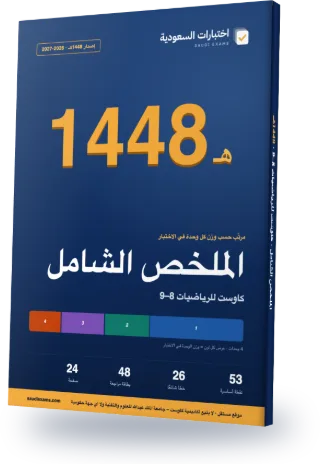 Complete Review Guide 2026–2027 included (PDF)Ordered by the weight of each unit in the examBuy now · SAR 34or 7 days for SAR 26
See everything included
Full mock exams like the real one and 164 explained questions that find your weak spots and train them
- Unlimited full mock exams to practise your pace and check your performance across the whole exam
- Practise 10 weak-area questions, starting where you lose the most marks
- 164 questions explaining why every option is right or wrong
- Arabic and English with one pass
- Unit notes and flashcards, then questions to check your understanding
The competition is not an entry requirement: Phase One is an elimination round, and qualifiers compete in the finals at KAUST. The first-place winner in the track gets a place at a summer camp at the University of Cambridge, plus free places in KAUST Academy programs. Source Last verified: 2026-11-25
Sources and references
- KAUST Academy – KAUST Mathematics Competition academy.kaust.edu.sa
- KMC 2026 First Round Booklet academy.kaust.edu.sa
- KAUST – KAUST concludes national mathematics competition finals kaust.edu.sa