Try the questions in the test above first, then open each one here to see the correct answer and why every other option is wrong.
01Determine the value of: 3\cdot\frac{1}{37}+2\cdot\frac{36}{37}+\frac{1}{37}\cdot\frac{36}{37}+\left(\frac{36}{37}\right)^2
Past exam question Unit: Algebra and Arithmetic
A2
Drops the last two terms and rounds: 3a+2b=2+a\approx2.03; but ab+b^2=b(a+b)=b still adds \frac{36}{37}.
B3 ✓ Correct answer
With a=\frac1{37}, b=\frac{36}{37}, a+b=1: ab+b^2=b(a+b)=b, so the sum is 3a+3b=3.
C4
Takes ab+b^2 as (a+b)^2=1 and adds it to 3a+3b=3; in fact ab+b^2=b, already counted in 3b.
D5
Adds the coefficients 3+2 as if \frac{1}{37} and \frac{36}{37} were each 1 and ignores the last two terms.
E6
Treats every fraction as 1, so the groups 3a, 2b and b(a+b) count as 3+2+1=6.
Reference: KAUST Mathematics Competition 2026, Phase One, Seniors track (grades 10–11), Question 5 and published solution
Ask a friend
02If a new girl joins the math club but 20\% of the boys leave it, the numbers of boys and girls would be equal. On the other hand, if one girl leaves the math club and then the number of girls increases by 30\%, the numbers of boys and girls would also be equal. How many children are currently in the math club?
Past exam question Unit: Algebra and Arithmetic
A112
With g girls, the first condition gives n=g+1.25(g+1) and the second n=g+1.3(g-1); n=112 gives g\approx49.2 and 49.3, which disagree.
B113
Putting n=113 into n=2.25g+1.25 gives g\approx49.67, not a whole number of girls, so the first condition already fails.
C114
Putting n=114 into n=2.3g-1.3 from the second condition gives g\approx50.13, not a whole number of girls.
D115
This is 50+65, the club right after one girl leaves in the second story; the question asks for the current total 51+65.
E116 ✓ Correct answer
From g+1=0.8b and 1.3(g-1)=b: g+1=1.04(g-1), so g=51, b=65, and the club has 116 children.
Reference: KAUST Mathematics Competition 2026, Phase One, Seniors track (grades 10–11), Question 8 and published solution
Ask a friend
03Let f(x)=(ax^2+x+3)(ax^2+x+5). If f(-3)=-1 what is the value of f(3)?
Past exam question Unit: Algebra and Arithmetic
A1
Assumes f(3)=-f(-3)=1 as if f were odd; the even terms ax^2, 3 and 5 make that false.
B3
3 is only the constant term of the first factor; the value of f(3) is a product of two factors.
C7
7 is just the second factor's value 9a+8; f(3) is the product of both factors.
D15
15 is f(0)=3\cdot5, the value with x=0; here x=3 and a is fixed by f(-3)=-1.
E35 ✓ Correct answer
f(-3)=9a(9a+2)=-1 gives (9a+1)^2=0, a=-\frac19; then f(3)=(9a+6)(9a+8)=5\cdot7=35.
Reference: KAUST Mathematics Competition 2026, Phase One, Seniors track (grades 10–11), Question 24 and published solution
Ask a friend
04Two integer numbers were added to the list [2,2,9,15,32] so that the range doubled, while the average remained unchanged. What is the larger of the two added numbers?
Past exam question Unit: Algebra and Arithmetic
A42 ✓ Correct answer
The mean stays 12, so the added numbers sum to 24; for range 60 they are 42 and -18, and the larger is 42.
B44
If the larger were 44, the smaller would be -20 (sum 24), and the range would be 44-(-20)=64, not 60.
C46
If the larger were 46, the smaller would be -22, giving range 68, not 60.
D48
If the larger were 48, the smaller would be -24, giving range 72, not 60.
E50
If the larger were 50, the smaller would be -26, giving range 76, not 60.
Reference: KAUST Mathematics Competition 2026, Phase One, Seniors track (grades 10–11), Question 25 and published solution
Ask a friend
05Positive real numbers x, y, and t satisfy the following system: x^2=y^2+6, (x+y)(t-1)=30, (x-y)(t+1)=16. What is the value of t?
Past exam question Unit: Algebra and Arithmetic
A8
This is t-1; the product of the last two equations gives t^2-1=80, so t=9 and t-1=8.
B9 ✓ Correct answer
Multiplying the last two equations: (x^2-y^2)(t^2-1)=480; with x^2-y^2=6, t^2-1=80, so t=9.
C10
This is t+1; the value of t itself is 9, because t^2=81.
D80
This is t^2-1, which equals 80; the question asks for t, the square root of t^2=81.
E81
This is t^2; take the positive square root to get t=9.
Reference: KAUST Mathematics Competition 2026, Phase One, Seniors track (grades 10–11), Question 27 and published solution
Ask a friend
06Bader, Nawaf, and Yasser each chose a positive integer. Each person multiplied his number by each of the other two numbers, then subtracted the smaller product from the larger product. Bader's result was 1, and Nawaf's result was 49. What was Yasser's result?
Past exam question Unit: Number Theory
A27
With a=1, Yasser gets c(b-1) where c=b\pm1; 27 would need b^2-1=27 or (b-1)^2=27, and neither has an integer solution.
B82
Splitting 82 as c(b-1), for example 2\cdot41, gives numbers like c=2 and b=42, which break Bader's condition |b-c|=1.
C48 ✓ Correct answer
Bader's a\cdot|b-c|=1 forces a=1; then b(c-1)=49 gives b=7,c=8, so Yasser gets 8\cdot|1-7|=48.
D36
Takes c=b-1=6 from |b-c|=1, so Yasser gets 6\cdot6=36; but then Nawaf's result is 7\cdot5=35, not 49.
E54
Uses c=9 instead of 8, getting 9\cdot6=54; but then Bader's result is |7-9|=2, not 1.
Reference: KAUST Mathematics Competition 2026, Phase One, Seniors track (grades 10–11), Question 19 and published solution
Ask a friend
07Let a and b be positive integers such that exactly three of the following statements are true and one is false: (1) a+7 is divisible by b. (2) a=5b+2. (3) a+b is divisible by 3. (4) a+4b is a prime number. Find the largest possible value of a+b.
Past exam question Unit: Number Theory
A8
Stops at b=1: (7,1) makes (1), (2), (4) true, but b=3 and b=9 also divide 5b+9 and give larger sums.
B20
Stops at b=3: (17,3) makes (1), (2), (4) true, but b=9 also divides 9 and gives (47,9) with sum 56.
C48
Statement (2) must hold, so a+b=6b+2 leaves remainder 2 on division by 6; 48 is a multiple of 6, so no valid pair gives it.
D56 ✓ Correct answer
(2) and (3) clash and (3) and (4) clash, so (3) is false; (1) and (2) need b\mid5b+9, so b=1,3,9 and the best is (47,9): 56.
E72
Forgets the +2 in (2), writing a+b=6b, and takes b=12; but b must divide 9, and 6b+2=72 has no integer solution.
Reference: KAUST Mathematics Competition 2026, Phase One, Seniors track (grades 10–11), Question 29 and published solution
Ask a friend
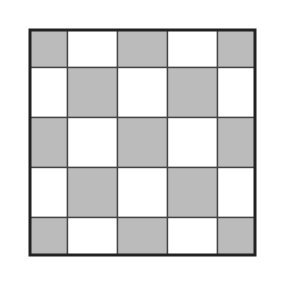
08We have a checkered tablecloth in which the sidelength of small squares is 1. A rectangle is cut from this tablecloth such that the sides of the rectangle are parallel to the sides of the squares, as shown in the figure. The total area of the white part of the rectangle is 10. What is the perimeter of the rectangle?
Past exam question Unit: Geometry
A12
A 3 by 3 block of whole squares has perimeter 12 but white area only 4; the rectangle also contains partial squares along its edges.
B14
A block of 3 by 4 whole squares has perimeter 14 but white area only 6, not 10; the partial strips must be counted.
C16
A 4\times4 block of whole squares has white area 8, not 10; the partial squares change the white area.
D18 ✓ Correct answer
With partial sides a,b,c,d: perimeter =2(a+b+c+d)+12 and white area =2(a+b+c+d)+4=10, so the perimeter is 10-4+12=18.
E20
A 4\times6 block of whole squares has white area 12, more than 10; a perimeter of 20 would make the white part too large.
Reference: KAUST Mathematics Competition 2026, Phase One, Seniors track (grades 10–11), Question 21 and published solution
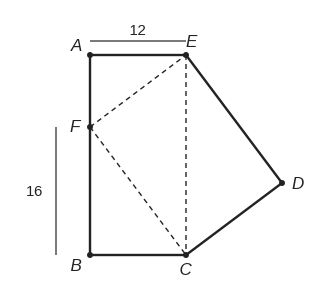
09In the figure, pentagon ABCDE is formed by two overlapping rectangles. Based on the labeled lengths in the diagram, what is the perimeter of the pentagon?
Past exam question Unit: Geometry
A70
This is the perimeter of rectangle FEDC alone, 2(15+20)=70, not of the pentagon.
B72
This is 25+12+15+20, leaving out side AE=12; all five sides are needed.
C74
This is the perimeter of rectangle ABCE alone, 2(12+25)=74, without the part that sticks out.
D84 ✓ Correct answer
AF=9, EF=15, FC=20, so the sides are AB=25, BC=12, CD=EF=15, DE=FC=20, EA=12: total 84.
E109
This is 84+25, which also counts the inner segment EC=25, but the perimeter has only the outer boundary.
Reference: KAUST Mathematics Competition 2026, Phase One, Seniors track (grades 10–11), Question 28 and published solution
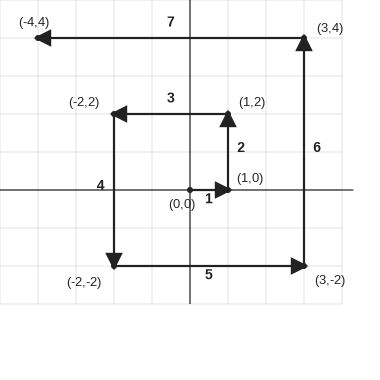
10A camel starts at (0,0) and moves as follows: It moves 1 unit right, 2 units up, 3 units left, 4 units down, then continues 5 units right, 6 units up, \ldots (the first seven moves are shown below). Find its coordinates after the 2025^{\text{th}} move.
Past exam question Unit: Combinatorics and Logic
A(1013,-1012) ✓ Correct answer
Right moves are 1,5,\ldots,2025 and left moves 3,7,\ldots,2023; the net x is 1+2\cdot506=1013, and y=-1012.
B(1014,-1013)
This is one unit too far in each direction, an off-by-one in counting the pairs: 506 pairs (-3+5) give x=1013, and 506 pairs (2-4) give y=-1012.
C(2025,-2024)
These are just the lengths of the last right move (2025) and the last down move (2024), as if no earlier move cancelled part of them.
D(2026,-2025)
This treats each coordinate as the number of the move plus one, ignoring that opposite moves cancel and leave only about half of 2025.
E(-1013,1012)
This swaps the signs of both coordinates, as if the first move went left; the camel actually ends to the right of and below the origin.
Reference: KAUST Mathematics Competition 2026, Phase One, Seniors track (grades 10–11), Question 26 and published solution