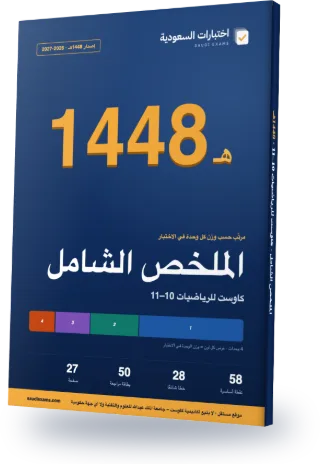
KMC Grades 10–11 Complete Review Guide 2026–2027
A 30-page PDF ordered by unit weight. The first three chapters cover 87% of the published syllabus weight.
- 30Pages
- 58Key points
- 28Common mistakes
- 50Flashcards
Guide map
Each chapter is one exam unit, ordered by its weight in the real exam.
| Chapter | Unit | Weight | Exam questions | Key points |
|---|---|---|---|---|
| 1 | Algebra and Arithmetic | 47% | 14 | 17 |
| 2 | Geometry | 23% | 7 | 14 |
| 3 | Number Theory | 17% | 5 | 14 |
| 4 | Combinatorics and Logic | 13% | 4 | 13 |
Chapter 1 in full: Algebra and Arithmetic
47% of the exam, about 14 questions. These are its key points, as in the guide.
- (Ratios, percentages, fractions and word problems) Percentage change: the price after a \(p\%\) rise is \( (1+\tfrac{p}{100}) \) times the old price. Example: 30% off then 10% off on 200 riyals gives \( 200\times0.7\times0.9=126 \) riyals, a total discount of 37%, not 40%.
- (Ratios, percentages, fractions and word problems) Sharing in a ratio: if 160 is shared in the ratio \(5:3\) there are 8 parts in all, one part is \(160\div8=20\), so the shares are 100 and 60.
- (Ratios, percentages, fractions and word problems) Average speed: if the same distance is covered at 60 km/h out and 40 km/h back, the average is \( \tfrac{2\cdot60\cdot40}{60+40}=48 \) km/h, because more time is spent at the slower speed. For joint work add rates: \( \tfrac1a+\tfrac1b=\tfrac1t \).
The rest of chapter 1, on this page
- (Ratios, percentages, fractions and word problems) Mixtures: track the amount of dissolved substance, not the volume. Example: 10 litres of a 30% solution hold 3 litres of solute; to reach 20% solve \( \tfrac{3}{10+x}=0.2 \), so add \(x=5\) litres of water.
- (Equations, systems and inequalities) Elimination: from \(x+y=10\) and \(x-y=4\) add to get \(2x=14\), so \(x=7\) and \(y=3\). When the coefficients differ, multiply one equation by a number first, then add.
- (Equations, systems and inequalities) Sum and product of roots (Vieta): for \(x^2-5x+6=0\) the sum is 5 and the product is 6, so \( x_1^2+x_2^2=5^2-2\cdot6=13 \) without finding the roots.
- (Equations, systems and inequalities) Inequalities: \( -2x+3>7 \) gives \( -2x>4 \) and then \( x<-2 \) after flipping the sign. When counting integer solutions watch the ends: \( |x-3|<5 \) means \( -2<x<8 \), which is 9 integers from \(-1\) to 7.
- (Equations, systems and inequalities) Absolute value: \( |x-3|=5 \) means \( x-3=5 \) or \( x-3=-5 \), so the solutions are 8 and \(-2\). For a root equation like \( \sqrt{x+2}=x \), squaring gives \(x=2\) or \(x=-1\), and substituting rules out \(-1\).
- (Algebraic expressions, powers, roots and clever simplification) Difference of squares: \( a^2-b^2=(a-b)(a+b) \). Example: \( 101^2-99^2=(2)(200)=400 \), and \( 999^2=(1000-1)^2=998001 \).
- (Algebraic expressions, powers, roots and clever simplification) Laws of exponents: \( a^m\cdot a^n=a^{m+n} \) and \( (a^m)^n=a^{mn} \). Example: \( \tfrac{8^4}{2^9}=\tfrac{2^{12}}{2^9}=2^3=8 \). Convert everything to the same base before combining exponents.
- (Algebraic expressions, powers, roots and clever simplification) Roots: pull the perfect square out of the root. Example: \( \sqrt{50}+\sqrt{18}=5\sqrt2+3\sqrt2=8\sqrt2 \), and \( \sqrt{72}=6\sqrt2 \). Do not add unlike roots such as \( \sqrt2+\sqrt3 \).
- (Algebraic expressions, powers, roots and clever simplification) Identities: \( a^2+b^2=(a+b)^2-2ab \). If \(a+b=7\) and \(ab=10\) then \(a^2+b^2=49-20=29\). If \( a+\tfrac1a=3 \) then \( a^2+\tfrac1{a^2}=9-2=7 \).
- (Algebraic expressions, powers, roots and clever simplification) Telescoping sums: \( \tfrac1{n(n+1)}=\tfrac1n-\tfrac1{n+1} \), so \( \tfrac1{1\cdot2}+\cdots+\tfrac1{9\cdot10}=1-\tfrac1{10}=\tfrac9{10} \).
- (Sequences, functions and averages) Arithmetic sequence: \( a_n=a_1+(n-1)d \) and the sum of \(n\) terms is \( \tfrac{n(a_1+a_n)}{2} \). Example: in \(3,7,11,\dots\) the 20th term is \(3+19\cdot4=79\), and \(1+2+\cdots+100=\tfrac{100\cdot101}{2}=5050\).
- (Sequences, functions and averages) Geometric sequence: \( a_n=a_1r^{n-1} \). Example: in \(2,6,18,\dots\) the 6th term is \(2\cdot3^5=486\), and \(1+2+4+\cdots+2^9=2^{10}-1=1023\).
- (Sequences, functions and averages) Functions: substitution is usually enough. If \( f(x)=2x+3 \) then \( f(f(x))=2(2x+3)+3=4x+9 \). If \( f(2x+1)=x^2 \), choose \(x\) with \(2x+1=7\), that is \(x=3\), so \(f(7)=9\).
- (Sequences, functions and averages) Averages: mean \(=\) total \(\div\) count, so total \(=\) mean \(\times\) count. Example: the mean of 5 numbers is 12 and a sixth number must raise it to 13, so the new total is \(6\times13=78\) and the added number is \(78-60=18\).
Common mistakes in this chapter
- Mixing up the base of a percentage: a 20% rise followed by a 20% fall does not restore the first price, because the fall is taken on the new price.
- Averaging speeds as plain numbers: for the same distance at two speeds the average is \( \tfrac{2ab}{a+b} \), not \( \tfrac{a+b}{2} \).
- Forgetting to flip an inequality when multiplying or dividing by a negative number: \( -2x>4 \) gives \( x<-2 \).
- Missing one of the two cases for an absolute value: \( |x-3|=5 \) has two solutions, 8 and \(-2\).
- Squaring both sides of an equation with a root and then not checking the answers; an extra solution that fails the original equation can appear.
- Off-by-one counting of terms: the number of values from \(a\) to \(b\) with step \(d\) is \( \tfrac{b-a}{d}+1 \), and the nth term uses \((n-1)d\).
- Writing \( (a-b)^2=a^2-b^2 \): the correct expansion is \( a^2-2ab+b^2 \), and this mistake is often hidden among the choices.
The other chapters are in the full guide
One purchase · lifetime access · review guide included
7-day review plan
The chapters are spread over 6 days by weight so each day carries a similar load. Day 7 is a full exam.
Day 1 · 47% of the exam
Chapter 1: Algebra and Arithmetic
Day 2 · 23% of the exam
Chapter 2: Geometry
Day 3 · 17% of the exam
Chapter 3: Number Theory
Day 4 · 13% of the exam
Chapter 4: Combinatorics and Logic
Day 5
Full mock exam: 30 questions in 120 minutes, then review the common mistakes in the units where you lost marks.
Before you read: see your score today
10 free questions from the main units, no sign-up. Then you know which chapter to start with.
Try 10 free questions and see your levelA look at each chapter
The first three key points of each chapter, as they appear in the guide (in Arabic in the PDF).
Chapter 1: Algebra and Arithmetic
- (Ratios, percentages, fractions and word problems) Percentage change: the price after a \(p\%\) rise…
- (Ratios, percentages, fractions and word problems) Sharing in a ratio: if 160 is shared…
- (Ratios, percentages, fractions and word problems) Average speed: if the same distance is covered…
Chapter 2: Geometry
- (Angles, triangles and polygons) The angles of a triangle add to 180°, and an…
- (Angles, triangles and polygons) The angles of an \(n\)-gon add to \( (n-2)\cdot180^\circ \)…
- (Angles, triangles and polygons) Pythagoras
Chapter 3: Number Theory
- (Divisibility, primes and factorization) Prime factorization and number of divisors: \( 360=2^3\cdot3^2\cdot5 \) has…
- (Divisibility, primes and factorization) Divisibility rules
- (Divisibility, primes and factorization) Primes
Chapter 4: Combinatorics and Logic
- (Counting, arrangements and selections) Multiplication principle: 3 shirts and 4 pairs of trousers give…
- (Counting, arrangements and selections) Arrangements
- (Counting, arrangements and selections) Selections
The full guide comes with lifetime access
The full guide (30 pages) is included with lifetime access to this exam, together with every question and full mock exam. Chapter 1 is free for everyone.
Questions about the guide
Is the guide free?
Chapter 1 is free to read on the guide page. The full guide comes with lifetime access to this exam; 7-day access does not include it.
Is it up to date for 2026–2027?
Yes. Unit weights and exam facts follow what the exam body last published, and the last check date is printed in the guide. If the standards change we update the file and buyers download the new version.
Does the guide have questions?
No. The guide covers key points and common mistakes; scoring, weak-area practice and full mock exams are on the site.
Can I read it on my phone?
Yes. A5 pages in a single column, with chapters linked from the contents.
- Pages
- 30
- Edition
- 1448 AH · 2026–2027
- Language
- English
- Last updated
All School Student Exams review guides
Back to KAUST Mathematics Competition (KMC) – Phase One – Grades 10–11
Full prep for this exam
All of this in one purchase.
- Full mock exam, same as the real one30 questions in 120 minutes. You get a total score and a score for every unit.
- Practice unit by unit170 questions, every option explained with its source. Starts with your weakest units.
- Complete Review Guide 2026–2027 (PDF)Ordered by each unit's weight in the exam. With lifetime access only.
Choose your access
Continue with your Google account and you go straight to the payment page.