KMC Grades 10–11: 30 Questions in 2 Hours
Phase One for grades 10–11: 30 multiple-choice questions in two hours with no calculator, the four units with an example each, and a weekly plan to 23 January.
- Next test
- 23 January 2027 Add the date to your calendar
- Questions and time
- 30 questions · 120 minutes
- Pass mark
- No pass mark; about 250 students from Phase One qualify for the finals at KAUST, and the qualifying score is not published
- Exam fee
- SAR 100 (non-refundable)
Start with 10 free questions to find what needs more work. No sign-up, with answer explanations.
Try 10 free questions and see your levelPut what you just read into practice
Start with 10 free questions to find what needs more work. No sign-up, with answer explanations.
Try 10 free questions and see your levelLast verified: 25 November 2026. The question count, duration, test rules and dates come from the competition page on the KAUST Academy website. They can change, so check it before registering. This is an independent guide with no connection to KAUST, KAUST Academy or any government body, and it does not promise any score or qualification.
What the competition is and who can enter
The KAUST Mathematics Competition is run by KAUST Academy and has three tracks by grade: 6–7, 8–9 and 10–11. This guide is for the last one, grades 10 and 11. Phase One is an in-person, proctored written test, and qualifiers go on to the finals at KAUST.
Dates and registration
- Registration: 6 October to 12 December 2026 through the Apply now button on the competition page; the fee is SAR 100, non-refundable.
- Phase One: 23 January 2027 at test centres in the education departments.
- Finals: 2–4 April 2027 at KAUST, Thuwal, a 4-hour test with 6 to 8 written-response questions.
What the Phase One paper looks like
- 30 multiple-choice questions, each with five choices (A–E) and one correct answer.
- Two hours, and calculators of any kind are not allowed.
- Questions are printed in Arabic and English together, and run roughly from easier to harder.
- There is no pass mark; about 250 students from the three tracks together qualify and the qualifying score is not published. The page does not say whether wrong answers lose marks, so do not assume they do or rely on guessing.
The four units and how many questions each has
KAUST states that the competition covers algebra, number theory, geometry and combinatorics (finals news) and does not publish how many questions each part has. We sorted the senior-track questions in the 2026 competition booklet into the four units one by one. This grouping is our own, and the split of this year's paper may differ.
| Unit | Questions (of 30) | Share | Suggested time |
|---|---|---|---|
| Algebra and Arithmetic | 14 | 47% | about 50 min |
| Number Theory | 5 | 17% | about 20 min |
| Geometry | 7 | 23% | about 28 min |
| Combinatorics and Logic | 4 | 13% | about 12 min |
A worked example from each unit
These examples are our own, not questions from the competition.
Algebra and Arithmetic
Question: A shop raises the price of an item by 25% and then cuts it by 20%. What is the overall change? Solution: multiply the change factors: 1.25\times0.8=1, so the price returns to where it started and does not change. Do not add 25-20=5.
Number Theory
Question: How many positive divisors does 180 have? Solution: 180=2^2\cdot3^2\cdot5, so the number of divisors is (2+1)(2+1)(1+1)=18.
Geometry
Question: A right triangle with legs 6 and 8 is inscribed in a circle through its vertices. What is the circle's area? Solution: the hypotenuse is \sqrt100=10, and an inscribed right angle stands on a diameter, so the diameter is 10, the radius is 5 and the area is 25\pi.
Combinatorics and Logic
Question: In how many ways can 4 friends sit in a row if two particular friends must sit next to each other? Solution: treat the two friends as one block, so 3 items can be arranged in 3!=6 ways, and the two friends can swap inside the block in 2 ways, giving 6\times2=12.
Study plan until 23 January
| Week | What to do |
|---|---|
| 25 Nov – 1 Dec | Do the free questions with no sign-up to see which unit is weakest, and review percentages and equations. |
| 2 – 8 Dec | Algebra and Arithmetic: ratios and word problems, systems of equations and inequalities. |
| 9 – 15 Dec | Algebra and Arithmetic: clever simplification, sequences and functions. Register before registration closes on 12 December. |
| 16 – 22 Dec | Number Theory: divisibility and factorization, GCD and remainders, the cycle of the last digit. |
| 23 – 29 Dec | Geometry: angles, triangles, similarity and areas. |
| 30 Dec – 5 Jan | Geometry: circles, coordinates and solids, then start counting, arrangements and selections. |
| 6 – 12 Jan | Probability, logic and patterns, then mixed questions from all four units with a log of your mistakes. |
| 13 – 19 Jan | A full mock exam of 30 questions in two hours with no calculator, then review every mistake and redo your weakest unit. |
| 20 – 23 Jan | Review only flashcards and formulas, sleep well, and check the exam-centre location and time from the organisers' messages. |
Managing time in the exam hall
- The average is four minutes a question. Start with the first questions because they are easier, and do not spend more than three minutes on a question whose idea has not appeared.
- Mark a postponed question and return to it after a first pass through the paper.
- Leave the last ten minutes to check the answers you copied onto the answer sheet.
- With no calculator, factorize and simplify before you calculate.
Finished reading? Try a set of questions
Start with 10 free questions to find your weakest units. Keep practising with the full question bank and mock exams from SAR 26.
Put the plan to work here
SAR 34 $9
One purchase · lifetime access · review guide included
- 170 questions, every option explained with its source
- Full mock exams: 30 questions in 120 minutes, like the real one
- Practice that starts with your weakest units, plus a review of your mistakes
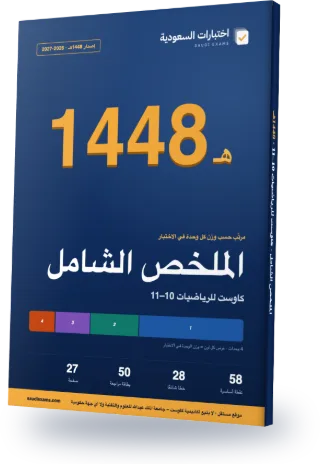 Complete Review Guide 2026–2027 included (PDF)Ordered by the weight of each unit in the examBuy now · SAR 34or 7 days for SAR 26
See everything included
Full mock exams like the real one and 170 explained questions that find your weak spots and train them
- Unlimited full mock exams to practise your pace and check your performance across the whole exam
- Practise 10 weak-area questions, starting where you lose the most marks
- 170 questions explaining why every option is right or wrong
- Arabic and English with one pass
- Unit notes and flashcards, then questions to check your understanding
The competition is not an entry requirement: Phase One is an elimination round, and qualifiers compete in the finals at KAUST. The first-place winner in the track gets a place at a summer camp at the University of Cambridge, plus free places in KAUST Academy programs. Source Last verified: 2026-11-25
Sources and references
- KAUST Academy – KAUST Mathematics Competition academy.kaust.edu.sa
- KAUST – KMC 2026 First Round booklet academy.kaust.edu.sa
- KAUST – KAUST concludes the national mathematics competition finals kaust.edu.sa