University Students & Graduates
Academic Acceleration Tests – Math 101 (Calculus I)
Academic Acceleration Tests – Math 101 (Calculus I) — Number of questions: ETEC does not publish the number of questions. Exam time: ETEC does not publish the test duration. Pass mark: Set by each university (e.g. 80 at Umm Al-Qura; 60 for university requirements at Princess Nourah). Calculator: ETEC does not publish a calculator policy; our questions do not need one. Exam fee: ETEC does not publish a fee. Source: Education and Training Evaluation Commission (ETEC) (Last verified: 2026-11-22). Question bank: A site supplementary practice session of 50 questions in 90 minutes with a result for every unit, plus 568 explained questions across 5 units, every option explained, a review of your mistakes, and two ways to practise: see the answer right away, or sit a full timed mock. Free questions: a 10-question diagnostic test covering the main units, no sign-up; at the end you get your score and your weakest units. With lifetime access: the Complete Review Guide, a 30-page PDF ordered by unit weight; chapter 1 is free to read on the guide page.
Last verified on the Education and Training Evaluation Commission (ETEC) website: 22 November 2026
If you sat the exam today, what would you score?
10 free questions · no sign-up · your score as soon as you finish
Question 1 of 10
What is cos⁻¹(cos(5π/4))?
All 10 free questions with answers and an explanation for every option
Where the questions come from
- Functions and Precalculus Review9 questions
- Limits and Continuity11 questions
- The Derivative and Differentiation Rules15 questions
- Applications of the Derivative9 questions
- Inverse Functions and Inverse Trigonometric Functions6 questions
Exam facts
- Exam language
- Arabic or English
- Number of questions
- ETEC does not publish the number of questions
- Exam time
- ETEC does not publish the test duration
- Pass mark
- Set by each university (e.g. 80 at Umm Al-Qura; 60 for university requirements at Princess Nourah)
- Calculator
- ETEC does not publish a calculator policy; our questions do not need one
- Exam fee
- ETEC does not publish a fee
- Registration
- Through the beneficiary profile on ETEC's e-services portal, as announced by your university Source
- Results
- The university informs the student; passing exempts the student from the course Source
- Retakes
- Princess Nourah offers no make-up test for absentees; rules differ by university Source
Last verified: 2026-11-22
Where other sources differ
- This bank covers Math 101 (Calculus I) only, scoped to the acceleration course references published by Princess Nourah University. Physics, chemistry, biology, computer science and the exemption track are not included.
- Questions are in Arabic and English because math courses are taught in both languages at Saudi universities.
- This site is independent and not affiliated with the Ministry of Education, ETEC or any university.
Exam body
Education and Training Evaluation Commission (ETEC): Official website: Education and Training Evaluation Commission (ETEC)
How to register
- Your university announces the acceleration courses and dates, and may nominate students according to the seats for each course.
- Register through the beneficiary profile on ETEC's e-services portal: https://e-services.etec.gov.sa/ or as your university announces.
- Check the course references your university publishes; the pass mark and content differ between universities.
Study guides (3)
Frequently asked questions
What are the academic acceleration tests?
ETEC achievement tests that let a university student pass the first year fully or partly, or some courses, such as the 101 courses in math, physics, chemistry, biology and computer science.
Can I try Acceleration Math 101 questions for free?
Yes. Free questions: a 10-question diagnostic test covering the main units, no sign-up; at the end you get your score and your weakest units. The free practice test page lists the same questions with answers and an explanation for every option. The rest of the questions and the full mock exams come with a pass from SAR 26.
What makes this Acceleration Math 101 question bank different?
Question bank: A site supplementary practice session of 50 questions in 90 minutes with a result for every unit, plus 568 explained questions across 5 units, every option explained, a review of your mistakes, and two ways to practise: see the answer right away, or sit a full timed mock. Practice questions and explanations are ready to use on your phone. Try the free questions and read the explanations before you buy.
Is there a PDF review guide for Acceleration Math 101?
Yes. "Acceleration Math 101 Complete Review Guide 2026–2027" is a 30-page Arabic PDF: 5 units ordered from the heaviest in the exam to the lightest, each chapter with key points, common mistakes and review cards, plus a 7-day plan. Chapter 1 is free to read on the guide page; the full guide comes with lifetime access to this exam and is not part of 7-day access. The guide has no questions: scoring, practice and mock exams are on the site.
What is the pass mark?
Each university sets it; for example 80 at Umm Al-Qura and 60 for university requirements at Princess Nourah.
What does this bank cover?
Math 101 (Calculus I): functions, limits and continuity, the derivative and its rules, applications of the derivative, and inverse and inverse trigonometric functions.
How do I register?
Follow your university's announcement, then register through the beneficiary profile on ETEC's e-services portal https://e-services.etec.gov.sa/ .
Is this an official site, and how do I pay?
It is an independent site, not part of Qiyas, this exam's regulator or any government body, with practice questions and answer explanations. You pay once, with no automatic renewal, through Waffo Pancake (the merchant of record) by Visa, Mastercard, Apple Pay or Google Pay, and your statement shows "WAFFO". If you were charged twice or the pass did not open, email support@saudiexams.com.
Acceleration Math 101 Complete Review Guide 2026–2027
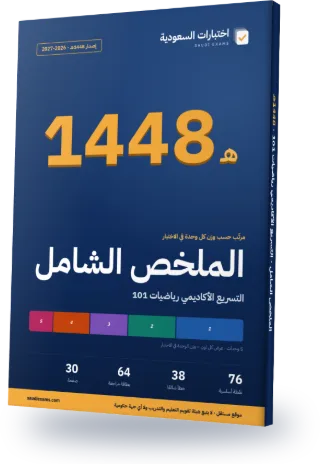
30-page · 76 key points · 38 common mistakes · 64 review cards
The first three chapters alone cover about 70% of the exam. Short on time? Start there.
About the question bank
Practice for the Math 101 (Calculus I) course in the first-year academic acceleration track: functions, limits and continuity, derivatives and their applications, and inverse trigonometric functions. 568 questions in Arabic and English with an explanation for every option.
- 568 questions in the bank
- 50 questions in 90 minutes per site supplementary practice session
- 64 flashcards
Every option explained so you understand why
What you get
- 568questions in the bankPractise with the answer shown right away, or sit a full timed mock
- 5unitsSplit by the exam syllabus
- 64flashcardsTo lock in terms and definitions
- 76quick review pointsEach unit in a few key lines
Study material sample: Functions and Precalculus Review
Summary
Unit 1 reviews the algebra and basic functions you need for Calculus I. It has four sub-topics. First, functions: domain, range, function notation, composition, and transformations (shifts, stretches, and reflections). Second, polynomial, rational, power, root, and piecewise functions, including slope and degree. Third, trigonometric functions: radian measure, the basic ratios, identities, and the graphs and periods of sine and cosine. Fourth, exponential and logarithmic functions and their laws. Questions usually ask you to evaluate a function, find a domain or range, simplify an expression, sketch a transformed graph, or solve an equation using identities or logarithm laws. You work without a calculator, so exact values and algebraic simplification matter more than decimals.
What the exam focuses on · Common traps · Try the flashcards
What the exam focuses on
- Domain: the set of all inputs that give a real output. For example, √(x−3) has domain x ≥ 3, and 1/(x−2) has domain x ≠ 2.
- Composition: (f∘g)(x) = f(g(x)). Apply g first, then f. Order matters, so usually f∘g ≠ g∘f.
- Slope: m = Δy/Δx = (y₂ − y₁)/(x₂ − x₁). Slope-intercept form: f(x) = mx + b. Point-slope form: y − y₁ = m(x − x₁).
Show 5 more
- Polynomials: the degree is the highest power with a nonzero coefficient, and the leading coefficient is that term's coefficient. Solve ax² + bx + c = 0 by factoring or by x = (−b ± √(b²−4ac))/(2a).
- Piecewise functions: use the rule that matches the interval, and check the boundary point. For example, if f(x) = 3x + 1 for x ≥ 2 and f(x) = x² for x < 2, then f(2) = 7.
- Radians: π radians = 180°, so θ(rad) = θ(deg) × π/180. Trigonometric calculus is done in radians.
- Core identities: sin²θ + cos²θ = 1, tan θ = sin θ / cos θ, and 1 + tan²θ = sec²θ. The period of sin and cos is 2π, and the period of tan is π.
- Natural log: ln x = log_e x. e^(ln x) = x for x > 0, and ln(eˣ) = x for every real x. Laws: ln(ab) = ln a + ln b, and ln(aⁿ) = n ln a.
Common traps
- Ignoring domain restrictions: writing the domain of √(x−3) as all real numbers. The correct domain is x ≥ 3.
- Reversing composition order: computing (f∘g)(x) by applying f first. The correct order is g first, then f.
- Wrong shift sign: f(x − 2) moves the graph 2 units to the right, not to the left.
Show 5 more
- Mixing reflections: f(−x) reflects the graph across the y-axis, while −f(x) reflects it across the x-axis.
- Degree and radian mix-up: using degrees in formulas that need radians, or forgetting that π equals 180°.
- Wrong log expansion: writing ln(a + b) as ln a + ln b, or ln(a − b) as ln a − ln b. Both statements are false.
- Power mistakes: (a + b)² does not equal a² + b². The rule a^m · a^n = a^(m+n) applies only when the bases are the same and are multiplied.
- Boundary error in piecewise functions: using the wrong rule at the boundary. If the condition is x ≥ 2, then x = 2 belongs to that piece.
Try the flashcards
Tap a card to see the answer
What is the domain of 1/(x − 5)?
x ≠ 5, because the denominator cannot be zero.
What is the domain of √(2x + 6)?
x ≥ −3, because the expression under the root must be non-negative.
If f(x) = x² and g(x) = x + 1, what is (f∘g)(x)?
(x + 1)², because f(g(x)) = (x + 1)².
What is the slope of the line through (1, 2) and (4, 8)?
m = (8 − 2)/(4 − 1) = 2.
What is the degree of 3x⁴ − x + 7, and what is its leading coefficient?
Degree 4, leading coefficient 3.
Convert 135° to radians.
3π/4, because 135 × π/180 = 3π/4.
What is the value of sin²θ + cos²θ?
1, which is the Pythagorean trigonometric identity.
What is the period of tan x?
π.
Why you can trust these questions
- Published questions: 568. Read the explanations and references, and report any error from the question.
- Exam facts last checked against the organiser’s website: 2026-11-22. We check them again every three months and two weeks before each test.
- Found a mistake? Tap "Report an error" under any question in the practice area, or email us at support@saudiexams.com
- Independent website. Not affiliated with ETEC (Qiyas), the Financial Academy, ACAMS, the ACFE, DAMA, CompTIA, Saudi Aramco or any government body.
Full prep for this exam
All of this in one purchase.
- Timed supplemental practice sessions50 questions in 90 minutes. You get a total score and a score for every unit.
- Practice unit by unit568 questions, every option explained with its source. Starts with your weakest units.
- Complete Review Guide 2026–2027 (PDF)Ordered by each unit's weight in the exam. With lifetime access only.
Choose your access
Continue with your Google account and you go straight to the payment page.