Academic Acceleration Tests – Math 101 (Calculus I)
A guide to the syllabus of the Academic Acceleration Test for Math 101 (Calculus I): sections, sub-topics, how the practice bank maps to them, and what has not been published.
- Questions and time
- ETEC does not publish the number of questions · ETEC does not publish the test duration
- Pass mark
- Set by each university (e.g. 80 at Umm Al-Qura; 60 for university requirements at Princess Nourah)
- Exam fee
- ETEC does not publish a fee
Start with 10 free questions to find what needs more work. No sign-up, with answer explanations.
Try 10 free questions and see your levelPut what you just read into practice
Start with 10 free questions to find what needs more work. No sign-up, with answer explanations.
Try 10 free questions and see your levelInformation last checked: 22 November 2026.
This site is independent. It is not affiliated with the Ministry of Education or with ETEC (the Education and Training Evaluation Commission), and it does not represent them.
This guide explains the syllabus of the Academic Acceleration Test for Math 101 (Calculus I): the sections and sub-topics, how our practice bank maps to them, and what the official body has not published.
What the test is
According to ETEC's definition, Academic Acceleration Tests are specialised achievement tests that speed up a university student's path by passing the first university year, fully or partly, or passing some university courses. Their goals are to encourage and support outstanding students, save time and effort for students and universities, support self-learning, and spend efficiently. Official ETEC page.
Tracks
- Acceleration track: first-year university courses (101 courses) in mathematics, physics, chemistry, biology and computer science. Math 101 falls under this track.
- Contractual track: courses chosen by the university.
- Exemption track: general university requirements, such as Islamic studies and Arabic language courses.
Who the tests target
Foundation (common) year students, first-year university students in the acceleration track, and university students in the exemption track. The beneficiary is the university.
Registration and pass marks
Registration is through the e-services portal, after creating a beneficiary profile. Universities announce the courses and dates. For example, the Deanship of Admission at Umm Al-Qura University nominates students according to the seats available for each course and announces the dates. Tests run in the first week of the semester (Umm Al-Qura details).
Each university sets its own pass mark. At Umm Al-Qura, you need 80 or above to pass an acceleration course. At Princess Nourah University, for partial acceleration of university requirements, you need 60 out of 100 or above. A lower mark is not recorded on the transcript and does not affect the GPA. There is no make-up test (admission document).
Syllabus
The acceleration course reference list at Princess Nourah University, for MATH101 Calculus (1), uses the textbook listed by the university and includes these sections (acceleration course references):
- Chapter 0: sections 0.1 to 0.4 (functions).
- Chapter 1: sections 1.1 to 1.6 (limits and continuity).
- Chapter 2: sections 2.1 to 2.7 (the derivative).
- Chapter 3: sections 3.1, 3.2 and 3.8 (the list notes implicit differentiation and derivatives of logarithmic and exponential functions).
- Chapter 6: sections 6.1 to 6.3 and 6.7 (inverse functions and inverse trigonometric functions).
The practice bank on this site
Our bank covers only Math 101 (Calculus I), in Arabic and English, and is organised into five units. It is for practice and review. It is not a copy of the official test. Explanations cite sections of a free, open-access calculus textbook. The practice problems do not need a calculator.
- Unit 1: functions and precalculus review. Maps to Chapter 0.
- Unit 2: limits and continuity. Maps to Chapter 1.
- Unit 3: the derivative and differentiation rules. Maps to Chapters 2 and 3.
- Unit 4: applications of the derivative (extrema, Rolle's theorem and the Mean Value Theorem, curve sketching, related rates, linear approximation). No section for this unit appears in the published reference list we reviewed, so check your university's list.
- Unit 5: inverse and inverse trigonometric functions. Maps to Chapter 6.
What has not been published
ETEC has not published the following items, so this guide cannot give details on them:
- Number of questions.
- Duration.
- Fee.
- Calculator policy.
- Question format.
Preparation tips
- Check your university's course reference list and pass mark first. They are the governing reference.
- Start with a diagnostic test, identify your weakest topics, and give them more time.
- Practise without a calculator.
- Write full solutions, not just final answers.
This guide is written for first-year university students who are strong in mathematics and want to skip the course.
Finished reading? Try a set of questions
Start with 10 free questions to find your weakest units. Keep practising with the full question bank and mock exams from SAR 26.
Put the plan to work here
SAR 34 $9
One purchase · lifetime access · review guide included
- 568 questions, every option explained with its source
- Timed supplementary practice sessions: 50 questions in 90 minutes
- Practice that starts with your weakest units, plus a review of your mistakes
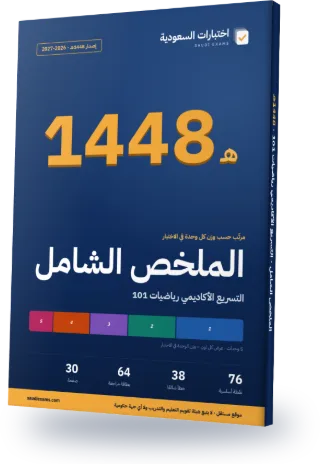 Complete Review Guide 2026–2027 included (PDF)Ordered by the weight of each unit in the examBuy now · SAR 34or 7 days for SAR 26
See everything included
Timed supplementary practice and 568 explained questions to review your weak areas
- Repeat supplementary practice sessions and review performance by unit
- Practise 10 weak-area questions, starting where you lose the most marks
- 568 questions explaining why every option is right or wrong
- Arabic and English with one pass
- Unit notes and flashcards, then questions to check your understanding
Passing an acceleration test exempts the student from the course and shortens the first year fully or partly; at the universities that publish their rules, a fail is not recorded on the transcript. Source Last verified: 2026-11-22
Sources and references
- ETEC – Academic Acceleration Tests (official page) etec.gov.sa
- ETEC e-services portal e-services.etec.gov.sa
- Umm Al-Qura University – acceleration test announcement uqu.edu.sa
- Princess Nourah University – admission document pnu.edu.sa
- Princess Nourah University – acceleration course references pnu.edu.sa