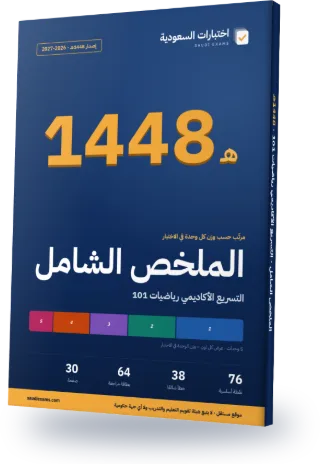
Acceleration Math 101 Complete Review Guide 2026–2027
A 32-page PDF ordered by unit weight. The first three chapters cover 70% of the published syllabus weight.
- 32Pages
- 76Key points
- 38Common mistakes
- 64Flashcards
Guide map
Each chapter is one exam unit, ordered by its weight in the real exam.
| Chapter | Unit | Weight | Key points |
|---|---|---|---|
| 1 | The Derivative and Differentiation Rules | 30% | 14 |
| 2 | Limits and Continuity | 22% | 16 |
| 3 | Functions and Precalculus Review | 18% | 15 |
| 4 | Applications of the Derivative | 18% | 15 |
| 5 | Inverse Functions and Inverse Trigonometric Functions | 12% | 16 |
Chapter 1 in full: The Derivative and Differentiation Rules
This chapter accounts for 30% of the published syllabus weight. These are its key points.
- (Definition of the derivative) The derivative is the limit of the difference quotient as h approaches 0. It gives the instantaneous rate of change.
- (Slope of a tangent line) The slope of the tangent at a is f′(a). It is the limit of the secant slope between (a, f(a)) and (x, f(x)) as x approaches a.
- (Differentiability) If a function is differentiable at a point, it is continuous there. The converse is false: |x| is continuous at 0 but not differentiable there.
The rest of chapter 1, on this page
- (Differentiability and continuity) A vertical tangent or a sharp corner at a point means the function is not differentiable at that point.
- (Power rule) If f(x) = c, then f′(x) = 0. If f(x) = xⁿ, then f′(x) = nxⁿ⁻¹.
- (Product rule) Use the product rule when the function is a product of two functions. Write the steps clearly.
- (Quotient rule) Use the quotient rule when the function is a fraction of two functions, and check that the denominator is not zero.
- (Higher derivatives) f″ is the derivative of f′, and f‴ is the derivative of f″. These are used to study concavity and inflection points.
- (Trigonometric functions) Remember the signs: the derivative of sine is positive, the derivative of cosine is negative, and the derivative of tangent is positive wherever it is defined.
- (Chain rule) When applying the chain rule more than once, differentiate from the outside in and multiply all the inner derivatives.
- (Implicit differentiation) After implicit differentiation, collect all dy/dx terms on one side, factor dy/dx out, and divide to get dy/dx.
- (Exponential functions) The derivative of eˣ is itself, and the derivative of e^(g(x)) is g′(x)·e^(g(x)).
- (Logarithmic functions) The derivative of ln x is 1/x, and the derivative of ln g(x) is g′(x)/g(x), where g(x) > 0.
- (Rate of change) The derivative f′(a) is the rate of change of f at a. If s(t) is a position function, then s′(t) is the instantaneous velocity.
Common mistakes in this chapter
- (Definition of the derivative) Do not substitute h = 0 directly into the difference quotient, since this gives 0/0. Simplify first, then take the limit.
- (Product rule) Do not multiply the two derivatives: (fg)′ ≠ f′g′.
- (Quotient rule) The order of subtraction matters: the numerator is f′g − fg′, not fg′ − f′g, and the denominator is g², not g.
- (Chain rule) Many students forget the inner derivative. For example, (sin(3x))′ = 3cos(3x), not cos(3x).
- (Implicit differentiation) When differentiating y², y³ or sin y, you must include dy/dx. For example, (y²)′ = 2y·dy/dx.
- (Exponential and logarithmic functions) Do not confuse the power rule with the rule for aˣ. Also (aˣ)′ = aˣ ln a, not xaˣ⁻¹, and (logₐ x)′ = 1/(x ln a).
- (Tangent lines) After finding the slope, do not forget the point. Writing only y = mx is wrong; use y − f(a) = m(x − a).
The other chapters are in the full guide
One purchase · lifetime access · review guide included
7-day review plan
The chapters are spread over 6 days by weight so each day carries a similar load. Day 7 is a full exam.
Day 1 · 30% of the exam
Chapter 1: The Derivative and Differentiation Rules
Day 2 · 22% of the exam
Chapter 2: Limits and Continuity
Day 3 · 18% of the exam
Chapter 3: Functions and Precalculus Review
Day 4 · 18% of the exam
Chapter 4: Applications of the Derivative
Day 5 · 12% of the exam
Chapter 5: Inverse Functions and Inverse Trigonometric Functions
Day 6
Review the common mistakes and flashcards.
Day 7
Complete a timed supplementary practice set and review the units where you lost marks.
Before you read: see your score today
10 free questions from the main units, no sign-up. Then you know which chapter to start with.
Try 10 free questions and see your levelA look at each chapter
The first three key points of each chapter, as they appear in the guide (in Arabic in the PDF).
Chapter 1: The Derivative and Differentiation Rules
- (Definition of the derivative) The derivative is the limit of the difference quotient as…
- (Slope of a tangent line) The slope of the tangent at a is f′(a)…
- (Differentiability) If a function is differentiable at a point, it is continuous there. The…
Chapter 2: Limits and Continuity
- (Limits from tables and graphs) Estimate a limit using values close to a from…
- (One-sided limits) Write the right-hand limit as x → a⁺ and the left-hand limit…
- (Infinite limits) If f(x) grows or decreases without bound as x approaches a, the…
Chapter 3: Functions and Precalculus Review
- (Functions) A function gives exactly one output for each input, written as y =…
- (Domain and range) The domain is the set of allowed inputs, and the range…
- (Domain and range) When finding a domain, check denominators (not zero) and even roots…
Chapter 4: Applications of the Derivative
- (Extrema) A local maximum at c means f(c) ≥ f(x) for all x close…
- (Critical points) A critical number must be inside the domain; endpoints are not counted…
- (Critical points) Fermat's theorem
Chapter 5: Inverse Functions and Inverse Trigonometric Functions
- (Inverse functions) f⁻¹ undoes f
- (Horizontal line test) If a horizontal line meets the graph more than once, the…
- (Finding an inverse) Solve y = f(x) for x, then swap the variables.
The full guide comes with lifetime access
Lifetime access includes the full guide (32 pages), all questions and supplementary practice. Chapter 1 is free for everyone.
Questions about the guide
Is the guide free?
Chapter 1 is free to read on the guide page. The full guide comes with lifetime access to this exam; 7-day access does not include it.
Is it up to date for 2026–2027?
Yes. Unit weights and exam facts follow what the exam body last published, and the last check date is printed in the guide. If the standards change we update the file and buyers download the new version.
Does the guide have questions?
No. The guide covers key points and common mistakes; scoring, weak-area practice and full mock exams are on the site.
Can I read it on my phone?
Yes. A5 pages in a single column, with chapters linked from the contents.
- Pages
- 32
- Edition
- 1448 AH · 2026–2027
- Language
- English
- Last updated
Full prep for this exam
All of this in one purchase.
- Timed supplemental practice sessions50 questions in 90 minutes. You get a total score and a score for every unit.
- Practice unit by unit568 questions, every option explained with its source. Starts with your weakest units.
- Complete Review Guide 2026–2027 (PDF)Ordered by each unit's weight in the exam. With lifetime access only.
Choose your access
Continue with your Google account and you go straight to the payment page.