National Science and Mathematics Olympiad (NSMO) – Cities and Provinces Test: Physics: free practice test

Start with 10 free questions to see what needs more practice. Finish to see your score, weakest units and every option explained.

Back to National Science and Mathematics Olympiad (NSMO) – Cities and Provinces Test: Physics

Practice test questions with answers and explanations

Try the questions in the test above first, then open each one here to see the correct answer and why every other option is wrong.

01The volume of a cube with a side length of 0.21 m is:

Past exam question Unit: Physics and Measurement

  1. A0.009261 m³

    This is the raw calculator value; 0.21 m has only two significant digits, so the product cannot keep four.

  2. B0.00926 m³

    Three significant digits is still more precision than the two-digit side length allows in a product.

  3. C0.0093 m³ ✓ Correct answer

    0.21³ = 0.009261 m³, and a product keeps the two significant digits of 0.21, giving 0.0093 m³.

  4. D0.009 m³

    Rounding to one significant digit throws away precision that the two-digit measurement actually has.

Reference: NSMO Cities and Provinces Test – Physics (Mawhiba, 2026), Question 1, with the published answer key

02If equal masses of two liquids of densities ρ₁ and ρ₂ are mixed, the density of the mixture is:

Past exam question Unit: Introduction to Fluids

  1. Aρ₁ρ₂/(ρ₁ + ρ₂)

    This is half the correct value: the total mass is 2m, not m, when the two volumes are added.

  2. B2ρ₁ρ₂/(ρ₁ + ρ₂) ✓ Correct answer

    Total mass 2m over total volume m/ρ₁ + m/ρ₂ gives 2ρ₁ρ₂/(ρ₁ + ρ₂), the harmonic mean of the densities.

  3. C√(ρ₁ρ₂)

    The geometric mean has no basis here; density of a mixture is total mass divided by total volume.

  4. D(ρ₁ + ρ₂)/2

    The simple average would apply to equal volumes mixed, not to equal masses, because the volumes differ.

Reference: NSMO Cities and Provinces Test – Physics (Mawhiba, 2026), Question 2, with the published answer key

03A hollow sphere has an outer radius of 10.0 cm and an inner radius of 9.0 cm. It floats in a liquid with half of its volume submerged. If the density of the liquid is 0.80 g/cm³, what is the density of the material of the sphere in g/cm³? The volume of a sphere of radius r is (4/3)πr³.

Past exam question Unit: Introduction to Fluids

  1. A1.5 g/cm³ ✓ Correct answer

    Weight equals buoyancy: ρ × (1000 − 729) = 0.80 × 500, so ρ = 400/271 ≈ 1.5 g/cm³.

  2. B2.0 g/cm³

    This uses a shell volume of 200 units instead of 1000 − 729 = 271, overstating the density.

  3. C3.0 g/cm³

    This ignores that only half the outer volume is under the liquid, roughly doubling the buoyant force.

  4. D4.5 g/cm³

    This value would need the shell to be far thinner than 1.0 cm; check the volumes with r³.

Reference: NSMO Cities and Provinces Test – Physics (Mawhiba, 2026), Question 4, with the published answer key

04The body whose motion is described by the graph began its motion at the origin. At what instant was it furthest from the origin?

Past exam question Unit: Motion in One Dimension

Velocity–time graph made of straight segments through the points (0 s, 4 m/s), (5, 0), (10, −3), (15, −3), (20, 0), (25, 5), (30, 5), (35, 0), (40, −3), (45, 0).
  1. A5 s

    At 5 s the body is only 10 m from the origin; it later reaches −20 m and then +30 m.

  2. B30 s

    At 30 s the body is still moving forward at 5 m/s, so its distance keeps growing until 35 s.

  3. C35 s ✓ Correct answer

    Areas give x = +10 m at 5 s, −20 m at 20 s and +30 m at 35 s, the largest distance reached.

  4. D45 s

    Between 35 s and 45 s the body moves back 15 m, so at 45 s it is only 15 m from the origin.

Reference: NSMO Cities and Provinces Test – Physics (Mawhiba, 2026), Question 9, with the published answer key

05Two men were in a building when a stone was thrown up from the ground beside them. The two men saw the stone through their windows as it rose and fell. The time between the two events for the first man was 10 s and for the second man it was 6 s. What is the difference in height between the two windows? Neglect air friction (g = 9.8 m/s²).

Past exam question Unit: Motion in One Dimension

  1. A490.0 m

    490 m is (g/2)(10)², using the whole 10 s instead of half of it for the fall from the top; it is not a difference.

  2. B313.6 m

    313.6 m uses (g/2)(10² − 6²) without halving the times to reach the top.

  3. C78.4 m ✓ Correct answer

    Each window is (g/8)T² below the top, so the difference is (9.8/8)(100 − 36) = 78.4 m.

  4. D39.2 m

    39.2 m is half the correct value, as if the times were divided by 2 twice.

Reference: NSMO Cities and Provinces Test – Physics (Mawhiba, 2026), Question 13, with the published answer key

06The following sets of three forces act on a body. In which case can the resultant NOT be zero?

Past exam question Unit: Vectors in Two Dimensions

  1. A10 N, 10 N, 10 N

    Three equal forces at 120° to each other cancel, so a zero resultant is possible.

  2. B10 N, 10 N, 20 N

    Two 10 N forces in one direction cancel a 20 N force opposite, so zero is possible.

  3. C10 N, 20 N, 20 N

    The 10 N and 20 N forces can combine to any value from 10 N to 30 N, including 20 N.

  4. D10 N, 20 N, 40 N ✓ Correct answer

    10 N and 20 N can add to at most 30 N, which can never balance 40 N.

Reference: NSMO Cities and Provinces Test – Physics (Mawhiba, 2026), Question 17, with the published answer key

07A motorcycle moves east with a velocity of 30.0 km/h, and then turns towards the north with a velocity of 26.5 km/h. What is the magnitude of the change in velocity?

Past exam question Unit: Vectors in Two Dimensions

  1. A4.00 km/h

    4.00 km/h is the change in speed only; the direction also changed by 90°.

  2. B−4.00 km/h

    A magnitude can never be negative, and the speed difference ignores the change of direction.

  3. C40.0 km/h ✓ Correct answer

    Δv = v₂ − v₁ has perpendicular parts 26.5 and −30.0, so |Δv| = √(26.5² + 30.0²) = 40.0 km/h.

  4. D56.0 km/h

    56.0 km/h adds the speeds as if the motorcycle reversed; the turn here is only 90°.

Reference: NSMO Cities and Provinces Test – Physics (Mawhiba, 2026), Question 18, with the published answer key

08The following vectors describe the motion of an object moving with constant acceleration at time t = 0: r = (5.0i − 2.0j) m, v = (3.0i + 6.0j) m/s, a = (2.0i − 3.0j) m/s². Which of the following vectors represents the position vector at maximum y?

Past exam question Unit: Motion in Two Dimensions

  1. A(11.0i + 10.0j) m

    This ignores the acceleration and moves for 2 s at the initial velocity only.

  2. B(15.0i + 4.0j) m ✓ Correct answer

    y is maximum when v_y = 6.0 − 3.0t = 0, so t = 2.0 s: x = 5 + 6 + 4 = 15.0 m, y = −2 + 12 − 6 = 4.0 m.

  3. C(9.5i + 7.0j) m

    This uses t = 1.5 s, but v_y is still positive then, so the object is still rising.

  4. D(11.8i + 3.5j) m

    These coordinates do not satisfy the equations of motion at any single time.

Reference: NSMO Cities and Provinces Test – Physics (Mawhiba, 2026), Question 22, with the published answer key

09Mohammed threw a ball out of his building's window with a speed v₀ = 14 m/s to his friend Khalid's window in the opposite building, who caught it at its highest point. If the height of Mohammed's window is 4.0 m and the height of Khalid's window is 9.0 m, what is the distance between their buildings approximately? (g = 9.8 m/s²)

Past exam question Unit: Projectile Motion

  1. A5 m

    5 m is the height gained, not the horizontal distance between the buildings.

  2. B10 m ✓ Correct answer

    Rising 5 m needs v_y = √(2 × 9.8 × 5) ≈ 9.9 m/s, so v_x ≈ 9.9 m/s and t ≈ 1.0 s, giving about 10 m.

  3. C15 m

    15 m would need a horizontal speed of about 15 m/s, more than the 14 m/s total speed allows.

  4. D20 m

    20 m assumes the whole 14 m/s is horizontal for over a second, ignoring the vertical part.

Reference: NSMO Cities and Provinces Test – Physics (Mawhiba, 2026), Question 21, with the published answer key

10A projectile is launched at an angle of 20.0° with respect to the horizontal. If its flight duration is 10.0 s, at what angle approximately should it be launched with the same initial speed for its flight duration to take 20.0 s?

Past exam question Unit: Projectile Motion

  1. A10.0°

    Halving the angle would shorten the flight; a longer flight needs a steeper launch.

  2. B40.0°

    Doubling the angle does not double the time, because flight time depends on sin θ, not θ.

  3. C43.2° ✓ Correct answer

    Flight time ∝ sin θ, so sin θ = 2 sin 20.0° = 0.684 and θ ≈ 43.2°.

  4. D47.5°

    47.5° would make sin θ ≈ 0.737, giving a flight time of about 21.6 s, not 20.0 s.

Reference: NSMO Cities and Provinces Test – Physics (Mawhiba, 2026), Question 25, with the published answer key

NSMO Physics

Full prep for this exam

All of this in one purchase.

  • Full mock exam, same as the real one25 questions in 120 minutes. You get a total score and a score for every unit.
  • Practice unit by unit507 questions, every option explained with its source. Starts with your weakest units.
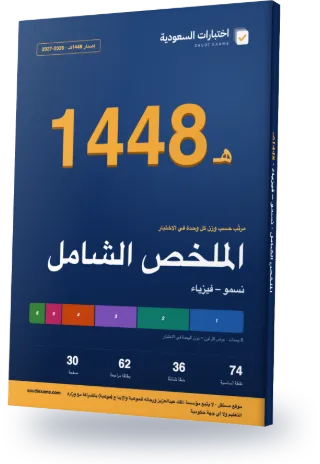
  • Complete Review Guide 2026–2027 (PDF)Ordered by each unit's weight in the exam. With lifetime access only.
Choose your access

One step before payment

Continue with your Google account and you go straight to the payment page.

Check my score freeFull prep