NSMO Physics Syllabus: Six Chapters and Test Format
What the physics Cities and Provinces test covers: 25 questions in 120 minutes on the bag's six chapters, from measurement to projectiles.
- Questions and time
- 25 questions · 120 minutes
- Pass mark
- Mawhiba does not publish a pass mark; students who qualify move on to the next stage
- Exam fee
- Free: registration in both tracks of the National Gifted Olympiad has no fee
Start with 10 free questions to find what needs more work. No sign-up, with answer explanations.
Try 10 free questions and see your levelPut what you just read into practice
Start with 10 free questions to find what needs more work. No sign-up, with answer explanations.
Try 10 free questions and see your levelLast verified: 18 November 2026. The number of questions, time and points come from Mawhiba's published 2026 physics sample test and its answer key, and the content comes from the Stage 1 science bag: Physics. They may change, so check before the test. This is an independent guide, not affiliated with Mawhiba, the Ministry of Education or any government body, and it does not promise any score.
The Cities and Provinces test is the first stage of the NSMO scientific track of the National Gifted Olympiad, and each subject has its own test. This guide is about the physics test, which is for third intermediate and first secondary students. Registration steps are in the registration guide.
Test format
- 25 multiple-choice questions with four options (A–D).
- 120 minutes.
- Points rise through the paper according to the answer key: questions 1–8 are worth 3, 9–17 are worth 4 and 18–25 are worth 5, for a total of 100.
- Each question is printed in Arabic and English on the same sheet.
- The instructions ban calculators "in the mathematics test only" and do not say outright that they are allowed in this test; ask your school coordinator.
- The bag uses g = 9.8 m/s² in its examples, while some sample questions give g = 10 m/s²; use the value the question states.
Bag chapters and questions on the 2026 paper
Mawhiba does not publish how questions are split across chapters. The numbers below are how the 25 questions of the 2026 sample test fall across the bag's chapters, by our reading; a future paper may differ.
| Chapter | Questions in 2026 | What it covers |
|---|---|---|
| Physics and Measurement | 2 | Chapter 1 of the bag (pp. 2–10): basic and derived quantities, SI units and prefixes, conversions, significant digits. |
| Introduction to Fluids | 6 | Chapter 2 (pp. 11–20): density, pressure and liquid pressure, atmospheric pressure, Pascal's principle and the hydraulic press, Archimedes' principle and floating. |
| Motion in One Dimension | 6 | Chapter 3 (pp. 21–37): displacement, speed, velocity and acceleration, position–time and velocity–time graphs, equations of motion, free fall. |
| Vectors | 5 | Chapter 4 (pp. 38–55): adding vectors by drawing and trigonometry, components and unit vectors, scalar and vector products. |
| Motion in Two Dimensions | 2 | Chapter 5 (pp. 56–60): position, velocity and acceleration vectors in a plane, motion with constant acceleration. |
| Projectile Motion | 4 | Chapter 6 (pp. 61–71): horizontal and angled launches, maximum height, time of flight and range. |
How to prepare
- Fluids and one-dimensional motion carried 12 of the 25 questions in 2026; start with them.
- Most questions are calculations or graphs, so practise p = ρgh, buoyancy, and the slope and area of motion graphs until they are quick.
- Practise splitting vectors and launch velocities into components with sine and cosine, and check the quadrant of every answer.
- Convert units before substituting, especially cm³ to m³ and km/h to m/s.
- Read the question in both Arabic and English when a term is unclear.
The bag includes worked examples and practice exercises, and the sample test and its key are on Mawhiba's website; solve them under time. Our 25 questions from the 2026 sample are shown with the official key, and the rest are our own questions written in the same style.
Finished reading? Try a set of questions
Start with 10 free questions to find your weakest units. Keep practising with the full question bank and mock exams from SAR 26.
Put the plan to work here
SAR 34 $9
One purchase · lifetime access · review guide included
- 507 questions, every option explained with its source
- Full mock exams: 25 questions in 120 minutes, like the real one
- Practice that starts with your weakest units, plus a review of your mistakes
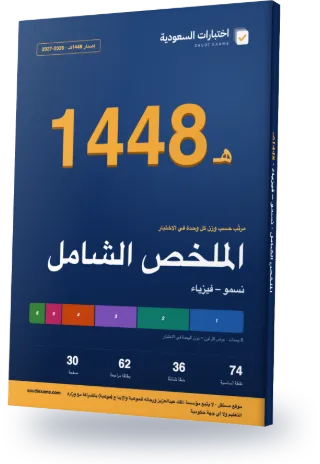 Complete Review Guide 2026–2027 included (PDF)Ordered by the weight of each unit in the examBuy now · SAR 34or 7 days for SAR 26
See everything included
Full mock exams like the real one and 507 explained questions that find your weak spots and train them
- Unlimited full mock exams to practise your pace and check your performance across the whole exam
- Practise 10 weak-area questions, starting where you lose the most marks
- 507 questions explaining why every option is right or wrong
- Arabic and English with one pass
- Unit notes and flashcards, then questions to check your understanding
The Cities and Provinces test is the first gate on the NSMO path: students who pass it train and continue through the later stages to the finals and then the national-team programs for the international olympiads. Source Last verified: 2026-11-18
Sources and references
- موهبة: أولمبياد الموهبة الوطني (المسار العلمي نسمو) mawhiba.sa
- موهبة: الحقيبة العلمية للمرحلة الأولى – الفيزياء mawhiba.sa
- موهبة: نموذج اختبار الفيزياء 2026 mawhiba.sa
- موهبة: مفتاح إجابات نموذج الفيزياء mawhiba.sa