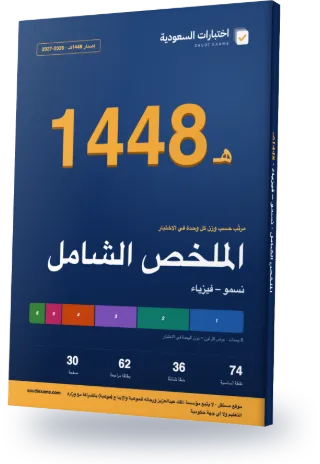
NSMO Physics Complete Review Guide 2026–2027
Every exam topic in a 30-page Arabic PDF, ordered from the heaviest unit to the lightest. The first three chapters alone cover about 68% of the exam questions.
- 30Pages
- 74Key points
- 36Common mistakes
- 62Flashcards
Guide map
Each chapter is one exam unit, ordered by its weight in the real exam.
| Chapter | Unit | Weight | Exam questions | Key points |
|---|---|---|---|---|
| 1 | Introduction to Fluids | 24% | 6 | 12 |
| 2 | Motion in One Dimension | 24% | 6 | 12 |
| 3 | Vectors in Two Dimensions | 20% | 5 | 14 |
| 4 | Projectile Motion | 16% | 4 | 12 |
| 5 | Physics and Measurement | 8% | 2 | 12 |
| 6 | Motion in Two Dimensions | 8% | 2 | 12 |
Chapter 1 in full: Introduction to Fluids
24% of the exam, about 6 questions. These are its key points, as in the guide.
- (Density) ρ = m/V; 1 g/cm³ = 1000 kg/m³ and water is about 1000 kg/m³.
- (Density) Density is a property of the material; cutting a block in half does not change it.
- (Pressure) p = F/A in N/m², called the pascal (Pa); a smaller area gives a larger pressure.
The rest of chapter 1, on this page
- (Fluid pressure) At depth h in a liquid, the extra pressure is ρgh, the same in all directions.
- (Fluid pressure) Points at the same depth in one connected liquid at rest have the same pressure.
- (Atmospheric pressure) The bag uses an atmospheric pressure of 101 325 Pa, about 1.01 × 10⁵ Pa.
- (Atmospheric pressure) Absolute pressure = atmospheric pressure + gauge pressure.
- (Pascal's principle) A pressure change in a confined fluid is passed equally to every part of it.
- (Hydraulic press) F₂ = F₁ × A₂/A₁; the force ratio equals the area ratio.
- (Archimedes' principle) The buoyant force equals the weight of the fluid displaced: F = ρ_fluid g V_sub.
- (Buoyancy) Apparent weight in a fluid = true weight − buoyant force.
- (Floating) A floating object's weight equals its buoyant force, and V_sub/V = ρ_object/ρ_fluid.
Common mistakes in this chapter
- Using 1 g/cm³ = 1 kg/m³; in fact 1 g/cm³ = 1000 kg/m³.
- Thinking liquid pressure depends on the container's shape or the amount of liquid; only depth and density matter.
- Forgetting atmospheric pressure when absolute pressure is asked, or adding it when gauge pressure is asked.
- Believing a hydraulic press multiplies work; it multiplies force while the small piston moves farther.
- Saying a floating object has no buoyant force, or a larger one than its weight; floating means the two are equal.
- Thinking a heavier object always sinks; floating depends on average density, not on mass.
The other chapters are in the full guide
One purchase · lifetime access · review guide included
7-day review plan
The chapters are spread over 6 days by weight so each day carries a similar load. Day 7 is a full exam.
Day 1 · 24% of the exam
Chapter 1: Introduction to Fluids
Day 2 · 24% of the exam
Chapter 2: Motion in One Dimension
Day 3 · 20% of the exam
Chapter 3: Vectors in Two Dimensions
Day 4 · 16% of the exam
Chapter 4: Projectile Motion
Day 5 · 8% of the exam
Chapter 5: Physics and Measurement
Day 6 · 8% of the exam
Chapter 6: Motion in Two Dimensions
Day 7
Full mock exam: 25 questions in 120 minutes, then review the common mistakes in the units where you lost marks.
Before you read: see your score today
10 free questions from the main units, no sign-up. Then you know which chapter to start with.
Try 10 free questions and see your levelA look at each chapter
The first three key points of each chapter, as they appear in the guide (in Arabic in the PDF).
Chapter 1: Introduction to Fluids
- (Density) ρ = m/V; 1 g/cm³ = 1000 kg/m³ and water is about 1000…
- (Density) Density is a property of the material; cutting a block in half does…
- (Pressure) p = F/A in N/m², called the pascal (Pa); a smaller area gives…
Chapter 2: Motion in One Dimension
- (Position and displacement) Displacement Δx = x_final − x_initial, a vector with sign.
- (Position and displacement) Moving the origin changes positions but not displacements.
- (Speed and velocity) Average velocity = Δx/Δt; average speed = total distance / total…
Chapter 3: Vectors in Two Dimensions
- (Scalars and vectors) A scalar has magnitude only; a vector has magnitude and direction.
- (Graphical addition) Place vectors head to tail; the resultant runs from the first tail…
- (Graphical addition) A + B = B + A, and the parallelogram gives the…
Chapter 4: Projectile Motion
- (Independence) Horizontal and vertical motions of a projectile are independent and share time.
- (Horizontal motion) With no air resistance, ax = 0 so vx is constant.
- (Vertical motion) ay = −g = −9.8 m/s² throughout the flight.
Chapter 5: Physics and Measurement
- (Nature of physics) Physics studies matter, energy and how they interact, using measurement, models…
- (Basic quantities) The SI has seven base quantities, including length in metres, mass in…
- (Derived quantities) Derived quantities are built from base ones: speed in m/s, area in…
Chapter 6: Motion in Two Dimensions
- (Position vector) r = xî + yĵ gives position relative to the origin.
- (Displacement) Δr = (x₂ − x₁)î + (y₂ − y₁)ĵ, independent of the path…
- (Average velocity) v_avg = Δr/Δt points along the displacement.
The full guide comes with lifetime access
The full guide (30 pages) is included with lifetime access to this exam, together with every question and full mock exam. Chapter 1 is free for everyone.
Questions about the guide
Is the guide free?
Chapter 1 is free to read on the guide page. The full guide comes with lifetime access to this exam; 7-day access does not include it.
Is it up to date for 2026–2027?
Yes. Unit weights and exam facts follow what the exam body last published, and the last check date is printed in the guide. If the standards change we update the file and buyers download the new version.
Does the guide have questions?
No. The guide covers key points and common mistakes; scoring, weak-area practice and full mock exams are on the site.
Can I read it on my phone?
Yes. A5 pages in a single column, with chapters linked from the contents.
- Pages
- 30
- Edition
- 1448 AH · 2026–2027
- Language
- Arabic
- Last updated
All School Student Exams review guides
Back to National Science and Mathematics Olympiad (NSMO) – Cities and Provinces Test: Physics
Full prep for this exam
All of this in one purchase.
- Full mock exam, same as the real one25 questions in 120 minutes. You get a total score and a score for every unit.
- Practice unit by unit507 questions, every option explained with its source. Starts with your weakest units.
- Complete Review Guide 2026–2027 (PDF)Ordered by each unit's weight in the exam. With lifetime access only.
Choose your access
Continue with your Google account and you go straight to the payment page.