Try the questions in the test above first, then open each one here to see the correct answer and why every other option is wrong.
01Two classes have 918 points in all. Class B has 36 fewer points than Class A. How many points does Class B have?
Practice question Unit: Number
A423
Doubling 423 and adding 36 gives 882, which is 36 short of the total.
B441 ✓ Correct answer
If both classes had the smaller score, the total would be 918 − 36. Half of 882 is 441.
C459
This splits the total equally, giving the classes the same score instead of a difference of 36.
D477
This is the larger score. Subtract the difference of 36 to get the smaller score.
Reference: TIMSS 2027 Assessment Frameworks (2025), ch. 1, Grade 4 Mathematics, Whole Numbers, topic 2, p. 10
Ask a friend
02A machine uses the same two steps each time. It changes 2 to 9, 4 to 15, and 7 to 24. Which rule fits the machine?
Practice question Unit: Number
ADouble, then add 5.
This works for 2, but it changes 4 to 13 instead of 15.
BTriple, then add 3. ✓ Correct answer
The three results are 6 + 3, 12 + 3, and 21 + 3. They all match.
CTriple, then add 1.
This gives 7 for an input of 2, but the machine gives 9.
DDouble, then add 7.
This works for 4, but it changes 7 to 21 instead of 24.
Reference: TIMSS 2027 Assessment Frameworks (2025), ch. 1, Grade 4 Mathematics, Expressions, Simple Equations, and Relationships, topic 3, p. 10
Ask a friend
03Four children fill equal-sized jars with sand. Which jar has more than half but less than three quarters filled?
Practice question Unit: Number
A2/5
Two fifths are below one half. Three of the five parts would be needed to pass half.
B4/8
Four out of eight equal parts make one half exactly. The jar must be more than half full.
C3/4
This is exactly the upper limit. The filled part must be smaller than three quarters.
D5/8 ✓ Correct answer
Five eighths are between four eighths and six eighths, which are one half and three quarters.
Reference: TIMSS 2027 Assessment Frameworks (2025), ch. 1, Grade 4 Mathematics, Fractions and Decimals, topic 1, p. 10
Ask a friend
04A race begins at 09:45. The first part takes 28 minutes. A 10-minute rest comes next. The last part takes 22 minutes. When does the race finish?
Practice question Unit: Measurement and Geometry
A10:13
That is when the first part ends. Add the rest and the last part.
B10:23
This is after the rest. The final part still needs 22 minutes.
C10:35
This includes both parts and skips the 10-minute rest between them.
D10:45 ✓ Correct answer
The three times add to 28 + 10 + 22 = 60 minutes. Add one hour to 09:45.
Reference: TIMSS 2027 Assessment Frameworks (2025), ch. 1, Grade 4 Mathematics, Measurement, topic 2, p. 11
Ask a friend
05Three boxes hold 51 pencils in all. The chart shows how many are in boxes 1 and 3. Where should the top of the bar for box 2 be?
Practice question Unit: Data
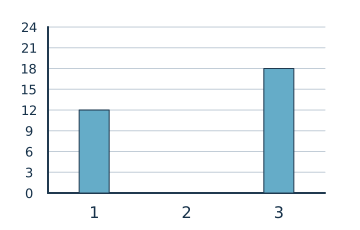
ABetween 12 and 15
The two shown bars total 30. A bar below 15 would make the total less than 45.
BAt 17
The sum would be 12 + 17 + 18 = 47, which is four short of 51.
CAt 18
An 18-unit bar would give a total of 48 pencils, not 51.
DAt 21 ✓ Correct answer
The bars shown total 12 + 18 = 30. Box 2 has 51 − 30 = 21.
Reference: TIMSS 2027 Assessment Frameworks (2025), ch. 1, Grade 4 Mathematics, Single Datasets, topic 2, p. 11
06Two young goats from the same parents are born with brown fur. One later gets a white mark after a wound heals. Which claim is best supported?
Practice question Unit: Biology
AThe white mark was inherited.
The white mark developed after an injury, so the evidence links it to the wound.
BBoth traits appeared after the wound.
Brown fur was already present on both goats before the wound and white mark appeared.
CThe brown fur can be inherited. ✓ Correct answer
Both goats had brown fur from birth. The white mark appeared only after a wound.
DBrown fur appeared because of the wound.
Both goats had brown fur at birth, including the one without the white mark.
Reference: TIMSS 2027 Assessment Frameworks (2025), ch. 2, grade 4, Biology, II.2A, p. 27
Ask a friend
07A greenhouse gets sunlight. Inside it, a green plant can make food, but a small snail needs leaves to eat. Which difference explains this?
Practice question Unit: Biology
AGreen plants can make food using light, air and water. ✓ Correct answer
The green plant uses light to make food. The snail gets food by eating part of a living thing.
BThe snail can make food from light only when it is outside.
A snail gets food by eating living things or their remains whether outside or inside a greenhouse.
CThe plant gets all its food directly from the soil.
Roots can take in water and minerals from soil, while leaves use light to make food.
DBoth make their own food by breathing the air.
Both use air, but the snail takes in food by eating, and the plant needs light and water to make food.
Reference: TIMSS 2027 Assessment Frameworks (2025), ch. 2, grade 4, Biology, I.4A, p. 27
Ask a friend
08A cup holds water, dissolved salt and grains of sand. Hani wants to collect the salt and the sand separately. Which plan works?
Practice question Unit: Physical Science
AEvaporate the water, then collect the solids together.
Evaporation leaves both solids in the cup. Collecting them together leaves the sand and salt mixed.
BFilter out the salt, then evaporate the water.
Dissolved salt passes through a filter with the water, so filtering cannot remove it first.
CFilter out the sand, then evaporate the water. ✓ Correct answer
Sand stays in the filter. The salt goes through in solution and remains when the water evaporates.
DLift out the salt and sand with a magnet.
Salt and ordinary sand grains are not collected this way. The salt is also dissolved in the water.
Reference: TIMSS 2027 Assessment Frameworks (2025), ch. 2, grade 4, Physical Science, I.3B, p. 30
Ask a friend
09A warm steel ball is placed in a cup of cooler water. The cup keeps heat from escaping to the room during the test. Which change should happen first?
Practice question Unit: Physical Science
AThe ball warms and the water cools.
The cooler water does not make the warmer ball hotter. Heat moves the other way.
BThe ball and the water both warm.
No source is heating both of them. The water gains heat that the ball loses.
CThe ball and the water both cool.
Heat moves into the water and makes it warmer. The cup limits heat loss to the room.
DThe ball cools and the water warms. ✓ Correct answer
Heat moves from the warmer ball to the cooler water, so their temperatures move closer together.
Reference: TIMSS 2027 Assessment Frameworks (2025), ch. 2, grade 4, Physical Science, II.2A, p. 30
Ask a friend
10Many fossils of sea animals are found together in a rock layer far inland. The animals lived in seawater. What does this support about the place long ago?
Practice question Unit: Earth Science
ASeawater may have covered the place. ✓ Correct answer
Finding many sea animals together in the rock supports the idea that this area once lay underwater.
BThe place was always dry land.
The fossils are evidence of sea life, which makes a past marine environment a better explanation.
CThe sea animals breathed only on dry land.
The information says that these animals lived in seawater. It does not show they needed dry land to breathe.
DA new ocean formed there this year.
Fossils record past life, and the place where the students found the rock is inland today.
Reference: TIMSS 2027 Assessment Frameworks (2025), ch. 2, grade 4, Earth Science, I.2B, p. 32
Ask a friend