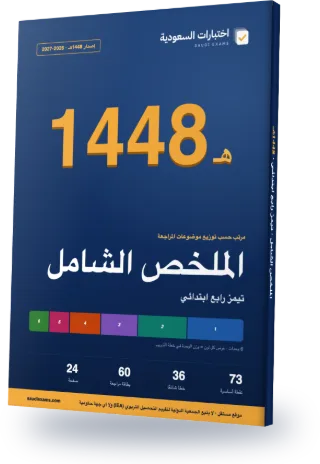
TIMSS Grade 4 Complete Review Guide 2026–2027
A 28-page PDF ordered by unit weight. The first three chapters cover 65% of the published syllabus weight.
- 28Pages
- 73Key points
- 36Common mistakes
- 60Flashcards
Guide map
Each chapter is one exam unit, ordered by its weight in the real exam.
| Chapter | Unit | Weight | Key points |
|---|---|---|---|
| 1 | Number | 25% | 12 |
| 2 | Biology | 23% | 12 |
| 3 | Physical Science | 18% | 13 |
| 4 | Measurement and Geometry | 15% | 12 |
| 5 | Data | 10% | 12 |
| 6 | Earth Science | 10% | 12 |
Chapter 1 in full: Number
This chapter accounts for 25% of the published syllabus weight. These are its key points.
- Split 3,507 into 3,000 + 500 + 7. The zero holds the tens place.
- To estimate 48 + 53, add 50 + 50 first. The exact answer should be near 100.
- For 6 boxes with 8 pencils each, the total is 6 × 8 = 48.
The rest of chapter 1, on this page
- Share 29 cards equally among 4 groups. Each group gets 7, with 1 left over.
- For 8 groups of 20, 8 × 20 gives 160.
- For 17 + □ = 24, subtract 17 from 24 to find the missing number.
- There are 32 children and 9 leave. The sentence 32 − 9 = □ shows how many are left.
- In the pattern 4, 9, 14, 19, add 5 each time. The next number is 24.
- Of 12 buttons, 3 are blue. That is 3/12 of the set, equal to 1/4.
- A quarter of a cake is smaller than half. Start with equally sized wholes when comparing with a drawing.
- The decimal 0.36 is 36 hundredths. Subtracting 0.10 leaves 0.26.
- Line up the decimal points when adding 1.70 and 0.25. The result is 1.95.
Common mistakes in this chapter
- In 7,042, 4 is in the tens place. Its value is 40.
- 0.8 is greater than 0.75. Write 0.8 as 0.80 to compare hundredths.
- When you add 2/7 and 3/7, the pieces stay in sevenths. The sum is 5/7.
- In a grouping problem, interpret the remainder before choosing the result.
- Use one operation per blank and check both sides of the equals sign.
- Before adding decimals, line up units with units and tenths with tenths.
The other chapters are in the full guide
One purchase · lifetime access · review guide included
7-day review plan
The chapters are spread over 6 days by weight so each day carries a similar load. Day 7 is a full exam.
Day 1 · 25% of the exam
Chapter 1: Number
Day 2 · 23% of the exam
Chapter 2: Biology
Day 3 · 18% of the exam
Chapter 3: Physical Science
Day 4 · 15% of the exam
Chapter 4: Measurement and Geometry
Day 5 · 10% of the exam
Chapter 5: Data
Day 6 · 10% of the exam
Chapter 6: Earth Science
Day 7
Complete a timed supplementary practice set and review the units where you lost marks.
Before you read: see your score today
10 free questions from the main units, no sign-up. Then you know which chapter to start with.
Try 10 free questions and see your levelA look at each chapter
The first three key points of each chapter, as they appear in the guide (in Arabic in the PDF).
Chapter 1: Number
- Split 3,507 into 3,000 + 500 + 7. The zero holds the tens place.
- To estimate 48 + 53, add 50 + 50 first. The exact answer should…
- For 6 boxes with 8 pencils each, the total is 6 × 8 =…
Chapter 2: Biology
- Roots take in water and hold the plant in place. The plant uses light…
- The lungs help take in oxygen. The heart pumps blood to the body.
- A butterfly egg hatches into a caterpillar, followed by a pupa and then an…
Chapter 3: Physical Science
- A liquid has a set volume and takes the shape of its container. A…
- Freezing changes the state of water. Rusting forms a different material.
- A filter can separate sand and water. A magnet can separate iron filings from…
Chapter 4: Measurement and Geometry
- A millimetre suits the thickness of a card. A kilometre suits the distance between…
- From 9
- For perimeter, add the lengths of all outside edges.
Chapter 5: Data
- Bars show differences among categories. Find the category, then read the bar height.
- A line graph shows change over time. A move from 8 to 11 is…
- A pie chart shows parts of one total. Half the circle represents half the…
Chapter 6: Earth Science
- Water covers more of Earth’s surface than land.
- A dune can form as windblown sand builds up.
- Fossil sea shells in rock can be evidence that the area was once covered…
The full guide comes with lifetime access
Lifetime access includes the full guide (28 pages), all questions and supplementary practice. Chapter 1 is free for everyone.
Questions about the guide
Is the guide free?
Chapter 1 is free to read on the guide page. The full guide comes with lifetime access to this exam; 7-day access does not include it.
Is it up to date for 2026–2027?
Yes. Unit weights and exam facts follow what the exam body last published, and the last check date is printed in the guide. If the standards change we update the file and buyers download the new version.
Does the guide have questions?
No. The guide covers key points and common mistakes; scoring, weak-area practice and full mock exams are on the site.
Can I read it on my phone?
Yes. A5 pages in a single column, with chapters linked from the contents.
- Pages
- 28
- Edition
- 1448 AH · 2026–2027
- Language
- English
- Last updated
Full prep for this exam
All of this in one purchase.
- Timed supplemental practice sessions40 questions in 72 minutes. You get a total score and a score for every unit.
- Practice unit by unit501 questions, every option explained with its source. Starts with your weakest units.
- Complete Review Guide 2026–2027 (PDF)Ordered by each unit's weight in the exam. With lifetime access only.
Choose your access
Continue with your Google account and you go straight to the payment page.