PISA Reading, Mathematics and Science Practice: free practice test

Start with 10 free questions to see what needs more practice. Finish to see your score, weakest units and every option explained.

OECD reports results on proficiency scales. Our exercises show practice accuracy. This is your practice accuracy. It cannot be converted to the exam’s scaled score or used to determine whether you pass.

Back to PISA Reading, Mathematics and Science Practice

Practice test questions with answers and explanations

Try the questions in the test above first, then open each one here to see the correct answer and why every other option is wrong.

01Which plan follows all the instructions for a Wednesday paper-artwork drop-off and later pickup?

Practice question Unit: Locating Information

Fictional workshop notice The frame shop accepts student artwork on Monday and Wednesday. Bring paper artwork in a flat folder. For artwork on fabric, bring a photograph first so the shop can choose a frame without handling the fabric. Write your name and class on a separate card. On Monday, the collection desk is beside the stairs. On Wednesday, it is inside the shop. Finished frames are collected at the shop on Saturday.

  1. AHand in a flat folder and card inside the shop. Return to the shop on Saturday. ✓ Correct answer

    Paper goes in a flat folder, Wednesday drop-off is inside the shop, and finished frames are collected there on Saturday.

  2. BHand in a flat folder and card inside the shop. Return to the shop on Wednesday.

    The Wednesday plan fits drop-off. The notice lists Saturday for collecting finished frames.

  3. CHand in a flat folder and card beside the stairs. Return to the shop on Saturday.

    The stairs are the Monday drop-off location. Wednesday drop-off takes place inside the shop.

  4. DHand in a photograph and card inside the shop. Return to the shop on Saturday.

    A photograph is the first step for fabric artwork. Paper artwork should arrive in a flat folder.

Reference: OECD PISA 2018 Reading Framework, Retrieving a Detail Within a Text.

02What do the narrator's final actions suggest about the picture?

Practice question Unit: Understanding and Inferring

Fictional journal I had made a wide tail for my kite. It looked splendid on the table, but it twisted around the string as soon as the kite rose. I cut the tail down to a narrow ribbon and tested it again. This time it stayed straight. My brother held up the discarded fabric and asked whether I wanted to put it back for the photograph. I shook my head. When he raised the camera, I waited for the next gust.

  1. AThe narrator wants the kite to appear as it did before the tests.

    The narrator keeps the new narrow tail even when offered a chance to restore the original one.

  2. BThe narrator wants to show why the wide tail twisted in the air.

    The narrator declines to put the wide tail back and waits to fly the kite with the narrow tail.

  3. CThe narrator wants to show the design that works in the air. ✓ Correct answer

    The narrator rejects the discarded fabric and waits for wind to fly the modified kite.

  4. DThe narrator wants to compare both tails beside the drawing.

    Waiting for wind suggests flight, and the narrator leaves the discarded fabric off.

Reference: OECD PISA 2018 Reading Framework, Integrating Evidence and Inferring.

03For a choice based only on drying at the covered entrance, which judgment is best supported?

Practice question Unit: Evaluating and Reflecting

Fictional product comparison Seller's card Our chair mat dries before the other shop's mat. We tested one of each outside at noon and ours was dry first. Buy it for the covered school entrance. Custodian's record I tried one of each mat on the covered entrance floor on two wet mornings. I put the same amount of water on each. Both times the other shop's mat felt dry first. I wrote down which was dry first but did not measure the number of minutes.

  1. AFavour the seller's mat because noon sunlight settles which will dry faster at the entrance.

    The outdoor result applies to a different setting from the covered entrance.

  2. BTreat the mats as equally fast because the custodian did not use a timer.

    The missing timer prevents a measured difference. It does not erase the observed order.

  3. CFavour the rival mat based on the entrance trials, but leave the size of the advantage open. ✓ Correct answer

    The custodian's trials match the intended location and agree on order. Neither trial measured the time gap.

  4. DFavour the rival mat in every location because its entrance result is more recent.

    Neither the passage chronology nor the conditions justify an all-location claim.

Reference: OECD PISA 2018 Reading Framework, Comparing Evidence and Resolving Conflicts.

04Which arrangement takes both the notebook and the sticker box within all limits?

Practice question Unit: Quantity

Exhibition supplies are packed into three bags. The limit is 18 kg per packed bag and 44 kg for the three packed bags combined. The display bag weighs 17.4 kg, the tool bag 15.8 kg and the stationery bag 8.6 kg. There is also a 0.5 kg notebook and a 1.6 kg box of stickers.

  1. APut the notebook in the tool bag and the box in the display bag.

    The total is 43.9 kg, but the display bag alone weighs 19 kg with the box.

  2. BPut the notebook in the display bag and the box in the tool bag. ✓ Correct answer

    Those two bags become 17.9 kg and 17.4 kg. All three together weigh 43.9 kg.

  3. CPut both the notebook and the box in the display bag.

    Adding 2.1 kg to the display bag brings it to 19.5 kg, above its individual limit.

  4. DPut the notebook in the stationery bag and the box in the display bag.

    The notebook fits in the stationery bag, but the box takes the display bag 1 kg over its limit.

Reference: OECD PISA 2022 Mathematics Framework, Representing and Estimating Quantities.

05At what minimum photo count does the first shop become cheaper?

Practice question Unit: Change and Relationships

Two groups are printing photos for an exhibition. The first shop charges 14 riyals to set up an order and then 3 riyals per photo. The second charges 6 riyals per photo and no setup fee. Both shops accept orders of at least one photo, with the same unit price at any order size and no other charges.

  1. A4 photos

    At four photos the customer pays 26 riyals at the first shop versus 24 at the second.

  2. B5 photos ✓ Correct answer

    Savings of three riyals per photo must exceed the setup fee of 14. At five photos they reach 15.

  3. C6 photos

    The first shop is cheaper for six photos, but it already becomes cheaper at five.

  4. D7 photos

    At seven photos the first shop saves seven riyals. Savings begin at a lower count.

Reference: OECD PISA 2022 Mathematics Framework, Comparing Models and Their Limits.

06The vertical path between the plaza and shelter closes. A student starts at the entrance, visits the shelter, and then reaches the car park by the shortest route. What is the total distance?

Practice question Unit: Space and Shape

A grid map shows a library entrance at (0, 0), a plaza at (4, 0), a shelter at (4, 3) and a car park at (0, 3). Each pair lists the horizontal coordinate first. Each grid unit is 20 metres. Walkers can use the rectangle’s four sides or a straight diagonal path connecting the entrance and shelter. Ignore path widths.

  1. A180 m ✓ Correct answer

    The 3-4-5 triangle gives a 100-metre diagonal. Add 80 metres from the shelter to the car park.

  2. B60 m

    This is the direct path to the car park. It skips the required visit to the shelter.

  3. C220 m

    This route passes the car park first, then visits the shelter and returns. The diagonal reaches the shelter sooner.

  4. D100 m

    This is the diagonal to the shelter. Another 80 metres remain from the shelter to the car park.

Reference: OECD PISA 2022 Mathematics Framework, Maps, Scales and Routes.

07The 11-minute value included a break outside the intended wait measure and is replaced with 3 minutes. What are the new Monday mean and median?

Practice question Unit: Uncertainty and Data

A library measures the waiting times at its desk on two days. The times below are minutes from joining the queue to being served, sorted from shortest to longest. Sunday: 2, 2, 3, 3, 5 Monday: 1, 2, 3, 3, 11 Each value comes from one reader. The team recorded no other readers in these two samples.

  1. AMean 2.4 minutes and median 3 minutes. ✓ Correct answer

    The updated values sum to 12 across five readers. The third observation is still 3.

  2. BMean 3 minutes and median 3 minutes.

    The mean must include the values below 3. The observations add up to only 12.

  3. CMean 3 minutes and median 2.4 minutes.

    The mean is 12 divided by five. A value of 2.4 is not the third observation.

  4. DMean 4 minutes and median 3 minutes.

    Monday’s mean was 4 minutes before correction. Reducing one observation lowers the mean.

Reference: OECD PISA 2022 Mathematics Framework, Data Representations and Variation.

08The felt now covers the last part of the ramp as well as the entire level floor. What change is expected compared with the original felt-floor run?

Practice question Unit: Explaining Phenomena Scientifically

In a classroom model, a handcart starts from rest at the same mark on a ramp each time. With a smooth sheet covering the level floor it rolls 140 cm past the foot of the ramp. With a felt sheet it rolls 65 cm. The ramp itself stays unchanged.

  1. AA lower speed at the foot and more than 65 cm on the floor.

    With the floor unchanged, a lower entry speed means less distance is needed to stop.

  2. BA lower speed at the foot and less than 65 cm on the floor. ✓ Correct answer

    Extra resistance on the ramp reduces entry speed. The same felt floor then stops the slower cart sooner.

  3. CThe same speed at the foot and exactly 65 cm on the floor.

    An unchanged floor does not preserve the stopping distance when the cart reaches it with lower speed.

  4. DThe same speed at the foot and less than 65 cm on the floor.

    The new covering changes the resistance before the cart reaches the foot, reducing its speed there.

Reference: OECD PISA 2025 Science Framework, Physical Systems.

09A pad qualifies if at least two recorded distances are at most 3 cm and none exceeds 6 cm. Which option lists all and only the pads that qualify?

Practice question Unit: Inquiry and Evidence

In a simulated design trial, a team compares three equally thick pads under the leg of a loaded model shelf. The goal is to reduce the distance the shelf slides when pushed sideways. With the same initial push on the same floor, three distances in cm are recorded for each pad. Pad P: 6, 7, 6. Pad Q: 2, 3, 2. Pad R: 1, 7, 6.

  1. AQ and R.

    Q satisfies both conditions, but R’s 7 cm reading breaks the overall limit.

  2. BQ only. ✓ Correct answer

    Q meets the stricter distance in all three trials and stays below the overall limit.

  3. CP and Q.

    P has no reading at or below 3 cm and at least one reading above 6 cm.

  4. DR only.

    R meets the stricter distance only once and also exceeds the overall limit in one trial.

Reference: OECD PISA 2025 Science Framework, Interpreting Data and Limits.

10The plaza limits average daily water additions to 25 L and extra electricity above once-through operation to 1 kWh per day. Which tested mode met both limits?

Practice question Unit: Evaluating Information and Decisions

A fictional plaza tests two fountain modes for four equally warm opening days each. Maintenance staff record the average water added to the system daily: 18 L in recirculating mode and 52 L in once-through mode. The recirculating pump uses 2 kWh more each day. A supplier’s leaflet says its recirculating system makes fountains waste-free without giving any measurements.

  1. ANeither tested mode meets both limits. ✓ Correct answer

    Recirculation meets the water limit but needs 2 extra kWh. The once-through mode exceeds the water limit.

  2. BOnly the once-through mode meets both limits.

    The baseline adds no electricity above itself, but its 52 L of water exceeds 25 L.

  3. COnly the recirculating mode meets both limits.

    Its 18 L water use qualifies, but the 2 kWh additional use exceeds the electricity limit.

  4. DBoth tested modes meet both limits.

    Each mode fails one stated limit, although the failed limit differs between modes.

Reference: OECD PISA 2025 Science Framework, Trade-offs and Evidence-based Decisions.

PISA Literacy Practice

Full prep for this exam

All of this in one purchase.

  • Timed supplemental practice sessions50 questions in 90 minutes. You get a total score and a score for every unit.
  • Practice unit by unit500 questions, every option explained with its source. Starts with your weakest units.
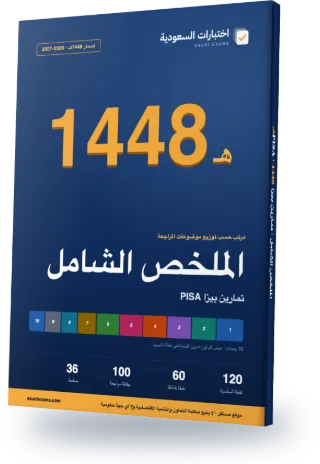
  • Complete Review Guide 2026–2027 (PDF)Ordered by each unit's weight in the exam. With lifetime access only.
Choose your access

One step before payment

Continue with your Google account and you go straight to the payment page.

Check my score freeFull prep