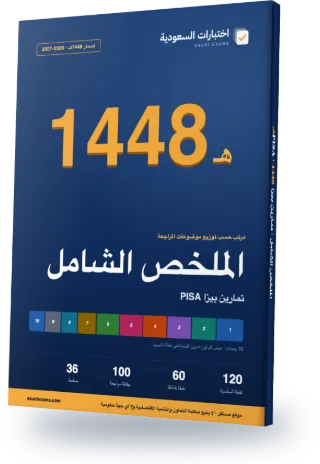
PISA Literacy Practice Complete Review Guide 2026–2027
A 36-page PDF ordered by unit weight. The first three chapters cover 34% of the published syllabus weight.
- 36Pages
- 120Key points
- 60Common mistakes
- 100Flashcards
Guide map
Each chapter is one exam unit, ordered by its weight in the real exam.
| Chapter | Unit | Weight | Key points |
|---|---|---|---|
| 1 | Evaluating and Reflecting | 12% | 12 |
| 2 | Locating Information | 11% | 12 |
| 3 | Understanding and Inferring | 11% | 12 |
| 4 | Explaining Phenomena Scientifically | 11% | 12 |
| 5 | Inquiry and Evidence | 11% | 12 |
| 6 | Evaluating Information and Decisions | 11% | 12 |
| 7 | Quantity | 9% | 12 |
| 8 | Change and Relationships | 8% | 12 |
| 9 | Space and Shape | 8% | 12 |
| 10 | Uncertainty and Data | 8% | 12 |
Chapter 1 in full: Evaluating and Reflecting
This chapter accounts for 12% of the published syllabus weight. These are its key points.
- Check data for each class over comparable periods.
- It asks the reader to act and offers reasons to do so.
- The update date and the period it covers.
The rest of chapter 1, on this page
- It lets the reader judge whether the method fits the question.
- Use it as evidence of that person’s experience. A broad conclusion needs wider data.
- One may give participants instructions and the other may tell visitors how to enter.
- There is one independent data source.
- Check each measure’s definition and identify a shared period if possible.
- A supported view connects to relevant evidence that can be checked.
- It helps you judge participation and whether some groups may be missing.
- Compare the headline’s claim with the amount and limits of evidence in the article.
- Check the data’s origin and seek independent evidence before selecting a result.
Common mistakes in this chapter
- Confusing a worthwhile goal with accurate data
- Accepting a broad claim based on one story
- Treating two repeated versions of one report as independent evidence
- Comparing percentages calculated from unlike groups
- Ignoring an author’s interest when they assess a product they sell
- Treating length or recency alone as evidence
The other chapters are in the full guide
One purchase · lifetime access · review guide included
7-day review plan
The chapters are spread over 6 days by weight so each day carries a similar load. Day 7 is a full exam.
Day 1 · 12% of the exam
Chapter 1: Evaluating and Reflecting
Day 2 · 20% of the exam
Chapter 2: Locating Information
Chapter 7: QuantityDay 3 · 19% of the exam
Chapter 3: Understanding and Inferring
Chapter 8: Change and RelationshipsDay 4 · 19% of the exam
Chapter 4: Explaining Phenomena Scientifically
Chapter 9: Space and ShapeDay 5 · 19% of the exam
Chapter 5: Inquiry and Evidence
Chapter 10: Uncertainty and DataDay 6 · 11% of the exam
Chapter 6: Evaluating Information and Decisions
Day 7
Complete a timed supplementary practice set and review the units where you lost marks.
Before you read: see your score today
10 free questions from the main units, no sign-up. Then you know which chapter to start with.
Try 10 free questions and see your levelA look at each chapter
The first three key points of each chapter, as they appear in the guide (in Arabic in the PDF).
Chapter 1: Evaluating and Reflecting
- Check data for each class over comparable periods.
- It asks the reader to act and offers reasons to do so.
- The update date and the period it covers.
Chapter 2: Locating Information
- Match the Thursday heading to the show and read the time on the same…
- Find the date connected to registering or submitting the form.
- Identify each group and read the conditions under its own heading.
Chapter 3: Understanding and Inferring
- The main idea accounts for several parts of the text. An example illustrates one…
- It places the next event after the one already described.
- Read the action and description and identify whose situation fits.
Chapter 4: Explaining Phenomena Scientifically
- Metal transfers energy from the hand faster than wood if both handles are cooler…
- It reduces air exchange and evaporation at the surface. Insulation can also slow heat…
- The combined mass of water and sugar stays constant if no matter enters or…
Chapter 5: Inquiry and Evidence
- It is the number of hours of light because that is the factor the…
- Plant height or its change, according to the specified measurement procedure.
- Keeping water constant makes the comparison clearer when evaluating the effect of light.
Chapter 6: Evaluating Information and Decisions
- Ask how energy use was measured, what baseline was used and under which conditions…
- When they come from independent measurements or analyses, rather than the same original observation.
- Check potential interests, the data collection and disclosures, and seek independent evidence where needed.
Chapter 7: Quantity
- 1,500 metres, since a kilometre equals 1,000 metres.
- Multiply by 100 to get 40%.
- Use 200 × 30, which is about 6,000.
Chapter 8: Change and Relationships
- 12 units in four hours.
- The initial value for the quantity on the horizontal axis.
- Each value is three greater than the previous one.
Chapter 9: Space and Shape
- The distance is 70 m because 3.5 × 20 = 70.
- Add all three segment lengths at the same scale, then convert the total to…
- It is shorter when the straight line connects the points while the path detours…
Chapter 10: Uncertainty and Data
- A shortened axis can make a small numerical difference look large.
- Sort the values and take the fourth one.
- The sum is 24 and there are four values, so the mean is 6.
The full guide comes with lifetime access
Lifetime access includes the full guide (36 pages), all questions and supplementary practice. Chapter 1 is free for everyone.
Questions about the guide
Is the guide free?
Chapter 1 is free to read on the guide page. The full guide comes with lifetime access to this exam; 7-day access does not include it.
Is it up to date for 2026–2027?
Yes. Unit weights and exam facts follow what the exam body last published, and the last check date is printed in the guide. If the standards change we update the file and buyers download the new version.
Does the guide have questions?
No. The guide covers key points and common mistakes; scoring, weak-area practice and full mock exams are on the site.
Can I read it on my phone?
Yes. A5 pages in a single column, with chapters linked from the contents.
- Pages
- 36
- Edition
- 1448 AH · 2026–2027
- Language
- English
- Last updated
Full prep for this exam
All of this in one purchase.
- Timed supplemental practice sessions50 questions in 90 minutes. You get a total score and a score for every unit.
- Practice unit by unit500 questions, every option explained with its source. Starts with your weakest units.
- Complete Review Guide 2026–2027 (PDF)Ordered by each unit's weight in the exam. With lifetime access only.
Choose your access
Continue with your Google account and you go straight to the payment page.