Nafes National Test, Grade 9 (Third Intermediate): free practice test

Start with 10 free questions to see what needs more practice. Finish to see your score, weakest units and every option explained.

Back to Nafes National Test, Grade 9 (Third Intermediate)

Practice test questions with answers and explanations

Try the questions in the test above first, then open each one here to see the correct answer and why every other option is wrong.

01In which sentence is "fixes" used in the same sense as in the passage ("sorts and fixes information")?

Practice question Unit: Reading: vocabulary and word meaning

Some students say that staying up late to finish assignments at the last minute does no harm as long as the work is handed in on time. I disagree, because I tried it for a whole school term. I stayed awake until late, and then I reached the first class tired and unable to follow the explanation. Many studies confirm that the brain sorts and fixes information during sleep, so a student who sleeps too little may quickly forget what was studied. I believe that organising time is more useful than staying up: splitting an assignment into small parts over several days makes studying lighter and its effect longer-lasting. In this way enough sleep becomes part of the plan for success rather than a deduction from its time.

  1. AThe carpenter fixes the nail in the wood with the hammer

    The sense here is physical, fastening one object into another, not retaining information.

  2. BThe teacher fixes the test date on the board

    Here it means setting a date, whereas the passage means making information stick in the brain.

  3. CThe worker fixes the notice to the wall with glue

    Here it means sticking a notice to a wall, a physical sense.

  4. DThe student fixes the rule in memory by repeating it ✓ Correct answer

    The passage says the brain "sorts and fixes information", meaning it makes it stay in memory, as this sentence does.

Reference: ETEC, Learning Outcomes Document for the National Tests (2026, 3rd ed.), Grade 9, Reading, indicator 1-1-1-2-9, p. 14

02What is the main difference between the two texts?

Practice question Unit: Reading: comprehension and analysis

Text 1: Remote learning gives the student flexibility in time and place, so he can review a recorded lesson more than once and at a speed that suits him. It also saves him travel time and tiredness. For this reason I see it as a successful method for someone who organises his time well. Text 2: Attending school allows the student to ask the teacher at once and to learn to work with classmates. In it the student gets used to keeping a fixed schedule, which many find hard at home. For this reason I believe in-person education is better at building discipline and social skills.

  1. Athe first is about the teacher's role, the second about modern devices

    Text 1 is about flexible time and place, not the teacher, and Text 2 is about attendance, not devices.

  2. Bthe first is about school sport, the second about arts

    Neither text mentions sport or the arts.

  3. Cthe first puts flexibility first, the second discipline and social skills ✓ Correct answer

    Text 1 finds the value in flexible time and place, Text 2 in a fixed schedule and working with classmates.

  4. Dthe first relies on figures, the second on a personal story

    Text 1 has no figures and Text 2 no story.

Reference: ETEC, Learning Outcomes Document for the National Tests (2026, 3rd ed.), Grade 9, Reading, indicator 2-1-1-2-9, p. 14

03Which real-life situation applies the passage's idea best?

Practice question Unit: Reading: evaluating, critiquing and applying a text

Desalinating seawater is one of the most important answers to the shortage of fresh water in dry regions. One common method relies on "reverse osmosis": seawater is forced under high pressure through a very thin membrane that lets water molecules pass but holds back most of the salts. The resulting water is then treated so that it is safe to drink. However, the process uses a great deal of energy, and it leaves behind a very salty solution called "brine" that must be handled carefully so that it does not harm marine life. For this reason engineers are working to cut energy use, including running plants on solar power, and to find safe ways of dealing with the brine. Many experts believe that the future success of desalination depends on improving its efficiency, not only on building more plants.

  1. Aa municipality that believes more plants alone will solve every water problem

    The text says success depends on efficiency "not only on building more plants", so this contradicts it.

  2. Ba school fitting devices that cut water use rather than only buying extra tanks ✓ Correct answer

    Improving efficiency rather than just expanding is the idea the passage ends on.

  3. Ca municipality building a new plant without considering its energy use

    This is expansion without efficiency, which the passage rejects.

  4. Da factory dumping its waste straight into the sea

    The text warns against careless disposal of brine, so this contradicts rather than applies it.

Reference: ETEC, Learning Outcomes Document for the National Tests (2026, 3rd ed.), Grade 9, Reading, indicator 3-1-1-2-9, p. 14

04If a and b are negative integers with a < b, which statement is always true?

Practice question Unit: Mathematics: numbers and operations

  1. A|a| < |b|

    Between two negatives the smaller one is farther from zero, so its absolute value is larger, not smaller.

  2. Ba × b < 0

    The product of two negatives is always positive, never negative.

  3. Ca + b > 0

    The sum of two negatives is always negative, never positive.

  4. D|a| > |b| ✓ Correct answer

    The smaller negative is farther from zero: −7 < −2 and |−7| > |−2|, so |a| > |b|.

Reference: ETEC, Learning Outcomes Document for the National Tests (2026, 3rd ed.), Grade 9, Mathematics, indicator 1-1-1-4-9, p. 27

05What is the range of the relation {(2,5), (3,7), (4,5), (6,9)}?

Practice question Unit: Mathematics: algebra and analysis

  1. A{5, 7, 9} ✓ Correct answer

    The range is the set of outputs (second coordinates) without repetition: {5, 7, 9}.

  2. B{2, 3, 4, 6}

    These are the inputs, the domain, not the range.

  3. C{2, 5, 7, 9}

    This puts 2 (an input) together with 5, 7, 9; the range contains only second coordinates.

  4. D{3, 4, 6, 9}

    This takes 3, 4, 6 (inputs) and 9 (an output); inputs and outputs are mixed.

Reference: ETEC, Learning Outcomes Document for the National Tests (2026, 3rd ed.), Grade 9, Mathematics, indicator 1-1-2-4-9 (outcome 3), p. 28

06Two parallel lines are cut by a transversal. Two alternate interior angles measure (2x + 10)° and (3x − 20)°. What is the measure of each angle?

Practice question Unit: Mathematics: geometry and measurement

  1. A30°

    30 is the value of x, not the angle measure.

  2. B70° ✓ Correct answer

    Alternate interior angles are equal: 2x + 10 = 3x − 20 gives x = 30, so each angle is 70°.

  3. C86°

    86° comes from treating them as co-interior angles with sum 180, giving x = 38.

  4. D110°

    110° is the supplement of the correct angle 70°.

Reference: ETEC, Learning Outcomes Document for the National Tests (2026, 3rd ed.), Grade 9, Mathematics, indicator 1-1-3-4-9 (outcome 1), p. 29

07During which stage of the cell cycle is DNA copied in preparation for division?

Practice question Unit: Science: life sciences

  1. AInterphase ✓ Correct answer

    In interphase the cell grows and its DNA is copied in preparation for division.

  2. BProphase of division

    In prophase the already-copied chromosomes condense.

  3. CMetaphase of division

    In metaphase the copied chromosomes line up.

  4. DTelophase of division

    In telophase the two nuclei form after separation is complete.

Reference: ETEC, Learning Outcomes Document for the National Tests (2026, 3rd ed.), Grade 9, Natural Science, indicator 2-1-1-5-9 (outcome 1), p. 42

08A sample of a radioactive element has a mass of 80 g and a half-life of 5 days. How much remains undecayed after 15 days?

Practice question Unit: Science: matter and its reactions (chemistry)

  1. A10 g ✓ Correct answer

    15 days = 3 half-lives: 80 → 40 → 20 → 10 g.

  2. B5 g

    5 g would need 4 half-lives, i.e. 20 days.

  3. C20 g

    20 g remains after two half-lives, i.e. 10 days.

  4. D26.7 g

    This divides 80 by 3 as if decay were steady.

Reference: ETEC, Learning Outcomes Document for the National Tests (2026, 3rd ed.), Grade 9, Natural Science, indicator 1-1-2-5-9 (outcome 5), p. 44

09A position–time graph shows an object going from 20 m at t = 20 s to 50 m at t = 25 s. What is its speed in this interval?

Practice question Unit: Science: physics (motion, forces, electromagnetism, energy, waves)

  1. A6 m/s ✓ Correct answer

    Speed = displacement ÷ time = (50 − 20) ÷ (25 − 20) = 30 ÷ 5 = 6 m/s, the slope of the position–time line.

  2. B2 m/s

    This comes from dividing 10 by 5, i.e. using a wrong difference between the two positions.

  3. C10 m/s

    This comes from dividing 50 by 5, i.e. using the final position instead of the change in position.

  4. D30 m/s

    This is the change in position (30 m) itself, not divided by the 5 s interval.

Reference: ETEC, Learning Outcomes Document for the National Tests (2026, 3rd ed.), Grade 9, Natural Science, indicator 1-2-2-5-9 (outcome 4), p. 45

10Which condition is most important when searching for life on a planet?

Practice question Unit: Science: Earth and space science

  1. Amany craters on the planet's surface

    Many craters usually indicate little erosion and often no atmosphere, and are not a requirement for life.

  2. Bthe presence of liquid water ✓ Correct answer

    Liquid water is essential for life's reactions, so its presence is the key condition when searching for life.

  3. Ca red-coloured surface

    A red surface comes from iron oxides and has no bearing on whether life is possible.

  4. Dhaving just one moon

    The number of moons does not decide habitability; Earth has one moon while some planets have none.

Reference: ETEC, Learning Outcomes Document for the National Tests (2026, 3rd ed.), Grade 9, Natural Science, indicator 2-1-3-5-9 (outcome 5), p. 48

Nafes Grade 9

Full prep for this exam

All of this in one purchase.

  • Full mock exam, same as the real one70 questions in 135 minutes. You get a total score and a score for every unit.
  • Practice unit by unit527 questions, every option explained with its source. Starts with your weakest units.
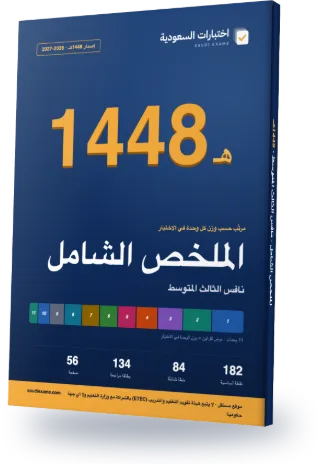
  • Complete Review Guide 2026–2027 (PDF)Ordered by each unit's weight in the exam. With lifetime access only.
Choose your access

One step before payment

Continue with your Google account and you go straight to the payment page.

Check my score freeFull prep