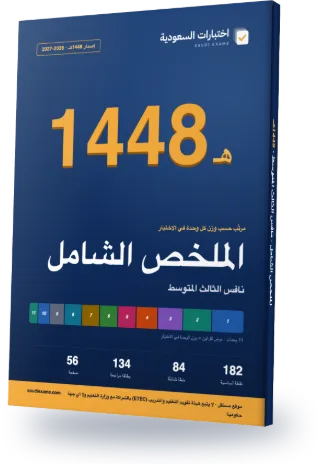
Nafes Grade 9 Complete Review Guide 2026–2027
Every exam topic in a 56-page Arabic PDF, ordered from the heaviest unit to the lightest. The first three chapters alone cover about 39% of the exam questions.
- 56Pages
- 182Key points
- 84Common mistakes
- 134Flashcards
Guide map
Each chapter is one exam unit, ordered by its weight in the real exam.
| Chapter | Unit | Weight | Exam questions | Key points |
|---|---|---|---|---|
| 1 | Mathematics: geometry and measurement | 14% | 10 | 17 |
| 2 | Science: physics (motion, forces, electromagnetism, energy, waves) | 13% | 9 | 18 |
| 3 | Reading: evaluating, critiquing and applying a text | 11% | 8 | 15 |
| 4 | Mathematics: algebra and analysis | 10% | 7 | 18 |
| 5 | Reading: vocabulary and word meaning | 9% | 6 | 15 |
| 6 | Reading: comprehension and analysis | 9% | 6 | 15 |
| 7 | Science: life sciences | 9% | 6 | 17 |
| 8 | Science: Earth and space science | 9% | 6 | 16 |
| 9 | Mathematics: numbers and operations | 7% | 5 | 18 |
| 10 | Science: matter and its reactions (chemistry) | 6% | 4 | 17 |
| 11 | Mathematics: statistics and probability | 4% | 3 | 16 |
Chapter 1 in full: Mathematics: geometry and measurement
14% of the exam, about 10 questions. These are its key points, as in the guide.
- (Indicator 1-1-3-4-9) The interior angles of an n-sided polygon sum to 180 × (n − 2); 720° for a hexagon and 540° for a pentagon.
- (Indicator 1-1-3-4-9) When a transversal crosses two parallel lines, corresponding angles are equal, alternate interior angles are equal, and co-interior angles sum to 180°.
- (Indicator 2-1-3-4-9) In a parallelogram opposite sides are parallel and equal and the diagonals bisect each other; in a rhombus all four sides are equal and the diagonals are perpendicular; in a rectangle the diagonals are equal.
The rest of chapter 1, on this page
- (Indicator 2-1-3-4-9) A square has 4 lines of symmetry, a rectangle 2, an equilateral triangle 3, and a circle infinitely many.
- (Indicator 3-1-3-4-9) The angles of a triangle sum to 180°, and an exterior angle equals the sum of the two remote interior angles.
- (Indicator 3-1-3-4-9) Pythagorean theorem in a right triangle: a² + b² = c² where c is the hypotenuse; legs 6 and 8 give hypotenuse 10.
- (Indicator 4-1-3-4-9) Congruent triangles have equal corresponding sides and angles, proved by SSS, SAS or ASA; similar triangles have proportional sides: with ratio 1:2, a length of 5 matches 10.
- (Indicator 5-1-3-4-9) In a right triangle: sin = opposite ÷ hypotenuse, cos = adjacent ÷ hypotenuse, tan = opposite ÷ adjacent; in a (3, 4, 5) triangle the sine of the angle opposite 3 is 3/5.
- (Indicator 1-2-3-4-9) Distance between two points = √((x2 − x1)² + (y2 − y1)²); between (0, 0) and (3, 4) it is 5.
- (Indicator 1-2-3-4-9) A line has equation y = mx + b; the line through (0, 1) with slope 2 is y = 2x + 1; parallel lines have equal slopes.
- (Indicator 2-2-3-4-9) A translation slides a figure without changing shape or orientation; reflection in the x-axis maps (x, y) to (x, −y); a 180° rotation about the origin maps (x, y) to (−x, −y).
- (Indicator 1-3-3-4-9) Metric conversions: 1 km = 1000 m; 1 m = 100 cm; 1 cm = 10 mm; 1 kg = 1000 g; 1 L = 1000 mL.
- (Indicator 1-3-3-4-9) In customary units: 1 foot = 12 inches; 1 yard = 3 feet; 1 inch ≈ 2.54 cm.
- (Indicator 2-3-3-4-9) Area: rectangle = length × width; triangle = ½ × base × height; parallelogram = base × height; trapezoid = ½ × sum of the bases × height.
- (Indicator 2-3-3-4-9) Circle circumference = 2πr and area = πr²; for radius 7 cm, circumference ≈ 44 cm and area ≈ 154 cm² using π ≈ 22/7.
- (Indicator 3-3-3-4-9) Volume of a prism = base area × height; a 4 × 3 × 2 cuboid has volume 24 cm³, and a cylinder's volume = πr²h.
- (Indicator 3-3-3-4-9) Volume of a pyramid or cone = ⅓ × base area × height, and of a sphere = (4/3)πr³; the surface area of a cube of side s is 6s².
Common mistakes in this chapter
- Using 180 × n for the angle sum of a polygon; the correct rule is 180 × (n − 2).
- Applying Pythagoras to any triangle; it holds only in a right triangle, where the hypotenuse is the side opposite the right angle and the longest.
- Treating similar triangles as congruent; similar triangles have equal angles and proportional sides, congruent triangles have equal sides.
- Mixing sin, cos and tan: sin = opposite ÷ hypotenuse, cos = adjacent ÷ hypotenuse, tan = opposite ÷ adjacent.
- Forgetting the half in triangle area: area = ½ × base × height.
- Using the slanted side instead of the perpendicular height in the area of a parallelogram or trapezoid.
- Converting square or cubic units with the length factor; 1 m² = 10,000 cm², not 100 cm².
- Thinking reflection in the x-axis changes x; it is the y-coordinate that changes: (3, 2) becomes (3, −2).
The other chapters are in the full guide
One purchase · lifetime access · review guide included
7-day review plan
The chapters are spread over 6 days by weight so each day carries a similar load. Day 7 is a full exam.
Day 1 · 14% of the exam
Chapter 1: Mathematics: geometry and measurement
Day 2 · 17% of the exam
Chapter 2: Science: physics (motion, forces, electromagnetism, energy, waves)
Chapter 11: Mathematics: statistics and probabilityDay 3 · 17% of the exam
Chapter 3: Reading: evaluating, critiquing and applying a text
Chapter 10: Science: matter and its reactions (chemistry)Day 4 · 17% of the exam
Chapter 4: Mathematics: algebra and analysis
Chapter 9: Mathematics: numbers and operationsDay 5 · 17% of the exam
Chapter 5: Reading: vocabulary and word meaning
Chapter 7: Science: life sciencesDay 6 · 17% of the exam
Chapter 6: Reading: comprehension and analysis
Chapter 8: Science: Earth and space scienceDay 7
Full mock exam: 70 questions in 135 minutes, then review the common mistakes in the units where you lost marks.
Before you read: see your score today
10 free questions from the main units, no sign-up. Then you know which chapter to start with.
Try 10 free questions and see your levelA look at each chapter
The first three key points of each chapter, as they appear in the guide (in Arabic in the PDF).
Chapter 1: Mathematics: geometry and measurement
- (Indicator 1-1-3-4-9) The interior angles of an n-sided polygon sum to 180 × (n…
- (Indicator 1-1-3-4-9) When a transversal crosses two parallel lines, corresponding angles are equal, alternate…
- (Indicator 2-1-3-4-9) In a parallelogram opposite sides are parallel and equal and the diagonals…
Chapter 2: Science: physics (motion, forces, electromagnetism, energy, waves)
- (Indicator 1-2-2-5-9) Average speed v = d ÷ t; a car covering 120 km…
- (Indicator 1-2-2-5-9) Acceleration a = (v₂ − v₁) ÷ t; an object going from…
- (Indicator 2-2-2-5-9) Momentum p = m × v in kg·m/s; in an isolated collision…
Chapter 3: Reading: evaluating, critiquing and applying a text
- (Indicator 3-1-1-2-9) A writer's feelings show in word choice: 'sadly' signals sorrow, 'with great…
- (Indicator 3-1-1-2-9) The motive is the reason for writing
- (Indicator 3-1-1-2-9) Tone is the writer's attitude to the subject, read from words and…
Chapter 4: Mathematics: algebra and analysis
- (Indicator 1-1-2-4-9) An arithmetic sequence has a constant difference d between consecutive terms; the…
- (Indicator 1-1-2-4-9) Slope (rate of change) = (y2 − y1) ÷ (x2 − x1);…
- (Indicator 1-1-2-4-9) A linear relation has a constant change in y for each constant…
Chapter 5: Reading: vocabulary and word meaning
- (Indicator 1-1-1-2-9) An unfamiliar word has three nearby clues: the sentence before it, the…
- (Indicator 1-1-1-2-9) A synonym is a word close in meaning to another, and the…
- (Indicator 1-1-1-2-9) Example
Chapter 6: Reading: comprehension and analysis
- (Indicator 2-1-1-2-9) The main idea is what the whole text is about; it often…
- (Indicator 2-1-1-2-9) A supporting idea backs the main idea with a reason, example or…
- (Indicator 2-1-1-2-9) Test a title with one question
Chapter 7: Science: life sciences
- (Indicator 1-1-1-5-9) Cell theory
- (Indicator 1-1-1-5-9) The nucleus holds the genetic material and controls the cell; mitochondria release…
- (Indicator 1-1-1-5-9) Plant cells alone have a cell wall, chloroplasts and a large central…
Chapter 8: Science: Earth and space science
- (Indicator 1-1-3-5-9) A star is a hot ball of gas that makes energy by…
- (Indicator 2-1-3-5-9) The solar system has eight planets in order from the Sun: Mercury…
- (Indicator 2-1-3-5-9) Vast distances between bodies are measured in light-years, the distance light travels…
Chapter 9: Mathematics: numbers and operations
- (Indicator 1-1-1-4-9) Integers
- (Indicator 1-1-1-4-9) Absolute value |x| is the distance from zero: |−6| = 6 and…
- (Indicator 1-1-1-4-9) To compare fractions use a common denominator or decimals: 3/4 = 0.75…
Chapter 10: Science: matter and its reactions (chemistry)
- (Indicator 1-1-2-5-9) An atom has a nucleus of positive protons and neutral neutrons, with…
- (Indicator 1-1-2-5-9) Neutrons = mass number − atomic number; a carbon atom with atomic…
- (Indicator 1-1-2-5-9) The sequence of atomic models
Chapter 11: Mathematics: statistics and probability
- (Indicator 1-1-4-4-9) A sample is part of the population; it is representative and unbiased…
- (Indicator 1-1-4-4-9) Bar graphs compare categories, line graphs show change over time, circle graphs…
- (Indicator 1-1-4-4-9) Scatter plot
The full guide comes with lifetime access
The full guide (56 pages) is included with lifetime access to this exam, together with every question and full mock exam. Chapter 1 is free for everyone.
Questions about the guide
Is the guide free?
Chapter 1 is free to read on the guide page. The full guide comes with lifetime access to this exam; 7-day access does not include it.
Is it up to date for 2026–2027?
Yes. Unit weights and exam facts follow what the exam body last published, and the last check date is printed in the guide. If the standards change we update the file and buyers download the new version.
Does the guide have questions?
No. The guide covers key points and common mistakes; scoring, weak-area practice and full mock exams are on the site.
Can I read it on my phone?
Yes. A5 pages in a single column, with chapters linked from the contents.
- Pages
- 56
- Edition
- 1448 AH · 2026–2027
- Language
- Arabic
- Last updated
Full prep for this exam
All of this in one purchase.
- Full mock exam, same as the real one70 questions in 135 minutes. You get a total score and a score for every unit.
- Practice unit by unit527 questions, every option explained with its source. Starts with your weakest units.
- Complete Review Guide 2026–2027 (PDF)Ordered by each unit's weight in the exam. With lifetime access only.
Choose your access
Continue with your Google account and you go straight to the payment page.