National Assessments (Nafs) – Grade 3: free practice test
Start with 10 free questions to see what needs more practice. Finish to see your score, weakest units and every option explained.
Practice test questions with answers and explanations
Try the questions in the test above first, then open each one here to see the correct answer and why every other option is wrong.
01Ahmed watered the plant in the morning, but the soil dried by noon because of the sun. What does "dried" mean?
Reference: ETEC Learning Outcomes Document for the National Assessments (3rd edition, 2026), Reading domain, outcome 3-2-1-1-1, indicator 1, p. 10
02Which comparison between the camel and the jerboa matches what you understood from the text?
On a spring morning, Salim went with his family to the desert to spend a quiet day near the dunes. He carried a small notebook because he liked drawing what he saw. After they set up the tent, he walked a little way with his father to look at footprints in the sand. His father said, “These are the tracks of a wild rabbit, and those are the tracks of a small lizard that came out looking for warmth.”
Salim sat beside a bush, watching the place quietly. He saw jerboas jumping quickly and then disappearing into their burrow when they heard a distant sound. After a while, a large camel passed by, walking slowly and steadily, and Salim noticed how its wide feet helped it walk on the sand. In the evening, he spotted a desert fox coming near the tent’s shade, then moving away when it sensed movement.
Salim returned happy and drew the camel, the jerboa, and the fox in his notebook. He said to his mother, “Today I learned that desert animals differ in their shapes and movements, but they all know how to live in this harsh place.”
Reference: ETEC Learning Outcomes Document for the National Assessments (3rd edition, 2026), Reading domain, outcome 3-2-1-1-2, indicator 5, p. 10
03What is the best proposed title for the text?
In every home we use water for drinking, cooking, and cleaning, but some people leave the tap open for a long time without need. Water is an important blessing for plants, animals, and people, so we must protect it. The mother says at home, “Every drop of water is a gift to life,” reminding her children that waste makes us lose this beautiful blessing.
A family can save water in easy ways. When brushing teeth, we close the tap and use a small cup, and during ablution or washing vegetables, we do not let water run without benefit. We can also collect the extra water from washing fruit to water the plants on the balcony. If one of the children notices a leak in the faucet, he tells the adults so they can fix it quickly. At the end of the week, the family compared the water bill with last month and found that it had gone down after these good habits, so everyone was happy and felt that the home had become more caring with this blessing.
Reference: ETEC Learning Outcomes Document for the National Assessments (3rd edition, 2026), Reading domain, outcome 3-2-1-1-3, indicator 5, p. 10
04Why did the students write notes during the visit?
On a school trip to Al-Ahsa, the third-grade class visited a museum of Saudi heritage near an old market. The guide explained that the museum collects things people used in homes and farms many years ago. In the first hall, the students saw coffee pots, a wooden chest for storing clothes, and pictures of houses built from mud. In the second hall, they saw old farming tools, such as a hand plow and a well bucket.
Then they moved to the transportation corner and found a picture of a camel that used to carry dates between villages, beside a model of a modern car that transports food quickly. The students wrote notes because the teacher asked them to learn how grandparents lived and how life developed. At the end of the visit, some of them bought a small booklet to help them remember the names of the exhibits when they returned to school.
Reference: ETEC Learning Outcomes Document for the National Assessments (3rd edition, 2026), Reading domain, outcome 3-2-1-1-2, indicator 4, p. 10
05Which option gives a suitable title, a different ending, and a solution to the problem mentioned in the text?
Today I visited my grandfather’s farm after dawn. The palm trees seemed to wave in the light as if they were tall guards, and the air carried the smell of wet soil. I walked among the trunks and saw yellow clusters of dates shining like drops of honey. My grandfather said that the palm tree is a friend of patience; it grows slowly, but it gives abundant goodness.
I helped my grandfather collect the dates that had ripened, and we put them in clean baskets. Then I noticed that the water hose was leaking many drops near one of the small palm trees. I told my grandfather, so he smiled and thanked me, then turned the water off for a while until my uncle could fix it in the evening. After that, we shared some of the dates with the neighbors, because my grandfather says, "Goodness grows when we share it."
I returned home thinking about the palm trees. Today I learned that caring for a palm tree needs patience and water without waste, and that a small date is the result of a long journey of work.
Reference: ETEC Learning Outcomes Document for the National Assessments (3rd edition, 2026), Reading domain, outcome 3-2-1-1-3, indicator 5, p. 10
06Which number has the digit 6 in the hundreds place, the digit 2 in the ones place, and rounds to 3600 to the nearest hundred?
Reference: ETEC Learning Outcomes Document for the National Assessments (3rd edition, 2026), Mathematics domain, outcome 3-4-1-1-1, indicator 1, p. 18
07There are 12 dates in a box. Khalid ate 3 dates. Which fraction represents the dates left out of the original number of dates?
Reference: ETEC Learning Outcomes Document for the National Assessments (3rd edition, 2026), Mathematics domain, outcome 3-4-1-1-2, indicator 1, p. 18
08Look at the cards in the table. If the same pattern continues, what is the next card?

Reference: ETEC Learning Outcomes Document for the National Assessments (3rd edition, 2026), Mathematics domain, outcome 3-4-2-1-1, indicator 1, p. 19
09Which shape has a number of sides that is 1 more than a rectangle and 1 less than a hexagon?
Reference: ETEC Learning Outcomes Document for the National Assessments (3rd edition, 2026), Mathematics domain, outcome 3-4-3-1-1, indicator 1, p. 19
10The librarian recorded the types of books borrowed today: story, science, story, religion, math, science, story, math, religion, story, science, math, story, religion, science, story. Which frequency table is correct for these data?
Reference: ETEC Learning Outcomes Document for the National Assessments (3rd edition, 2026), Mathematics domain, outcome 3-4-4-1-1, indicator 1, p. 20
Full prep for this exam
All of this in one purchase.
- Full mock exam, same as the real one40 questions in 80 minutes. You get a total score and a score for every unit.
- Practice unit by unit586 questions, every option explained with its source. Starts with your weakest units.
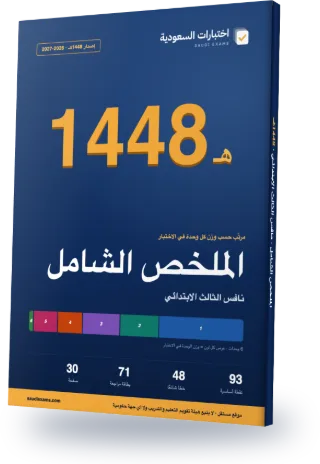
- Complete Review Guide 2026–2027 (PDF)Ordered by each unit's weight in the exam. With lifetime access only.
Choose your access
Continue with your Google account and you go straight to the payment page.