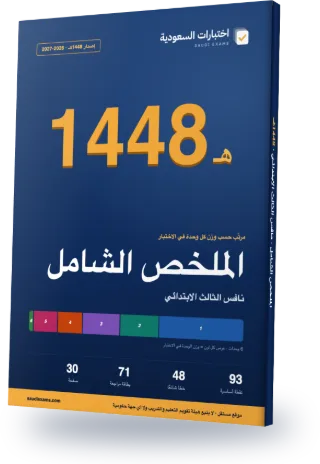
Nafs Grade 3 Complete Review Guide 2026–2027
Every exam topic in a 30-page Arabic PDF, ordered from the heaviest unit to the lightest. The first three chapters alone cover about 74% of the exam questions.
- 30Pages
- 93Key points
- 48Common mistakes
- 71Flashcards
Guide map
Each chapter is one exam unit, ordered by its weight in the real exam.
| Chapter | Unit | Weight | Exam questions | Key points |
|---|---|---|---|---|
| 1 | Reading Comprehension | 38% | 15 | 16 |
| 2 | Numbers and Operations | 18% | 7 | 16 |
| 3 | Geometry and Measurement | 18% | 7 | 16 |
| 4 | Vocabulary and Word Meaning | 12% | 5 | 14 |
| 5 | Algebra: Patterns and Properties of Operations | 12% | 5 | 15 |
| 6 | Statistics and Data | 2% | 1 | 16 |
Chapter 1 in full: Reading Comprehension
38% of the exam, about 15 questions. These are its key points, as in the guide.
- (Outcome 3-2-1-1-2.1) The general purpose is why the text was written: to inform, to narrate, or to describe something, not just a repeated word in the text.
- (Outcome 3-2-1-1-2.1) The main idea covers most of the sentences, while a detail belongs to only a small part.
- (Outcome 3-2-1-1-2.2) Direct information is found exactly in the text, such as the character’s name, the place, or the time.
The rest of chapter 1, on this page
- (Outcome 3-2-1-1-2.2) Text type is identified by its form and content: a story has characters and events, while an informational text has facts and information.
- (Outcome 3-2-1-1-2.3) Elements of a read text include: the title, paragraphs, characters if present, and events or information.
- (Outcome 3-2-1-1-2.3) When ordering events, look for sequence words: began, then, after that, finally.
- (Outcome 3-2-1-1-2.4) Cause answers the question: Why did this happen? Result answers: What happened after it?
- (Outcome 3-2-1-1-2.4) A character’s motive may be helping a friend, fear, or love of learning, and it is understood from the action or from the sentence that describes it.
- (Outcome 3-2-1-1-2.5) Similarities and differences may be between two characters, two ideas, or two situations in the text.
- (Outcome 3-2-1-1-2.5) To link cause to result, ask yourself: Which came first? What effect came from it?
- (Outcome 3-2-1-1-3.1) An aesthetic expression is a beautiful phrase in the text that stands out, and the student can give an opinion about it in simple words such as: I liked it because it describes the scene clearly.
- (Outcome 3-2-1-1-3.2) An acceptable opinion needs a reason, such as: I liked the boy’s action because he helped his brother.
- (Outcome 3-2-1-1-3.3) Some events are possible in real life, such as losing a bag and then finding it, while others are usually not possible if they are very imaginary.
- (Outcome 3-2-1-1-3.4) Values in a text may include honesty, cooperation, orderliness, and respect for elders. Look for what the text encourages or rejects.
- (Outcome 3-2-1-1-3.5) A good title is short, clear, and represents most of the text, not a long sentence full of details.
- (Outcome 3-2-1-1-3.5) When suggesting a different ending or a solution to a problem, make your suggestion fit the events and characters of the text.
Common mistakes in this chapter
- Choosing an answer that seems true from general knowledge but is not stated in the text.
- Confusing the main idea with a small detail, such as treating one example as the meaning of the whole text.
- Ordering events by what the student prefers instead of the order in the text.
- Treating every opinion question as fully open, while it usually requires an opinion with a suitable reason.
- Not noticing words such as: first, then, after that, and finally.
- Mixing up cause and effect, such as saying, 'He got sick because he did not go to school,' instead of the reverse if that is what the text says.
- Choosing a nice title that does not represent the whole topic of the text.
- Judging whether events could happen without considering whether they are realistic or imaginary in the text.
The other chapters are in the full guide
One purchase · lifetime access · review guide included
7-day review plan
The chapters are spread over 6 days by weight so each day carries a similar load. Day 7 is a full exam.
Day 1 · 38% of the exam
Chapter 1: Reading Comprehension
Day 2 · 18% of the exam
Chapter 2: Numbers and Operations
Day 3 · 18% of the exam
Chapter 3: Geometry and Measurement
Day 4 · 12% of the exam
Chapter 4: Vocabulary and Word Meaning
Day 5 · 12% of the exam
Chapter 5: Algebra: Patterns and Properties of Operations
Day 6 · 2% of the exam
Chapter 6: Statistics and Data
Day 7
Full mock exam: 40 questions in 80 minutes, then review the common mistakes in the units where you lost marks.
Before you read: see your score today
10 free questions from the main units, no sign-up. Then you know which chapter to start with.
Try 10 free questions and see your levelA look at each chapter
The first three key points of each chapter, as they appear in the guide (in Arabic in the PDF).
Chapter 1: Reading Comprehension
- (Outcome 3-2-1-1-2.1) The general purpose is why the text was written: to inform, to…
- (Outcome 3-2-1-1-2.1) The main idea covers most of the sentences, while a detail belongs…
- (Outcome 3-2-1-1-2.2) Direct information is found exactly in the text, such as the character’s…
Chapter 2: Numbers and Operations
- (Outcome 3-4-1-1-1) Place value helps us understand a number
- (Outcome 3-4-1-1-1.1) To find a digit’s value, look at its place. In 4,718, the…
- (Outcome 3-4-1-1-1.1) When rounding to the nearest ten, look at the ones; to the…
Chapter 3: Geometry and Measurement
- (Outcome 3-4-3-1-1.1) A triangle has 3 sides and 3 vertices, a pentagon has 5…
- (Outcome 3-4-3-1-1.1) A square and a rectangle both have 4 sides and 4 vertices…
- (Outcome 3-4-3-1-1.1) A circle is not a polygon, and it has no sides or…
Chapter 4: Vocabulary and Word Meaning
- (Outcome 3-2-1-1-1) Start by reading the whole sentence; a word’s meaning often appears from…
- (Outcome 3-2-1-1-1.1) A synonym is a word with a similar meaning, such as: happy…
- (Outcome 3-2-1-1-1.1) An antonym is a word with the opposite meaning, such as: tall…
Chapter 5: Algebra: Patterns and Properties of Operations
- (Outcome 3-4-2-1-1.1) In a non-numeric pattern, describe the rule in words, such as: red…
- (Outcome 3-4-2-1-1.1) A pattern may depend on more than one attribute, such as: big…
- (Outcome 3-4-2-1-1.2) In a numeric pattern, look for one operation that repeats: +2, -3…
Chapter 6: Statistics and Data
- (Outcome 3-4-4-1-1) At this level, statistics means collecting simple data, then organizing it, representing…
- (Outcome 3-4-4-1-1.1) Data can be collected from the nearby environment, such as: favorite color…
- (Outcome 3-4-4-1-1.1) A category is a group with the same name, such as the…
The full guide comes with lifetime access
The full guide (30 pages) is included with lifetime access to this exam, together with every question and full mock exam. Chapter 1 is free for everyone.
Questions about the guide
Is the guide free?
Chapter 1 is free to read on the guide page. The full guide comes with lifetime access to this exam; 7-day access does not include it.
Is it up to date for 2026–2027?
Yes. Unit weights and exam facts follow what the exam body last published, and the last check date is printed in the guide. If the standards change we update the file and buyers download the new version.
Does the guide have questions?
No. The guide covers key points and common mistakes; scoring, weak-area practice and full mock exams are on the site.
Can I read it on my phone?
Yes. A5 pages in a single column, with chapters linked from the contents.
- Pages
- 30
- Edition
- 1448 AH · 2026–2027
- Language
- Arabic
- Last updated
Full prep for this exam
All of this in one purchase.
- Full mock exam, same as the real one40 questions in 80 minutes. You get a total score and a score for every unit.
- Practice unit by unit586 questions, every option explained with its source. Starts with your weakest units.
- Complete Review Guide 2026–2027 (PDF)Ordered by each unit's weight in the exam. With lifetime access only.
Choose your access
Continue with your Google account and you go straight to the payment page.