Try the questions in the test above first, then open each one here to see the correct answer and why every other option is wrong.
01Electron microscopy of liver cells showed these changes under different conditions:
Condition I: marked dilation of the smooth endoplasmic reticulum with more microbodies.
Condition II: enlarged Golgi apparatus forming abnormal secretory vesicles.
Condition III: more lysosomes with accumulated undigested material.
Which proteins were most affected in conditions I, II and III, respectively?
Past exam question Unit: The Cell
ATransport proteins; hydrolytic enzymes; cytoskeletal proteins
Hydrolytic enzymes belong to lysosomes, not the Golgi, and condition III points to failing lysosomal enzymes, not the cytoskeleton.
BDetoxification enzymes; packaging proteins; hydrolytic enzymes ✓ Correct answer
Smooth ER detoxifies, the Golgi packages secretions, and undigested material in lysosomes reflects faulty hydrolytic enzymes.
CPackaging proteins; cytoskeletal proteins; transport enzymes
Smooth ER enlargement with microbodies signals detoxification work, not packaging, and lysosomes are linked to digestion.
DHydrolytic enzymes; transport proteins; detoxification enzymes
Lysosomal digestion fits condition III, while smooth ER changes in condition I match detoxification enzymes, not hydrolysis.
Reference: NSMO Cities and Provinces Test – Biology (Mawhiba, 2026), Question 16, with the published answer key
Ask a friend
02Scientists labelled the membrane proteins of a mouse cell and a human cell with two different markers and fused the cells into one hybrid cell. At first the two kinds of protein stayed on separate halves of the surface (state A). Normally, after incubation at 37 °C for 1 hour, the proteins spread evenly over the whole surface (state B). If the cell instead took 2 hours to go from state A to state B, which could be the reason(s)?
I. The membrane had a greater ratio of unsaturated to saturated phospholipids.
II. Incubation was carried out at 18 °C.
Past exam question Unit: The Cell
AI only
More unsaturated phospholipids keep the membrane more fluid, which would speed up protein movement rather than slow it.
BII only ✓ Correct answer
Lower temperature makes the lipid bilayer less fluid, so membrane proteins drift more slowly and mixing takes longer.
CI and II
Only the lower temperature slows mixing; a higher unsaturated ratio works in the opposite direction by increasing fluidity.
DNeither I nor II
Incubation at 18 °C is a valid reason, because cooling reduces membrane fluidity and slows lateral diffusion of proteins.
Reference: NSMO Cities and Provinces Test – Biology (Mawhiba, 2026), Question 3, with the published answer key
Ask a friend
03Scientists induced random mutations in the β-galactosidase (lactase) enzyme of bacteria grown in a lactose-rich medium. Later, the amount of glucose and galactose produced from lactose breakdown had increased tenfold. Which hypotheses best explain what the mutation did?
I. The mutated enzyme made the bacteria reproduce faster, increasing the sugar consumed.
II. The mutation changed the shape of the active site so that it binds the substrate more strongly.
III. The enzyme became able to break down other compounds into glucose and galactose.
IV. The mutation made the lactose-degrading enzyme faster at breaking down lactose.
Past exam question Unit: Cell Chemistry
AII and IV ✓ Correct answer
A better-fitting active site binds lactose more effectively, and a faster enzyme splits more lactose, directly explaining more product.
BI and III
Faster reproduction is not a direct effect on the enzyme, and only lactose yields glucose plus galactose here.
CI and II
The change measured is the product of lactose hydrolysis per enzyme activity, which hypothesis I about growth does not explain.
DIII and IV
Enzymes are specific, so the same enzyme would not suddenly turn other compounds into glucose and galactose.
Reference: NSMO Cities and Provinces Test – Biology (Mawhiba, 2026), Question 22, with the published answer key
Ask a friend
04Some plants can survive for many years in a sealed terrarium containing water, air and healthy soil with soil organisms such as bacteria and fungi. The terrarium is never opened, and nothing is added or removed. For the sealed terrarium to remain sustainable, which of the following must be true?
Past exam question Unit: Metabolism
AThe plant's rate of photosynthesis must be greater than or equal to its rate of respiration at all times.
At night the plant only respires, so photosynthesis cannot match or exceed respiration at every moment.
BThe plant's average rate of photosynthesis must be greater than the plant's rate of respiration. ✓ Correct answer
Bacteria and fungi also respire, so the plant must fix more carbon and release more oxygen than it uses itself.
CThe plant's average rates of photosynthesis and respiration must be equal over long periods of time.
If the plant only balanced its own respiration, nothing would remain to supply the soil organisms that also respire.
DAs long as the plant can carry out some photosynthesis, the ecosystem will remain sustainable.
A small amount of photosynthesis could be less than total respiration, so oxygen and sugars would eventually run out.
Reference: NSMO Cities and Provinces Test – Biology (Mawhiba, 2026), Question 7, with the published answer key
Ask a friend
05The electron transport chain, a series of protein complexes and electron carriers in the inner mitochondrial membrane, produces most of the energy cells need. Which statement about it is correct?
Past exam question Unit: Metabolism
AEach FADH2 molecule generates more ATP through the chain than each NADH molecule does.
FADH2 passes its electrons in after Complex I, so fewer protons are pumped and it yields less ATP than NADH.
BWater is produced at Complex I of the chain.
Water forms at the end of the chain, where oxygen accepts electrons and protons, not at the first complex.
CATP synthase moves H+ ions out of the matrix.
Protons flow through ATP synthase back into the matrix, down their gradient; that flow drives ATP formation.
DThe pH in the matrix is higher than the pH in the intermembrane space. ✓ Correct answer
The complexes pump H+ out of the matrix into the intermembrane space, so the matrix has fewer protons and a higher pH.
Reference: NSMO Cities and Provinces Test – Biology (Mawhiba, 2026), Question 21, with the published answer key
Ask a friend
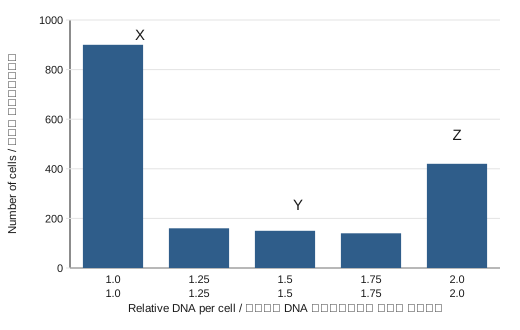
06The graph shows the distribution of cells according to the relative amount of DNA per cell, measured by flow cytometry. X, Y and Z mark groups of cells at different stages of the cell cycle. What do X, Y and Z represent?
Past exam question Unit: Cell Division
AX: M phase; Y: G1 and S phases; Z: anaphase and G2 phase
Cells in M phase hold doubled DNA, so they belong in the higher peak, not the large peak with one unit.
BX: G1 phase; Y: S phase; Z: G2 and M phases ✓ Correct answer
G1 cells have one DNA unit, S cells are replicating with intermediate amounts, and G2 and M cells carry doubled DNA.
CX: cytokinesis; Y: anaphase; Z: M phase
Cytokinesis and anaphase are brief parts of M phase, so they cannot form the large G1 peak or the intermediate group.
DX: M phase; Y: S and G2 phases; Z: G1 phase
G1 cells have the smallest DNA amount, so they form peak X, not the doubled peak at Z.
Reference: NSMO Cities and Provinces Test – Biology (Mawhiba, 2026), Question 9, with the published answer key
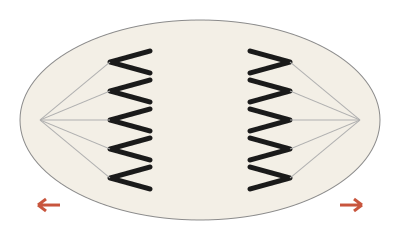
07The drawing shows a dividing cell: two groups of single, unduplicated chromosomes (V-shaped) are being pulled towards opposite poles. Which stages of cell division could it represent?
I. Mitosis – metaphase
II. Mitosis – anaphase
III. Meiosis I – metaphase I
IV. Meiosis I – anaphase I
V. Meiosis II – metaphase II
VI. Meiosis II – anaphase II
Past exam question Unit: Cell Division
AII only
Anaphase of mitosis fits, but anaphase II also separates single chromatids, so mitosis alone does not cover every possibility.
BI and V
Metaphase stages show chromosomes lined up at the equator, not two groups moving apart towards the poles.
CII, IV and VI
Anaphase I separates homologous chromosomes that still have two chromatids each, so the moving units would not be single.
DII and VI ✓ Correct answer
Both mitotic anaphase and anaphase II pull separated sister chromatids, single units, to opposite poles, matching the drawing.
Reference: NSMO Cities and Provinces Test – Biology (Mawhiba, 2026), Question 2, with the published answer key
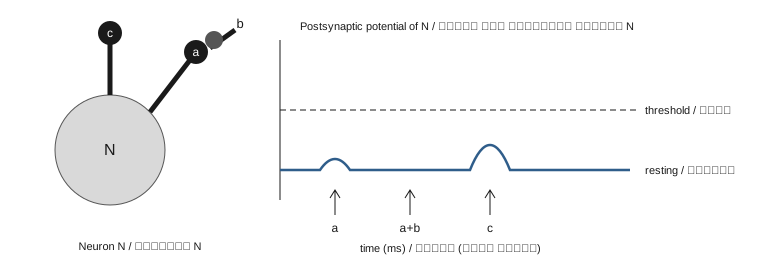
08Neuron N receives signals directly from two separate nerve terminals, a and c. Nerve terminal b synapses onto terminal a. The trace shows the potentials recorded in N when a, a with b, and c are stimulated. Which statements are true?
I. Action potentials would be generated in N if terminals a and c were stimulated simultaneously.
II. The neurotransmitter released from terminal b is inhibitory.
III. When terminal b is stimulated alone, an inhibitory postsynaptic potential (IPSP) would be recorded in N.
IV. When b and c are stimulated together, the EPSP recorded in N is smaller than when c alone is stimulated.
Past exam question Unit: Human Body Systems
AOnly I and II ✓ Correct answer
Two subthreshold EPSPs from a and c add together by spatial summation to reach threshold, and b clearly blocks the effect of a.
BOnly II and IV
Terminal b synapses only on a, not on c, so stimulating b cannot shrink the EPSP produced by c.
COnly II and III
Because b contacts terminal a rather than N itself, stimulating b alone produces no potential at all in N.
DOnly III and IV
Neither III nor IV holds, because b acts only through terminal a and has no direct synapse on neuron N.
Reference: NSMO Cities and Provinces Test – Biology (Mawhiba, 2026), Question 14, with the published answer key
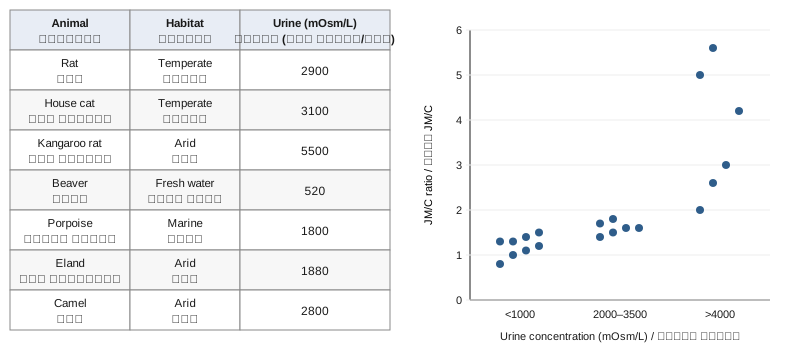
09Animals live in environments with different water availability. To conserve water, kidneys concentrate urine. The kidney has two types of nephron: cortical nephrons (C) with a short loop of Henle in the renal cortex, and juxtamedullary nephrons (JM) with a long loop reaching into the medulla, which help concentrate urine more. The table gives urine concentration in some animals, and the graph shows the JM/C ratio for species grouped by urine concentration. Which statement is correct?
Past exam question Unit: Human Body Systems
AThe beaver does not have cortical nephrons.
The beaver produces the most dilute urine, so its JM/C ratio is low, meaning cortical nephrons dominate rather than being absent.
BThe ratio of juxtamedullary to cortical nephrons in the kangaroo rat is 1.5 or more. ✓ Correct answer
The kangaroo rat makes urine above 4000 mOsm/L, and every species in that group has a JM/C ratio of at least 2.
CLong loops of Henle reduce salt reabsorption, which reduces urine concentration.
Long loops build a salty medulla that draws water out, so they increase urine concentration rather than reduce it.
DAnimals in dry areas have a greater proportion of cortical nephrons than animals living in fresh water.
Dry-habitat animals concentrate urine more, so they have relatively more juxtamedullary nephrons, not more cortical ones.
Reference: NSMO Cities and Provinces Test – Biology (Mawhiba, 2026), Question 17, with the published answer key
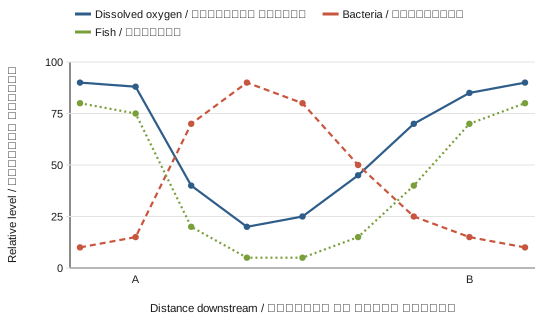
10The graph shows what happened in a river after raw sewage was dumped at point A. What happened by point B that allowed the fish to increase in number again?
Past exam question Unit: Ecology
ABacteria increased, fish mortality decreased, and oxygen levels were high.
By point B the bacteria curve has fallen back to its starting level, so bacterial numbers did not increase.
BBacteria decreased, fish mortality decreased, and oxygen levels were low.
Low oxygen is what killed the fish below A; fish recover at B only because oxygen has returned to high levels.
CBacteria decreased, fish mortality decreased, and oxygen levels were high. ✓ Correct answer
Once the sewage was broken down, decomposing bacteria declined, oxygen recovered, and fewer fish died, so their numbers rose.
DBacteria increased, fish mortality decreased, and oxygen levels were low.
Rising bacteria consume oxygen; the recovery at B needs both fewer bacteria and more dissolved oxygen.
Reference: NSMO Cities and Provinces Test – Biology (Mawhiba, 2026), Question 12, with the published answer key