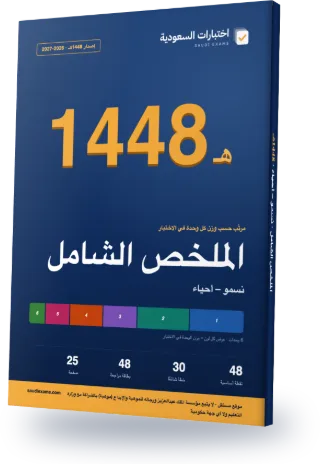
NSMO Biology Complete Review Guide 2026–2027
Every exam topic in a 25-page Arabic PDF, ordered from the heaviest unit to the lightest. The first three chapters alone cover about 64% of the exam questions.
- 25Pages
- 48Key points
- 30Common mistakes
- 48Flashcards
Guide map
Each chapter is one exam unit, ordered by its weight in the real exam.
| Chapter | Unit | Weight | Exam questions | Key points |
|---|---|---|---|---|
| 1 | The Cell | 24% | 6 | 8 |
| 2 | Human Body Systems | 24% | 6 | 8 |
| 3 | Metabolism | 16% | 4 | 8 |
| 4 | Cell Division | 16% | 4 | 8 |
| 5 | Ecology | 12% | 3 | 8 |
| 6 | Cell Chemistry | 8% | 2 | 8 |
Chapter 1 in full: The Cell
24% of the exam, about 6 questions. These are its key points, as in the guide.
- (Characteristics of life) All living things are organised, grow, reproduce, respond, keep homeostasis, use energy and adapt.
- (Cell theory) All organisms are made of cells; the cell is the basic unit of life; cells come from pre-existing cells.
- (Cell size) Most cells are smaller than 100 μm; the surface-to-volume ratio limits size.
The rest of chapter 1, on this page
- (Plant vs animal) Only plant cells have a wall, chloroplasts and a large central vacuole; centrioles are typical of animal cells.
- (Protein route) Ribosome on rough ER → ER channels → Golgi body → vesicle → cell membrane.
- (Mitochondrion) Double membrane with cristae; site of most aerobic respiration; many in active muscle cells.
- (Plastids) Chloroplasts are green, chromoplasts give red and orange colours, leucoplasts are colourless stores.
- (Transport) Diffusion and osmosis need no energy; active transport moves substances against the gradient using ATP.
Common mistakes in this chapter
- Calling the cell wall selectively permeable: the bag describes it as fully permeable; the membrane is the selective one.
- Mixing up hypotonic and hypertonic: name the solution relative to the cell, then water moves toward the more concentrated side.
- Thinking plant cells burst in pure water: the wall resists, so they become turgid instead.
- Forgetting that facilitated diffusion uses carrier or channel proteins but no ATP.
- Assuming one cell means prokaryote: Euglena and Paramecium are single eukaryotic cells.
The other chapters are in the full guide
One purchase · lifetime access · review guide included
7-day review plan
The chapters are spread over 6 days by weight so each day carries a similar load. Day 7 is a full exam.
Day 1 · 24% of the exam
Chapter 1: The Cell
Day 2 · 24% of the exam
Chapter 2: Human Body Systems
Day 3 · 16% of the exam
Chapter 3: Metabolism
Day 4 · 16% of the exam
Chapter 4: Cell Division
Day 5 · 12% of the exam
Chapter 5: Ecology
Day 6 · 8% of the exam
Chapter 6: Cell Chemistry
Day 7
Full mock exam: 25 questions in 120 minutes, then review the common mistakes in the units where you lost marks.
Before you read: see your score today
10 free questions from the main units, no sign-up. Then you know which chapter to start with.
Try 10 free questions and see your levelA look at each chapter
The first three key points of each chapter, as they appear in the guide (in Arabic in the PDF).
Chapter 1: The Cell
- (Characteristics of life) All living things are organised, grow, reproduce, respond, keep homeostasis, use…
- (Cell theory) All organisms are made of cells; the cell is the basic unit…
- (Cell size) Most cells are smaller than 100 μm; the surface-to-volume ratio limits size.
Chapter 2: Human Body Systems
- (Muscles) Tendons join muscle to bone; skeletal muscles cause movement by contracting and relaxing.
- (Nerves) Myelin speeds impulses; the smallest stimulus that triggers an impulse is the threshold.
- (Drugs) Caffeine and nicotine are stimulants; alcohol is a depressant.
Chapter 3: Metabolism
- (Energy) The Sun is the main energy source on Earth; producers capture it.
- (Photosynthesis) 6CO₂ + 6H₂O → C₆H₁₂O₆ + 6O₂, light energy to chemical energy, in…
- (Pigments) Chlorophyll a and b absorb blue and red most; carotenoids show in autumn…
Chapter 4: Cell Division
- (Size) Most cells are under 100 μm; the main limit is the surface-to-volume ratio.
- (Bacteria) Divide by binary fission, their most common way to reproduce.
- (Cell cycle) Interphase, mitosis, cytokinesis; interphase = G1 (growth), S (DNA copied), G2 (proteins…
Chapter 5: Ecology
- (Factors) Biotic
- (Competition) Organisms use the same resources at the same time; usually the weaker is…
- (Examples) Alga + fungus in lichens
Chapter 6: Cell Chemistry
- (Elements) Major and essential elements occur in all organisms; trace elements in some, free…
- (Carbohydrates) C, H, O in ratio 1
- (Sugars) Mono- and disaccharides dissolve and cross membranes; polysaccharides do neither.
The full guide comes with lifetime access
The full guide (25 pages) is included with lifetime access to this exam, together with every question and full mock exam. Chapter 1 is free for everyone.
Questions about the guide
Is the guide free?
Chapter 1 is free to read on the guide page. The full guide comes with lifetime access to this exam; 7-day access does not include it.
Is it up to date for 2026–2027?
Yes. Unit weights and exam facts follow what the exam body last published, and the last check date is printed in the guide. If the standards change we update the file and buyers download the new version.
Does the guide have questions?
No. The guide covers key points and common mistakes; scoring, weak-area practice and full mock exams are on the site.
Can I read it on my phone?
Yes. A5 pages in a single column, with chapters linked from the contents.
- Pages
- 25
- Edition
- 1448 AH · 2026–2027
- Language
- Arabic
- Last updated
All School Student Exams review guides
Back to National Science and Mathematics Olympiad (NSMO) – Cities and Provinces Test: Biology
Full prep for this exam
All of this in one purchase.
- Full mock exam, same as the real one25 questions in 120 minutes. You get a total score and a score for every unit.
- Practice unit by unit503 questions, every option explained with its source. Starts with your weakest units.
- Complete Review Guide 2026–2027 (PDF)Ordered by each unit's weight in the exam. With lifetime access only.
Choose your access
Continue with your Google account and you go straight to the payment page.