MAP Growth Grades 6–12 Math and Reading Practice: free practice test
Start with 10 free questions to see what needs more practice. Finish to see your score, weakest units and every option explained.
MAP Growth reports a RIT score for each assessed subject. This is your practice accuracy. It cannot be converted to the exam’s scaled score or used to determine whether you pass.
Practice test questions with answers and explanations
Try the questions in the test above first, then open each one here to see the correct answer and why every other option is wrong.
01One printer makes 18 posters from 6 sheets of card. A second makes 20 from 5 sheets. If each printer keeps its own ratio, which one uses fewer sheets for 60 posters and by how many?
Reference: Common Core State Standards, Mathematics, 6.RP.A.3.a.
02Which expression is equivalent to −2.4k + 1.8 when −0.6 has been factored out?
Reference: Common Core State Standards, Mathematics, 7.EE.A.1.
03A table for a function lists the points (−2, 8), (0, 5), (2, 2), and (6, −4). Why can these points all lie on one straight line?
Reference: Common Core State Standards, Mathematics, 8.F.A.3.
04Two cubes with 3 cm edges are glued together along one full face. What is the exterior surface area of the result?
Reference: Common Core State Standards, Mathematics, 7.G.B.6.
05A population model is y = 460 + 18t, where t is years after 2020. A second model uses h, years after 2025, for the same data and relationship. What are the second model's slope and intercept?
Reference: Common Core State Standards, Mathematics, HSS.ID.C.7.
06Which evidence best establishes something the archive staff can verify and something the scene leaves uncertain?
The Spare Channel
[A public archive. In one pool of light at a workbench, Adela cues a recording of a neighborhood gathering. In a second pool farther back, a bare chair faces the audience. On the recording, spoons scrape, people walk on a hollow floor, and an unidentified voice sings four notes.]
ADELA — The form has a line for “performer.” We don't even know whether the singer was invited.
RAMON — Start with the scrape. That will sound marvelous in the launch presentation. They'll think we bought the whole building.
[Adela shows Ramon the budget form. He flattens it with his hand. Halfway down a page, “repair of floorboards” has been crossed out in red.]
RAMON — What excellent care we're taking of the place.
ADELA — The budget buys one clean channel. The part that brings up the voice drops most of the room.
[She plays a trial edit. The voice can be heard without the floor or the spoons. Ramon looks toward the bare chair.]
RAMON — If the singing goes out alone, somebody may say it was a concert.
[Adela stops the edit. She takes the blank performer card and sets it on the chair. Ramon reaches for the original tape. Only the light at the chair remains as the four notes sound again amid the footsteps.]
Reference: Common Core State Standards, English Language Arts/Literacy, RL.11-12.1.
07How does repeating the four notes in their original sound setting as the lights shift affect the ending?
The Spare Channel
[A public archive. In one pool of light at a workbench, Adela cues a recording of a neighborhood gathering. In a second pool farther back, a bare chair faces the audience. On the recording, spoons scrape, people walk on a hollow floor, and an unidentified voice sings four notes.]
ADELA — The form has a line for “performer.” We don't even know whether the singer was invited.
RAMON — Start with the scrape. That will sound marvelous in the launch presentation. They'll think we bought the whole building.
[Adela shows Ramon the budget form. He flattens it with his hand. Halfway down a page, “repair of floorboards” has been crossed out in red.]
RAMON — What excellent care we're taking of the place.
ADELA — The budget buys one clean channel. The part that brings up the voice drops most of the room.
[She plays a trial edit. The voice can be heard without the floor or the spoons. Ramon looks toward the bare chair.]
RAMON — If the singing goes out alone, somebody may say it was a concert.
[Adela stops the edit. She takes the blank performer card and sets it on the chair. Ramon reaches for the original tape. Only the light at the chair remains as the four notes sound again amid the footsteps.]
Reference: Common Core State Standards, English Language Arts/Literacy, RL.11-12.5.
08Which claim goes beyond the evidence the author provides?
A Case for the Visible Patch
[1] When our costume club repaired a torn green coat, we could have hidden the tear with matching thread. Instead we sewed a blue patch over it. From the audience, the bright square looked like part of the design. The same idea could make it easier for beginners to mend their own clothes.
[2] A repair that must disappear calls for a close match in color and careful placement. The blue patch left more room for choice. The person sewing it could adjust its position as long as it covered the tear. At the next club meeting, beginners tried visible and hidden repairs on two matching scraps. Six of eight finished the visible repair during the meeting, while three finished the hidden one.
[3] We plan to teach the visible method first at our next workshop. The test was small, but it suggests that a bold patch can lower the barrier to starting. Our blue patch will probably also outlast the green coat. We have used the coat in just one performance since mending it.
Reference: Common Core State Standards, English Language Arts/Literacy, RI.6.8.
09Which pair of ideas develops through the volunteer's two attempts?
The Weatherboard Experiment
[1] A volunteer at a coastal walking center wanted to know which of three ways of making trail signs would age best outdoors. She made sample boards of the same wood, painted them in the same colors, and treated each board with a different clear finish. Before putting them outside, she asked two visitors to read the signs from where the path turned.
[2] The volunteer then set the boards against a wall that faced the sea. On rainy days, the lowest board received spray from puddles that did not reach the other two. The marks the volunteer planned to compare might now reflect the boards' positions as well as the differences between the finishes.
[3] She began again with new boards. This time she placed the boards side by side at the same height. She also added a reading test at the end of every month, because a finish could change the look of the paint without making the letters harder to read.
[4] The walking center published a sheet showing how each board looked at the end of the season and how far away visitors could read it. The sheet described the first attempt as well as the second so that other centers could see why the test had changed.
Reference: Common Core State Standards, English Language Arts/Literacy, RI.7.2.
10The prefix tri- means “three.” Which description could support a plan marked “trilingual materials”?
Reference: Common Core State Standards, English Language Arts/Literacy, L.7.4.b.
Full prep for this exam
All of this in one purchase.
- Timed supplemental practice sessions40 questions in 90 minutes. You get a total score and a score for every unit.
- Practice unit by unit500 questions, every option explained with its source. Starts with your weakest units.
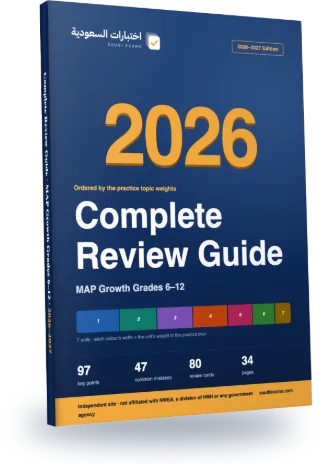
- Complete Review Guide 2026–2027 (PDF)Ordered by each unit's weight in the exam. With lifetime access only.
Choose your access
Continue with your Google account and you go straight to the payment page.