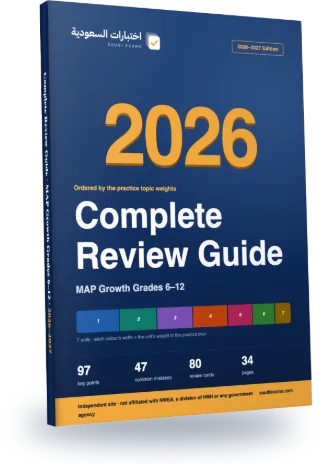
MAP Growth Grades 6–12 Complete Review Guide 2026–2027
A 34-page PDF ordered by unit weight. The first three chapters cover 52% of the published syllabus weight.
- 34Pages
- 97Key points
- 47Common mistakes
- 80Flashcards
Guide map
Each chapter is one exam unit, ordered by its weight in the real exam.
| Chapter | Unit | Weight | Key points |
|---|---|---|---|
| 1 | Algebra and Functions | 19% | 15 |
| 2 | Literary Reading | 17% | 12 |
| 3 | Informational Reading | 17% | 14 |
| 4 | Vocabulary and Figurative Language | 17% | 14 |
| 5 | Number and Quantity | 12% | 14 |
| 6 | Geometry and Measurement | 11% | 14 |
| 7 | Data and Probability | 8% | 14 |
Chapter 1 in full: Algebra and Functions
This chapter accounts for 19% of the published syllabus weight. These are its key points.
- To evaluate 2a² − 3a at a = −2, substitute parentheses to obtain 2(−2)² − 3(−2) = 14.
- Expand −3(2x − 5) as −6x + 15. Both terms are multiplied by −3.
- Factoring a common coefficient reverses distribution. For example, 14p − 21q = 7(2p − 3q).
The rest of chapter 1, on this page
- If 5x + 9 = 29, subtract 9 and divide by 5 to get x = 4. In a model, check the units and whether the answer is allowed.
- When the variable terms cancel, a true equality gives infinitely many solutions and a false equality gives none.
- A strict boundary excludes equality. To graph p < 12, place an open circle at 12 and shade to the left.
- Solving −4u ≥ 20 gives u ≤ −5 because division by −4 reverses the sign.
- A solution to a system of two equations is a shared ordered pair. On the graphs of two distinct intersecting lines, it is their point of intersection.
- If f(x) = (x − 7)(x + 1), the zeros are 7 and −1 because either zero factor makes the entire product zero.
- The form a(x − h)² + k has vertex (h, k). A positive a gives a minimum, and a negative a gives a maximum.
- In f(6) = 13, the input is 6 and the output is 13. Use the axis or variable labels to attach units.
- In y = mx + b, m is the output change per unit of input and b is the output when x = 0.
- Between inputs a and b, the average rate is [f(b) − f(a)]/(b − a). It measures total output change per unit of input over that interval.
- A horizontal graph segment means a constant output. An interior point where a graph changes from falling to rising is a local minimum when both changes are strict.
- In P(t) = C·rᵗ, C is the value at t = 0 and r is the factor per unit of t. A 15% decrease corresponds to r = 0.85.
Common mistakes in this chapter
- Distributing a negative multiplier changes every term inside the parentheses.
- An exponent applies to its base. In 3x², square x before multiplying by 3.
- Dividing an inequality by a negative number reverses the inequality sign.
- A point that satisfies one equation in a system still needs to satisfy the other equation.
- An x-intercept has output zero. A y-intercept has input zero.
- Repeated outputs are allowed in a function. Each input must have exactly one output.
- Equal changes in output imply a constant rate only when the input intervals have the same length.
The other chapters are in the full guide
One purchase · lifetime access · review guide included
7-day review plan
The chapters are spread over 6 days by weight so each day carries a similar load. Day 7 is a full exam.
Day 1 · 19% of the exam
Chapter 1: Algebra and Functions
Day 2 · 17% of the exam
Chapter 2: Literary Reading
Day 3 · 17% of the exam
Chapter 3: Informational Reading
Day 4 · 17% of the exam
Chapter 4: Vocabulary and Figurative Language
Day 5 · 12% of the exam
Chapter 5: Number and Quantity
Day 6 · 19% of the exam
Chapter 6: Geometry and Measurement
Chapter 7: Data and ProbabilityDay 7
Complete a timed supplementary practice set and review the units where you lost marks.
Before you read: see your score today
10 free questions from the main units, no sign-up. Then you know which chapter to start with.
Try 10 free questions and see your levelA look at each chapter
The first three key points of each chapter, as they appear in the guide (in Arabic in the PDF).
Chapter 1: Algebra and Functions
- To evaluate 2a² − 3a at a = −2, substitute parentheses to obtain 2(−2)²…
- Expand −3(2x − 5) as −6x + 15. Both terms are multiplied by −3.
- Factoring a common coefficient reverses distribution. For example, 14p − 21q = 7(2p −…
Chapter 2: Literary Reading
- To support an inference, connect the exact action or wording that makes your conclusion…
- A summary reports the main events or ideas and excludes a reader’s personal opinion.
- A theme develops through events, reactions, and changes rather than through topic alone.
Chapter 3: Informational Reading
- Find the smallest set of details that supports the specific claim the question makes.
- If asked for the strongest evidence, compare details that all relate to the claim…
- Keep an inference within what the passage establishes. Use tentative wording when the author…
Chapter 4: Vocabulary and Figurative Language
- A phrase set off by commas can define an unfamiliar noun beside it.
- A contrast can explain a word through a difference between two situations.
- A later example can give a concrete meaning to an abstract word used earlier.
Chapter 5: Number and Quantity
- A rate of y per x is y ÷ x when x is nonzero…
- Multiply both terms of a ratio by the same positive factor to produce an…
- To find the whole from a known percent and part, divide the part by…
Chapter 6: Geometry and Measurement
- A triangle's area is half the product of a base and its perpendicular height…
- The volume of a right rectangular prism is the product of its three edge…
- A horizontal or vertical segment's length is the absolute difference of the coordinate that…
Chapter 7: Data and Probability
- Mean and median describe center, while measures such as interquartile range describe variability. (CCSS…
- The interquartile range is the upper quartile minus the lower quartile. (CCSS 6.SP.B.5.c)
- Mean absolute deviation is the mean distance of the observations from the mean. (CCSS…
The full guide comes with lifetime access
Lifetime access includes the full guide (34 pages), all questions and supplementary practice. Chapter 1 is free for everyone.
Questions about the guide
Is the guide free?
Chapter 1 is free to read on the guide page. The full guide comes with lifetime access to this exam; 7-day access does not include it.
Is it up to date for 2026–2027?
Yes. Unit weights and exam facts follow what the exam body last published, and the last check date is printed in the guide. If the standards change we update the file and buyers download the new version.
Does the guide have questions?
No. The guide covers key points and common mistakes; scoring, weak-area practice and full mock exams are on the site.
Can I read it on my phone?
Yes. A5 pages in a single column, with chapters linked from the contents.
- Pages
- 34
- Edition
- 1448 AH · 2026–2027
- Language
- English
- Last updated
Full prep for this exam
All of this in one purchase.
- Timed supplemental practice sessions40 questions in 90 minutes. You get a total score and a score for every unit.
- Practice unit by unit500 questions, every option explained with its source. Starts with your weakest units.
- Complete Review Guide 2026–2027 (PDF)Ordered by each unit's weight in the exam. With lifetime access only.
Choose your access
Continue with your Google account and you go straight to the payment page.