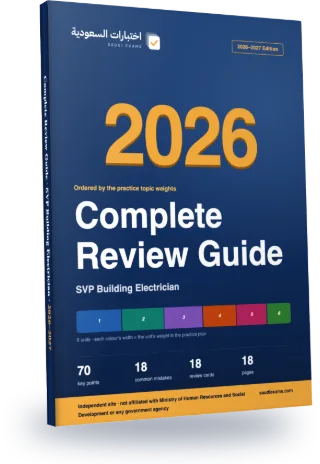
SVP Building Electrician Complete Review Guide 2026–2027
A 18-page PDF ordered by unit weight. The first three chapters cover 57% of the published syllabus weight.
- 18Pages
- 70Key points
- 18Common mistakes
- 18Flashcards
Guide map
Each chapter is one exam unit, ordered by its weight in the real exam.
| Chapter | Unit | Weight | Key points |
|---|---|---|---|
| 1 | Electrical Principles and Measurement | 20% | 10 |
| 2 | Building Circuits and Fault Recognition | 19% | 12 |
| 3 | Safety, Tools and Maintenance | 18% | 12 |
| 4 | Cables and Connections | 16% | 12 |
| 5 | Conduit Routes and Inspection | 15% | 12 |
| 6 | Surface Trunking Routes | 12% | 12 |
Chapter 1 in full: Electrical Principles and Measurement
This chapter accounts for 20% of the published syllabus weight. These are its key points.
- Read the legend before expanding any project abbreviation.
- A source, a switch and a load have different roles.
- A milliampere is one thousandth of an ampere.
The rest of chapter 1, on this page
- Watts describe power, and watt-hours describe energy.
- The single path of an ideal series circuit carries one common current.
- Branches whose ends share the same two nodes have the same potential difference.
- Separate resolution, observed error and whether the reading meets a stated tolerance.
- A current check and a voltage check measure different quantities. Real equipment assessment belongs with qualified people.
- Preserve sign and reading direction when copying a voltage record.
- Identify the instrument or simulated report, the conditions and the field being checked.
Common mistakes in this chapter
- The same symbol can have different meanings in different project legends.
- Power and energy use different units.
- An off display is limited evidence about the state of equipment.
The other chapters are in the full guide
One purchase · lifetime access · review guide included
7-day review plan
The chapters are spread over 6 days by weight so each day carries a similar load. Day 7 is a full exam.
Day 1 · 20% of the exam
Chapter 1: Electrical Principles and Measurement
Day 2 · 19% of the exam
Chapter 2: Building Circuits and Fault Recognition
Day 3 · 18% of the exam
Chapter 3: Safety, Tools and Maintenance
Day 4 · 16% of the exam
Chapter 4: Cables and Connections
Day 5 · 15% of the exam
Chapter 5: Conduit Routes and Inspection
Day 6 · 12% of the exam
Chapter 6: Surface Trunking Routes
Day 7
Complete a timed supplementary practice set and review the units where you lost marks.
Before you read: see your score today
10 free questions from the main units, no sign-up. Then you know which chapter to start with.
Try 10 free questions and see your levelA look at each chapter
The first three key points of each chapter, as they appear in the guide (in Arabic in the PDF).
Chapter 1: Electrical Principles and Measurement
- Read the legend before expanding any project abbreviation.
- A source, a switch and a load have different roles.
- A milliampere is one thousandth of an ampere.
Chapter 2: Building Circuits and Fault Recognition
- A single-throw contact either completes or interrupts its one path.
- A changeover common selects one of the alternatives in the defined stable positions.
- In a paired selector exercise, compare actual route mappings. Printed labels can differ at…
Chapter 3: Safety, Tools and Maintenance
- Trace the hazard to the place or action that creates the exposure.
- Keep other people clear when a hazard is unresolved.
- For a report, identify the location and describe what you actually saw.
Chapter 4: Cables and Connections
- Square millimetres describe area, while millimetres describe length or diameter.
- A schedule can specify both the number of cores and the area of each…
- A reel identifier preserves traceability when otherwise identical items are divided.
Chapter 5: Conduit Routes and Inspection
- An in-line coupling joins suitable conduit ends, while an adapter meets a box interface.
- A saddle supports the tube on the surface or at the stated stand-off.
- A draw aid and a permanent fitting belong in different kit columns.
Chapter 6: Surface Trunking Routes
- Write the supplied scale and units before reading a route length.
- When stock comes in fixed lengths, check each cut and the remainder separately.
- Use the approved drawing and stated dimensions for the route record.
The full guide comes with lifetime access
Lifetime access includes the full guide (18 pages), all questions and supplementary practice. Chapter 1 is free for everyone.
Questions about the guide
Is the guide free?
Chapter 1 is free to read on the guide page. The full guide comes with lifetime access to this exam; 7-day access does not include it.
Is it up to date for 2026–2027?
Yes. Unit weights and exam facts follow what the exam body last published, and the last check date is printed in the guide. If the standards change we update the file and buyers download the new version.
Does the guide have questions?
No. The guide covers key points and common mistakes; scoring, weak-area practice and full mock exams are on the site.
Can I read it on my phone?
Yes. A5 pages in a single column, with chapters linked from the contents.
- Pages
- 18
- Edition
- 1448 AH · 2026–2027
- Language
- English
- Last updated
Full prep for this exam
All of this in one purchase.
- Timed supplemental practice sessions15 questions in 30 minutes. You get a total score and a score for every unit.
- Practice unit by unit500 questions, every option explained with its source. Starts with your weakest units.
- Complete Review Guide 2026–2027 (PDF)Ordered by each unit's weight in the exam. With lifetime access only.
Choose your access
Continue with your Google account and you go straight to the payment page.